Maya Angelou
Poet · Writer · Activist · Actor
1928–2014 · Born in St. Louis, Missouri, United States · 4 min read
- Verified: 13 November 2026
- Sources: 5
- Independently reviewed
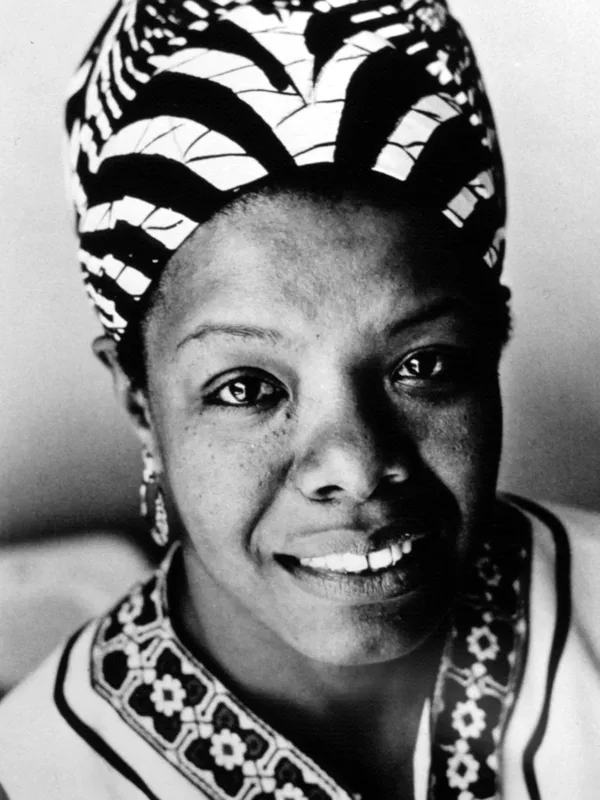

American poet, memoirist and civil rights activist whose I Know Why the Caged Bird Sings (1969) and 'Still I Rise' made her one of the most widely read writers of her time.
Early Life
Maya Angelou was born Marguerite Annie Johnson on 4 April 1928 in St. Louis, Missouri. Her parents separated when she was three, and she spent much of her childhood in the care of her paternal grandmother, Annie Henderson, in Stamps, Arkansas. Before she was eight she was raped by her mother's boyfriend; her attacker was then murdered, possibly by her uncles, and the trauma left her almost completely mute for several years. At sixteen she gave birth to her son, Guy Johnson. In 1940 she moved with her mother to San Francisco, where she worked as a dancer and took her professional name: 'Maya' was a childhood nickname, and 'Angelou' was a variation of the surname of her first husband, Tosh Angelos.
Career
Angelou's working life began on stage and in song: she danced, studied with Martha Graham and Pearl Primus, released the album Miss Calypso in 1956, and toured 22 countries with a State Department production of Porgy and Bess. Moving to New York in the late 1950s, she found encouragement at the Harlem Writers Guild and performed in Jean Genet's play The Blacks in 1961. She then worked as a journalist in Cairo for the Arab Observer and in Ghana for The African Review, and on her return to the United States in 1964 she helped Malcolm X establish the Organization of Afro-American Unity and served as a coordinator of the Southern Christian Leadership Conference at Martin Luther King Jr.'s request. Her first memoir, I Know Why the Caged Bird Sings, appeared in 1969, and writing became her life's work: seven autobiographies, several poetry collections, children's books, and work in film and television, including the screenplay Georgia, Georgia (1972), a role in the miniseries Roots (1977), and her directorial debut, Down in the Delta (1998). From 1981 she was a professor of American studies at Wake Forest University in Winston-Salem, North Carolina.
Achievements
Angelou's achievement was to turn a life of hardship into a body of work that spoke for millions. I Know Why the Caged Bird Sings (1969) brought her international recognition and a National Book Award nomination, and she went on to publish seven volumes of autobiography. Her poetry collections, from Just Give Me a Cool Drink of Water 'fore I Diiie (1971) to And Still I Rise (1978), made poems such as 'Still I Rise' and 'Phenomenal Woman' part of the common language of resilience. She won three Grammy Awards for her spoken-word recordings, received the National Medal of Arts in 2000 and the Presidential Medal of Freedom in 2011, and in 1993 she read 'On the Pulse of Morning' at President Bill Clinton's inauguration, only the second poet in American history to deliver an inaugural poem.
- Published I Know Why the Caged Bird Sings (1969), her first memoir, which was nominated for a National Book Award in 1970
- Wrote 'Still I Rise' (1978), one of the most quoted and performed poems in American literature
- Composed and read 'On the Pulse of Morning' at President Bill Clinton's inauguration in 1993, only the second poet in American history to deliver an inaugural poem
- Wrote the screenplay for Georgia, Georgia (1972), one of the first feature-film screenplays by an African American woman
- Won three Grammy Awards for her spoken-word albums in 1993, 1995 and 2002
- Received the National Medal of Arts in 2000 and the Presidential Medal of Freedom in 2011
- Received the Spingarn Medal from the NAACP in 1994 and a Tony Award nomination for Look Away in 1973
- Published seven volumes of autobiography between 1969 and 2013
Legacy
Angelou died on 28 May 2014 at her home in Winston-Salem, North Carolina, aged 86, after a long period of ill health caused by heart problems. She is remembered as one of the most widely read American writers of the twentieth century, a voice of Black womanhood and of the civil rights movement whose memoirs and poems are taught in schools and quoted at public occasions around the world. 'Still I Rise' is recited at graduations and protests alike, and her reading at Clinton's inauguration fixed her in public memory as a national poet. Her work showed that autobiography could carry the history of a whole people, and her life — from a mute child in segregated Arkansas to the podium at a presidential inauguration — remains one of the great American stories of self-invention.
Contributions
Angelou's contribution was to make the autobiography of a Black American woman a central text of American literature. Her seven memoirs showed that a life lived through segregation, poverty and single motherhood could be told with literary ambition and without self-pity, and they opened the form to generations of writers who followed. Her poetry gave public language to resilience: 'Still I Rise' and 'Phenomenal Woman' are performed and quoted wherever people need words for endurance. As an activist she worked alongside Malcolm X and Martin Luther King Jr., and as a performer and professor she carried poetry and the history of Black America into theatres, classrooms and a presidential inauguration.
Notable Works
- I Know Why the Caged Bird Sings (1969)
- Just Give Me a Cool Drink of Water 'fore I Diiie (1971)
- Gather Together in My Name (1974)
- And Still I Rise (1978)
- The Heart of a Woman (1981)
- I Shall Not Be Moved (1990)
- 'Still I Rise' (poem, 1978)
- 'Phenomenal Woman' (poem, 1978)
- 'On the Pulse of Morning' (poem, 1993)
- Georgia, Georgia (screenplay, 1972)
Milestones
- 1928 — Born Marguerite Annie Johnson in St. Louis, Missouri Source: Encyclopaedia Britannica
- 1940 — Moves to San Francisco and takes the professional name Maya Angelou Source: Encyclopaedia Britannica
- 1950s — Tours Europe and Africa with a State Department production of Porgy and Bess Source: Encyclopaedia Britannica
- 1961 — Moves to Cairo and works for the Arab Observer; later works in Ghana Source: Encyclopaedia Britannica
- 1964 — Helps Malcolm X establish the Organization of Afro-American Unity Source: Encyclopaedia Britannica
- 1969 — Publishes I Know Why the Caged Bird Sings, nominated for a National Book Award Source: Encyclopaedia Britannica
- 1972 — Screenplay Georgia, Georgia is produced as a feature film Source: Encyclopaedia Britannica
- 1978 — Publishes And Still I Rise, containing 'Still I Rise' Source: Encyclopaedia Britannica
- 1981 — Becomes professor of American studies at Wake Forest University Source: Encyclopaedia Britannica
- 1993 — Reads 'On the Pulse of Morning' at President Bill Clinton's inauguration Source: Encyclopaedia Britannica
- 2000 — Receives the National Medal of Arts Source: Encyclopaedia Britannica
- 2011 — Awarded the Presidential Medal of Freedom Source: Encyclopaedia Britannica
- 2014 — Dies in Winston-Salem, North Carolina, aged 86 Source: Encyclopaedia Britannica
Timeline
- 4 April 1928
Born Marguerite Annie Johnson in St. Louis, Missouri
Source: Encyclopaedia Britannica; Wikipedia (Maya Angelou) - 1931
Parents separate; she is sent to live with her grandmother Annie Henderson in Stamps, Arkansas
Year only — exact date unknown Source: Encyclopaedia Britannica - 1940
Moves with her mother to San Francisco and begins work as a dancer, taking the professional name Maya Angelou
Year only — exact date unknown Source: Encyclopaedia Britannica - 1944
Gives birth to her son, Guy Johnson, at the age of sixteen
Year only — exact date unknown Source: Encyclopaedia Britannica - 1956
Releases the album Miss Calypso
Year only — exact date unknown Source: Encyclopaedia Britannica - 1961
Performs in Jean Genet's play The Blacks; moves to Cairo and works for the Arab Observer
Year only — exact date unknown Source: Encyclopaedia Britannica - 1964
Returns to the United States; helps Malcolm X establish the Organization of Afro-American Unity
Year only — exact date unknown Source: Encyclopaedia Britannica - 1969
Publishes I Know Why the Caged Bird Sings, her first memoir, to critical acclaim
Year only — exact date unknown Source: Encyclopaedia Britannica - 1972
Georgia, Georgia is released, with her screenplay — one of the first feature-film screenplays by an African American woman
Year only — exact date unknown Source: Encyclopaedia Britannica - 1973
Receives a Tony Award nomination for her performance in Look Away
Year only — exact date unknown Source: Encyclopaedia Britannica - 1978
Publishes the poetry collection And Still I Rise, containing 'Still I Rise' and 'Phenomenal Woman'
Year only — exact date unknown Source: Encyclopaedia Britannica - 1981
Becomes professor of American studies at Wake Forest University in Winston-Salem, North Carolina
Year only — exact date unknown Source: Encyclopaedia Britannica - 20 January 1993
Reads 'On the Pulse of Morning' at President Bill Clinton's inauguration
Source: Encyclopaedia Britannica - 2011
Awarded the Presidential Medal of Freedom by President Barack Obama
Year only — exact date unknown Source: Encyclopaedia Britannica - 28 May 2014
Dies at her home in Winston-Salem, North Carolina, aged 86
Source: Encyclopaedia Britannica
Related Personalities
Frequently Asked Questions
Who was Maya Angelou?
Maya Angelou (1928–2014) was an American poet, memoirist and civil rights activist whose seven autobiographies and several poetry collections made her one of the most widely read American writers. Her first memoir, I Know Why the Caged Bird Sings (1969), remains a landmark of American literature.
Source: Encyclopaedia Britannica ; Poetry FoundationWhat is I Know Why the Caged Bird Sings about?
Published in 1969, I Know Why the Caged Bird Sings tells of Angelou's childhood up to the age of seventeen, growing up in Stamps, Arkansas, under the Jim Crow laws of the segregated South. It recounts the trauma she suffered as a child, years of near-silence, and her discovery of literature and her own voice.
Source: Encyclopaedia Britannica ; Wikipedia (Maya Angelou)What is 'Still I Rise' about?
'Still I Rise', first published in the collection And Still I Rise (1978), is a defiant celebration of the resilience of Black women in the face of oppression. Its repeated refrain answers centuries of insult and injustice with confidence, and the poem has become one of the most quoted and performed poems in American literature.
Source: Encyclopaedia Britannica ; Poetry FoundationWhy did Maya Angelou read a poem at Bill Clinton's inauguration?
Angelou was invited to compose and read 'On the Pulse of Morning' at President Bill Clinton's inauguration on 20 January 1993. She was only the second poet in American history to deliver an inaugural poem, after Robert Frost in 1961, and her reading brought her work to a vast new audience.
Source: Encyclopaedia BritannicaWhat honours did Maya Angelou receive?
Angelou won three Grammy Awards for her spoken-word albums in 1993, 1995 and 2002, received the National Medal of Arts in 2000 and the Spingarn Medal in 1994. In 2011 President Barack Obama awarded her the Presidential Medal of Freedom, the highest civilian honour in the United States.
Source: Encyclopaedia BritannicaHow did Maya Angelou die?
Maya Angelou died on 28 May 2014 at her home in Winston-Salem, North Carolina, at the age of eighty-six. She had been in poor health for some time, suffering from heart problems, and her death was widely mourned, with tributes from political leaders, writers and readers around the world.
Source: Encyclopaedia Britannica ; Wikipedia (Maya Angelou)Sources & References
- Maya Angelou | Biography, Books, Poems, Death, & Facts — Encyclopaedia Britannica (accessed 13 November 2026)
- Maya Angelou — Wikipedia (accessed 13 November 2026)
- Maya Angelou — Poetry Foundation (accessed 13 November 2026)
- Maya Angelou — Academy of American Poets (accessed 13 November 2026)
- File:Portrait photograph of Maya Angelou, c. 1974.webp — Wikimedia Commons (portrait file page) — Wikimedia Commons (accessed 13 November 2026)
Explore More
- More Writers & Authors
- Personalities from United States
- Personalities from Egypt
- Personalities from Ghana
- More poets
- More writers
- More activists
- More actors
- Famous people born in April
- Browse all personalities
Featured on these lists: