Emily Dickinson
Poet · Writer
1830–1886 · Born in Amherst, Massachusetts, United States · 4 min read
- Verified: 13 November 2026
- Sources: 5
- Independently reviewed
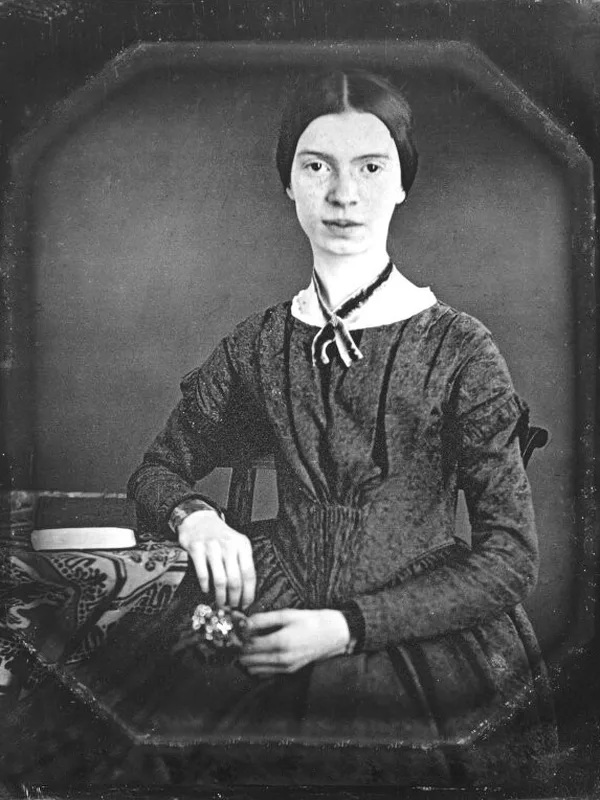

American poet who spent her life in Amherst, Massachusetts, and wrote nearly 1,800 poems in private; published only after her death, she is now among America's greatest poets.
Early Life
Emily Elizabeth Dickinson was born on 10 December 1830 at the family home, the Homestead, in Amherst, Massachusetts, the middle child of Edward Dickinson, a lawyer, and Emily Norcross Dickinson. Her father was a prominent citizen of Amherst — treasurer of Amherst College, a state legislator and later a member of the United States Congress — and her grandfather Samuel Fowler Dickinson had been a founder of Amherst College. She attended Amherst Academy for seven years, where she studied English and classical literature, Latin, botany, geology, history and the sciences, and where she studied under principal Leonard Humphrey. In the autumn of 1847 she entered Mount Holyoke Female Seminary, but stayed only a year and returned home to Amherst, where she would live for the rest of her life.
Education
Dickinson studied at Amherst Academy for seven years and at Mount Holyoke Female Seminary in 1847–1848.
Career
Dickinson's career as a poet was almost entirely private. She studied for seven years at Amherst Academy and briefly at Mount Holyoke Female Seminary in 1847–1848, then returned to her family home in Amherst, where she spent the rest of her life. She wrote prolifically but published only about ten poems in her lifetime, most of them anonymously and altered by editors, and one letter. She sent poems enclosed in letters to friends and family, and from 1862 she corresponded with the writer and editor Thomas Wentworth Higginson, who encouraged her but did not publish her work. Her most productive years were from about 1858 to 1865, when she wrote hundreds of poems and copied them into the fascicles. She received visitors less and less as the years went on, baked bread, tended her garden, and wrote. After her death her younger sister Lavinia found the cache of poems in her room and set about getting them printed, with Higginson and Mabel Loomis Todd editing the first volume of 1890.
Achievements
Dickinson's achievement is one of the strangest in literary history: she wrote nearly 1,800 poems, almost none of which were published in her lifetime, and became one of the greatest American poets after her death. Her poems — short, elliptical, built on dashes, capital letters and slant rhyme — broke the rules of nineteenth-century verse and created a language for saying what was possible but not yet realised. She copied her finished poems into about forty hand-sewn booklets, the fascicles, between about 1858 and 1865. The first volume of her work, Poems, appeared in 1890, four years after her death, and went through eleven editions in less than two years, though its editors smoothed her punctuation and regularised her rhymes. It was not until Thomas H. Johnson's scholarly edition of 1955 that her poems were printed close to the way she wrote them, and the original order of the fascicles was restored only in 1981.
- Wrote nearly 1,800 poems, one of the most original bodies of work in the English language
- Created a distinctively elliptical language of short lines, dashes and slant rhyme that broke with the poetry of her time
- Her poems were gathered into about forty hand-sewn booklets, the fascicles, between about 1858 and 1865
- The first volume of her poetry, Poems, was published posthumously in 1890 and went through eleven editions in less than two years
- Thomas H. Johnson's scholarly edition of The Poems of Emily Dickinson (1955) restored her poems close to her original wording
- Her work is now regarded as canonical, and she is counted among the greatest American poets
Legacy
Dickinson died on 15 May 1886 at her home in Amherst, aged 55, of Bright's disease, a kidney disorder. At her death almost none of her poetry had been published, and few outside her family knew she wrote it. Within a few years she was famous: the 1890 Poems sold widely, and by the twentieth century she was recognised as one of America's greatest and most original poets. Her influence runs through modern American poetry — her compression, her dashes, her slant rhymes and her way of making the abstract tangible are now part of the language of poetry itself. Her poems are read by people of all ages, set to music, and taught in schools around the world. The Homestead and the Evergreens, her brother's house next door, are preserved in Amherst as the Emily Dickinson Museum.
Contributions
Dickinson's contribution was to remake the English poem from the inside. She took the hymn metre and the ballad stanza she knew from church and made them carry thoughts about death, eternity, nature and the self that no one had put into verse before. Her dashes hold a thought open; her capital letters make a common noun into an idea; her slant rhymes refuse to resolve. She showed that a poem could be four lines long and contain a universe, and that a poet need not publish, perform or even leave the house to change literature. Her fascicles — poems copied and sewn by hand, kept in a drawer — are one of the great acts of faith in the future of poetry.
Notable Works
- 'Because I could not stop for Death' (c. 1863)
- 'I heard a Fly buzz — when I died' (c. 1862)
- 'Hope is the thing with feathers' (c. 1861)
- 'I'm Nobody! Who are you?' (c. 1861)
- 'A narrow Fellow in the Grass' (c. 1865)
- 'Success is counted sweetest' (c. 1859)
- Poems (1890, first published collection)
- The Poems of Emily Dickinson (1955, Thomas H. Johnson edition)
Milestones
- 1830 — Born at the Homestead in Amherst, Massachusetts Source: Poetry Foundation
- 1840 — Begins seven years at Amherst Academy Source: Poetry Foundation
- 1847 — Enters Mount Holyoke Female Seminary for a single year Source: Poetry Foundation
- 1858 — Begins her most productive period of writing Source: Academy of American Poets
- 1862 — Begins correspondence with Thomas Wentworth Higginson Source: Wikipedia (Emily Dickinson)
- 1886 — Dies in Amherst, aged 55, leaving nearly 1,800 poems unpublished Source: Academy of American Poets
- 1890 — Poems, the first volume of her poetry, is published Source: Poetry Foundation
- 1955 — Thomas H. Johnson publishes the complete poems in her original wording Source: Academy of American Poets
- 1981 — The original order of the fascicles is restored by Ralph W. Franklin Source: Academy of American Poets
Timeline
- 10 December 1830
Born Emily Elizabeth Dickinson at the Homestead in Amherst, Massachusetts
Source: Poetry Foundation; Academy of American Poets - 1840
Begins seven years of study at Amherst Academy
Approximate date Source: Poetry Foundation; Wikipedia (Emily Dickinson) - 1847
Enters Mount Holyoke Female Seminary; leaves after a single year and returns home
Year only — exact date unknown Source: Poetry Foundation - 1850
Begins to withdraw from social visiting; devotes herself to writing, baking and gardening
Approximate date Source: Poetry Foundation - 1858
Begins her most productive period, copying finished poems into hand-sewn fascicles
Approximate date Source: Academy of American Poets; Poetry Foundation - 1862
Begins her correspondence with Thomas Wentworth Higginson, sending him poems
Year only — exact date unknown Source: Wikipedia (Emily Dickinson) - 1874
Her father, Edward Dickinson, dies
Year only — exact date unknown Source: Wikipedia (Emily Dickinson) - 1882
Her mother, Emily Norcross Dickinson, dies
Year only — exact date unknown Source: Wikipedia (Emily Dickinson) - 1883
Her nephew Gilbert, her brother Austin's son, dies; her health begins to fail
Year only — exact date unknown Source: Wikipedia (Emily Dickinson) - 15 May 1886
Dies at her home in Amherst, aged 55, of Bright's disease
Source: Wikipedia (Emily Dickinson); Academy of American Poets - 1890
Poems, the first volume of her poetry, is published by Higginson and Mabel Loomis Todd
Year only — exact date unknown Source: Poetry Foundation; Academy of American Poets - 1955
Thomas H. Johnson publishes The Poems of Emily Dickinson, restoring her original wording
Year only — exact date unknown Source: Academy of American Poets; Wikipedia (Emily Dickinson) - 1981
Ralph W. Franklin's The Manuscript Books of Emily Dickinson restores the original order of the fascicles
Year only — exact date unknown Source: Academy of American Poets
Related Personalities
Frequently Asked Questions
Who was Emily Dickinson?
Emily Dickinson (1830–1886) was an American poet who spent almost her whole life in Amherst, Massachusetts, and wrote nearly 1,800 poems, most of them unpublished in her lifetime. Her short, elliptical poems on death, nature and immortality are now regarded as among the greatest in American literature.
Source: Poetry Foundation ; Academy of American PoetsWhy was Dickinson hardly published in her lifetime?
Only about ten of Dickinson's nearly 1,800 poems appeared in print while she lived, most of them anonymously and altered by editors to fit conventional taste. She sent poems in letters to friends and family but did not seek publication, and her work became known only after her sister Lavinia found the poems after her death.
Source: Academy of American Poets ; Poetry FoundationWhat are Dickinson's most famous poems?
Dickinson's best-known poems include 'Because I could not stop for Death', 'I heard a Fly buzz — when I died', 'Hope is the thing with feathers', 'I'm Nobody! Who are you?' and 'A narrow Fellow in the Grass'. Most of her poems have no titles and are known by their first lines or by their numbers in scholarly editions.
Source: Poetry Foundation ; Wikipedia (Emily Dickinson)What is a fascicle?
A fascicle is one of about forty small hand-sewn booklets into which Dickinson copied her finished poems in ink between about 1858 and 1865, her most productive years. Her family discovered the booklets after her death, and scholars later used them to restore the order and wording of her poems.
Source: Academy of American Poets ; Poetry FoundationWhen was Dickinson's poetry first published?
The first volume of Dickinson's poetry, Poems, was published in 1890, four years after her death, edited by Thomas Wentworth Higginson and Mabel Loomis Todd. It was a great success, running through eleven editions in less than two years, although the editors smoothed her punctuation and regularised her rhymes.
Source: Poetry Foundation ; Academy of American PoetsHow did Emily Dickinson die?
Dickinson died on 15 May 1886 at her family home in Amherst, Massachusetts, at the age of fifty-five, of Bright's disease, a kidney disorder. She had been ill for about two years, and at her death almost none of her poetry had been published or publicly recognised.
Source: Wikipedia (Emily Dickinson) ; Academy of American PoetsSources & References
- Emily Dickinson — Poetry Foundation (accessed 13 November 2026)
- About Emily Dickinson — Academy of American Poets (accessed 13 November 2026)
- Emily Dickinson — Wikipedia (accessed 13 November 2026)
- Emily Dickinson — Encyclopaedia Britannica (accessed 13 November 2026)
- File:Emily Dickinson daguerreotype (Restored).jpg — Wikimedia Commons (portrait file page) — Wikimedia Commons (accessed 13 November 2026)
Explore More
- More Writers & Authors
- Personalities from United States
- More poets
- More writers
- Famous people born in December
- Browse all personalities
Featured on these lists: