Mao Zedong
Chairman of the Chinese Communist Party · Founder of the People's Republic of China · Revolutionary · Poet · Political theorist
1893–1976 · Born in Shaoshan, Hunan, China · 4 min read
- Verified: 13 November 2026
- Sources: 4
- Independently reviewed
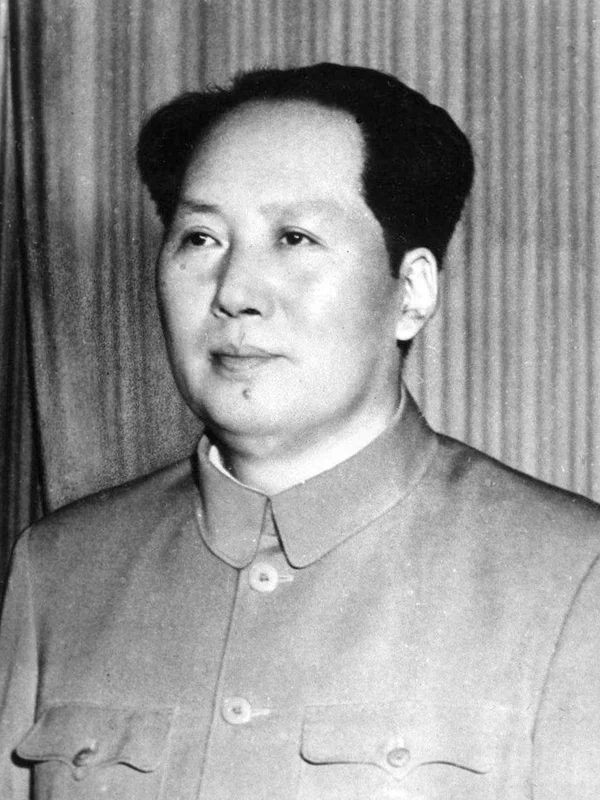

Chinese revolutionary who founded the People's Republic of China in 1949 and led it as Chairman of the Communist Party until his death in 1976; his campaigns included the Great Leap Forward and the Cultural Revolution, which caused tens of millions of deaths.
Early Life
Mao Zedong was born on 26 December 1893 in Shaoshan, a village in Hunan province, China, to Mao Yichang, a farmer who had become a grain dealer, and Wen Qimei. He was the eldest of the children who survived infancy. He attended the local village school, left home at 16 to study, and was influenced by the Xinhai Revolution of 1911, which ended the Qing dynasty, and by the May Fourth Movement of 1919, which protested against the treatment of China by foreign powers. He worked as a library assistant at Peking University, where he came into contact with Marxist ideas.
Education
Mao was educated at village schools in Hunan and then at the First Normal School in Changsha, a teacher training college, from which he graduated in 1918. He had no university degree. His later education came through political study, military experience and the Communist movement.
Career
Mao helped to found the Chinese Communist Party in 1921. During the 1930s he built a base in the countryside, and on the Long March of 1934-1935 his forces retreated from Nationalist armies across China; at the Zunyi Conference in 1935 he became the party's leader. He led the Communists from Yanan during the war against Japan from 1937 to 1945 and then in the civil war against the Nationalists, winning control of mainland China. On 1 October 1949 he proclaimed the People's Republic of China in Beijing and became its founding leader, serving as Chairman of the Communist Party until his death. In the 1950s his government carried out land reform, brought China into the Korean War, and built a planned economy with Soviet help. In 1958 he launched the Great Leap Forward, a campaign to industrialise China rapidly through collective farming and backyard steel production; it led to the deadliest famine in recorded history, with historians' estimates of the deaths ranging from about 15 million to about 55 million between 1958 and 1962. In 1966 he launched the Great Proletarian Cultural Revolution, a campaign to remove rivals and to renew revolutionary feeling, in which tens of millions of people were persecuted and the number of deaths is estimated from the hundreds of thousands to the millions. In 1972 he received the United States President Richard Nixon in Beijing, beginning the normalisation of relations between China and the United States. After years of ill health he suffered a series of heart attacks and died on 9 September 1976 in Beijing at the age of 82.
Achievements
Mao founded the People's Republic of China in 1949 and led it for 27 years, unifying mainland China under Communist rule after decades of war and division. His government carried out land reform, raised literacy, improved public health and raised life expectancy, and gave women formal legal equality. China became a nuclear power in 1964 and took China's seat at the United Nations in 1971. At the same time his campaigns caused vast numbers of deaths: historians estimate that the famine of the Great Leap Forward killed between about 15 million and about 55 million people, and that the total number of deaths under his rule, through starvation, persecution, prison labour and executions, ranges from about 40 million to about 80 million. His rule is therefore recorded as both a founding achievement and a period of large-scale human loss.
- Helped to found the Chinese Communist Party in 1921
- Became leader of the Communist Party at the Zunyi Conference in 1935
- Led the Communists through the Long March of 1934-1935
- Proclaimed the People's Republic of China on 1 October 1949
- Led China as Chairman of the Communist Party from 1949 until his death in 1976
- Carried out land reform and raised literacy and public health in China
- Oversaw China becoming a nuclear power in 1964
- Received President Richard Nixon in Beijing in 1972, beginning the normalisation of relations with the United States
Legacy
Mao is remembered in China as the founding father of the People's Republic, and his portrait still hangs in Tiananmen Square in Beijing. His supporters point to the unification of China, land reform, literacy, public health and the end of foreign domination; critics, including many historians outside China, point to the famine of the Great Leap Forward, the persecution of the Cultural Revolution and the destruction of cultural heritage. The Chinese Communist Party's official assessment describes his achievements as primary and his errors as secondary, while many historians outside China give a much harsher account. The profile records both assessments without taking a side.
Contributions
Mao founded the People's Republic of China and shaped its politics, economy and culture for 27 years. His ideas, known as Mao Zedong Thought, influenced Communist movements in Asia, Africa and Latin America, and his writings on guerrilla warfare influenced military thinking. His campaigns also caused the deaths of tens of millions of people and the destruction of much of China's cultural heritage, and the study of his rule remains central to the history of twentieth-century China.
Notable Works
- On Practice (1937)
- On Protracted War (1938)
- Quotations from Chairman Mao Tse-tung (1964)
- Selected Works of Mao Tse-tung
Milestones
- 1893 — Born on 26 December in Shaoshan, Hunan, China Source: Encyclopaedia Britannica
- 1921 — Helped to found the Chinese Communist Party Source: Wikipedia
- 1935 — Became leader of the Communist Party at the Zunyi Conference Source: Wikipedia
- 1949 — Proclaimed the People's Republic of China on 1 October Source: Wikipedia
- 1958 — Launched the Great Leap Forward, which led to a famine that killed millions Source: Wikipedia
- 1964 — China became a nuclear power Source: Wikipedia
- 1966 — Launched the Cultural Revolution Source: Wikipedia
- 1971 — The People's Republic of China took China's seat at the United Nations Source: Wikipedia
- 1972 — Received President Richard Nixon in Beijing Source: Wikipedia
- 1976 — Died on 9 September in Beijing at the age of 82 Source: Wikipedia
Timeline
- 26 December 1893
Born in Shaoshan, Hunan, China
Source: Encyclopaedia Britannica - 1918
Graduated from the First Normal School in Changsha
Year only — exact date unknown Source: Wikipedia - 1921
Helped to found the Chinese Communist Party
Year only — exact date unknown Source: Wikipedia - 1934
Began the Long March
Year only — exact date unknown Source: Wikipedia - 1935
Became leader of the Communist Party at the Zunyi Conference
Year only — exact date unknown Source: Wikipedia - 1 October 1949
Proclaimed the People's Republic of China in Beijing
Source: Wikipedia - 1958
Launched the Great Leap Forward
Year only — exact date unknown Source: Wikipedia - 1966
Launched the Cultural Revolution
Year only — exact date unknown Source: Wikipedia - 1972-02
Received President Richard Nixon in Beijing
Year only — exact date unknown Source: Wikipedia - 9 September 1976
Died in Beijing at the age of 82
Source: Wikipedia
Related Personalities
Frequently Asked Questions
Who was Mao Zedong?
Mao Zedong (26 December 1893 - 9 September 1976) was a Chinese revolutionary who founded the People's Republic of China in 1949 and led it as Chairman of the Communist Party until his death in 1976. He led the Communists through the Long March and the civil war, and his later campaigns included the Great Leap Forward and the Cultural Revolution.
Source: Encyclopaedia Britannica ; WikipediaWhat was the Great Leap Forward?
The Great Leap Forward was the campaign launched by Mao in 1958 to industrialise China rapidly through collective farming and small-scale industry. It led to the deadliest famine in recorded history: historians' estimates of the deaths between 1958 and 1962 range from about 15 million to about 55 million people.
Source: WikipediaWhat was the Cultural Revolution?
The Cultural Revolution, formally the Great Proletarian Cultural Revolution, was the campaign launched by Mao in 1966 to remove rivals and to renew revolutionary feeling. Tens of millions of people were persecuted, and the number of deaths is estimated from the hundreds of thousands to the millions. It lasted until Mao's death in 1976.
Source: WikipediaHow many people died under Mao's rule?
No single figure is agreed. Historians estimate that the famine of the Great Leap Forward killed between about 15 million and about 55 million people, and that the total number of deaths under Mao's rule, through starvation, persecution, prison labour and executions, ranges from about 40 million to about 80 million.
Source: WikipediaHow did Mao Zedong die?
Mao died on 9 September 1976 in Beijing at the age of 82, after a series of heart attacks following years of ill health. He was succeeded as leader by Hua Guofeng, and Deng Xiaoping later led China in a different direction with economic reforms.
Source: WikipediaWhy is Mao still honoured in China?
In China Mao is honoured as the founding father of the People's Republic of China, and the Communist Party's official assessment describes his achievements as primary and his errors as secondary. Outside China many historians give a much harsher account, pointing to the famine and the Cultural Revolution. The profile records both assessments.
Source: Wikipedia ; Encyclopaedia BritannicaSources & References
- Mao Zedong — Encyclopaedia Britannica — Encyclopaedia Britannica (accessed 13 November 2026)
- Mao Zedong — Wikipedia (cross-check) — Wikipedia (accessed 13 November 2026)
- Mao Zedong — Marxists Internet Archive (primary writings) — Marxists Internet Archive (accessed 13 November 2026)
- File:Mao Zedong 1950 Portrait (3x4 cropped).jpg — Wikimedia Commons (portrait file page) — Wikimedia Commons (accessed 13 November 2026)