Napoleon Bonaparte
Emperor of France · Military commander · Statesman · Political leader
1769–1821 · Born in Ajaccio, Corsica, France · 4 min read
- Verified: 13 November 2026
- Sources: 4
- Independently reviewed
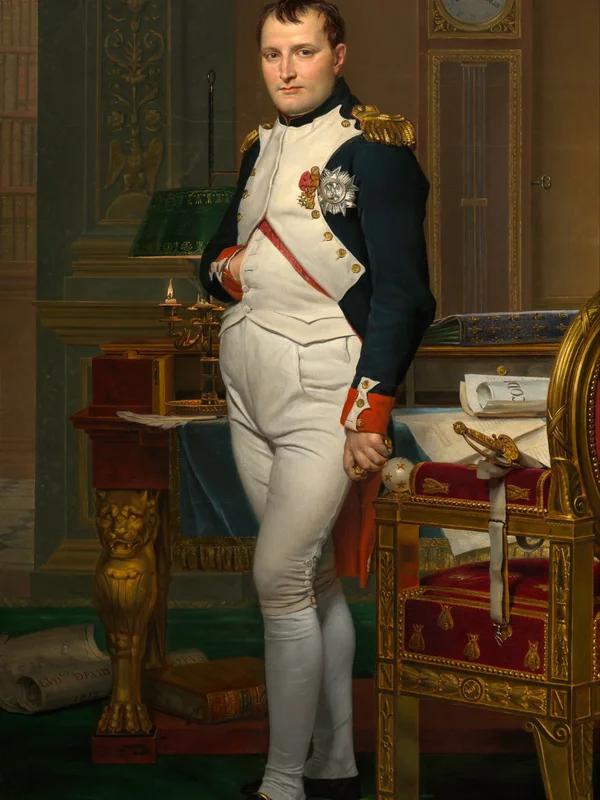

Corsican-born French general who seized power in 1799, crowned himself Emperor of the French in 1804, reshaped Europe through the Napoleonic Wars and the Napoleonic Code, and died in exile on Saint Helena in 1821.
Early Life
Napoleone di Buonaparte was born on 15 August 1769 in Ajaccio, Corsica, the second surviving son of Carlo Buonaparte, a lawyer, and Letizia Ramolino. Corsica had been ceded to France by Genoa only a year earlier, and Napoleon grew up speaking Corsican Italian at home and French at school. In 1779 he was sent to the military school at Brienne in France, where he was mocked for his accent and his poverty, and where he read widely in history and military theory.
Education
Napoleon studied at the military school of Brienne-le-Château from 1779 to 1784, then at the École Militaire in Paris, where he trained as an artillery officer and graduated in 1785. His reading of history, geography and the works of Enlightenment writers shaped his thinking about government and war, and his skill with artillery, learned at school, made his early reputation.
Career
Napoleon was commissioned as a second lieutenant of artillery in 1785. He first came to notice at the Siege of Toulon in 1793, where his artillery plan helped drive the British from the port. In 1796 he was given command of the French army in Italy, where a series of rapid victories over the Austrians made him famous across Europe. In 1798 he invaded Egypt, winning the Battle of the Pyramids but losing his fleet to the British under Nelson at the Nile. Returning to France in 1799, he seized power in the Coup of 18 Brumaire and became First Consul. As First Consul he remade the French state: he made peace with the Catholic Church in the Concordat of 1801, founded the Bank of France in 1800, and in 1803 sold Louisiana to the United States. On 21 March 1804 he issued the Civil Code, and on 2 December 1804 he crowned himself Emperor of the French in Notre-Dame in Paris. His greatest victory, Austerlitz, came on 2 December 1805, but his attempt to invade Russia in 1812 ended in disaster, with the loss of most of his army. Defeated by a coalition of European powers, he abdicated in April 1814 and was exiled to the island of Elba. He escaped in March 1815 and regained power for the Hundred Days, but was defeated at Waterloo on 18 June 1815 by Wellington and Blücher. He abdicated again and was exiled by the British to Saint Helena in the South Atlantic, where he died on 5 May 1821.
Achievements
Napoleon's central achievements were military and legal. As a general he won a string of victories, Toulon, the Italian campaign, Marengo, Austerlitz, Jena, that made France the dominant power in Europe and made him the most studied commander in military history. As a ruler he created the Civil Code of 1804, known as the Napoleonic Code, which swept away feudal law and remains the basis of the law of France and of many countries in Europe and Latin America. He founded the Bank of France, reorganised the administration of France into departments run by prefects, and rebuilt the country's schools and roads. His Concordat of 1801 ended a decade of conflict between France and the Catholic Church.
- Won the Siege of Toulon in 1793, his first major success
- Won the Italian campaign of 1796-1797 against Austria
- Seized power in the Coup of 18 Brumaire in November 1799 and became First Consul
- Founded the Bank of France in 1800
- Negotiated the Concordat of 1801 with the Catholic Church
- Issued the Civil Code, the Napoleonic Code, on 21 March 1804
- Crowned himself Emperor of the French on 2 December 1804
- Won the Battle of Austerlitz on 2 December 1805
- Sold Louisiana to the United States in 1803
- Returned from Elba for the Hundred Days in 1815
Legacy
Napoleon is remembered both as a military genius and as a ruler whose wars cost millions of lives. His admirers credit him with spreading the legal and administrative reforms of the Revolution across Europe and with creating modern France; his critics point to the destruction of the Napoleonic Wars, the restoration of slavery in the French colonies in 1802, and his seizure of power by force. His Civil Code remains his most lasting legacy, and his campaigns are still studied in military academies. He died in exile, but his body was returned to France in 1840 and now lies in Les Invalides in Paris.
Contributions
Napoleon's contribution was to remake France and much of Europe in the image of the Revolution's reforms: a single civil code, a centralised administration, a national bank and a modern school system, carried across the continent by his armies. His campaigns remain the classic study of speed, surprise and concentration of force, and his Civil Code still shapes the law of France and of many countries in Europe and Latin America.
Notable Works
- Civil Code (Napoleonic Code) (1804)
- Concordat of 1801
- Bank of France (1800)
- Mémorial de Sainte-Hélène (dictated, published 1823)
Milestones
- 1769 — Born on 15 August in Ajaccio, Corsica Source: Encyclopaedia Britannica
- 1779 — Sent to the military school at Brienne in France Source: Encyclopaedia Britannica
- 1785 — Commissioned as a second lieutenant of artillery Source: Encyclopaedia Britannica
- 1793 — Helped retake Toulon from the British Source: Encyclopaedia Britannica
- 1796 — Won the Italian campaign against Austria Source: Encyclopaedia Britannica
- 1798 — Invaded Egypt; won the Battle of the Pyramids Source: Encyclopaedia Britannica
- 1799 — Seized power in the Coup of 18 Brumaire; became First Consul Source: Encyclopaedia Britannica
- 1800 — Founded the Bank of France Source: Wikipedia (Napoleon)
- 1801 — Signed the Concordat with the Catholic Church Source: Wikipedia (Napoleon)
- 1803 — Sold Louisiana to the United States Source: Encyclopaedia Britannica
- 1804 — Issued the Civil Code and crowned himself emperor Source: Encyclopaedia Britannica
- 1805 — Won the Battle of Austerlitz Source: Encyclopaedia Britannica
- 1812 — Invaded Russia; the campaign ended in disaster Source: Encyclopaedia Britannica
- 1814 — Abdicated and was exiled to Elba Source: Encyclopaedia Britannica
- 1815 — Returned for the Hundred Days; defeated at Waterloo Source: Encyclopaedia Britannica
- 1821 — Died at Longwood House on Saint Helena Source: Encyclopaedia Britannica
- 1840 — His body was returned to France and buried in Les Invalides, Paris Source: Wikipedia (Napoleon)
Timeline
- 15 August 1769
Born in Ajaccio, Corsica
Source: Encyclopaedia Britannica - 1779
Sent to the military school at Brienne in France
Year only — exact date unknown Source: Encyclopaedia Britannica - 1785
Commissioned as a second lieutenant of artillery
Year only — exact date unknown Source: Encyclopaedia Britannica - 1793
Helped retake Toulon from the British, his first major success
Year only — exact date unknown Source: Encyclopaedia Britannica - 1796
Given command of the French army in Italy; won a series of victories over Austria
Year only — exact date unknown Source: Encyclopaedia Britannica - 21 July 1798
Won the Battle of the Pyramids in Egypt
Source: Wikipedia (Napoleon) - 9 November 1799
Seized power in the Coup of 18 Brumaire and became First Consul
Source: Encyclopaedia Britannica - 18 January 1800
Founded the Bank of France
Source: Wikipedia (Napoleon) - 15 July 1801
Signed the Concordat with the Catholic Church
Source: Wikipedia (Napoleon) - 1803
Sold Louisiana to the United States
Year only — exact date unknown Source: Encyclopaedia Britannica - 21 March 1804
Issued the Civil Code, the Napoleonic Code
Source: Encyclopaedia Britannica - 2 December 1804
Crowned himself Emperor of the French in Notre-Dame, Paris
Source: Encyclopaedia Britannica - 2 December 1805
Won the Battle of Austerlitz
Source: Encyclopaedia Britannica - 24 June 1812
Invaded Russia; the campaign ended in disaster
Source: Wikipedia (Napoleon) - 6 April 1814
Abdicated and was exiled to Elba
Source: Encyclopaedia Britannica - 18 June 1815
Defeated at the Battle of Waterloo
Source: Encyclopaedia Britannica - 5 May 1821
Died at Longwood House on Saint Helena, aged 51
Source: Encyclopaedia Britannica
Related Personalities
Frequently Asked Questions
Who was Napoleon Bonaparte?
Napoleon Bonaparte (15 August 1769 - 5 May 1821) was a Corsican-born French general who seized power in 1799, crowned himself Emperor of the French in 1804, reshaped Europe through the Napoleonic Wars and the Napoleonic Code, and died in exile on Saint Helena.
Source: Encyclopaedia BritannicaHow did Napoleon become emperor?
Napoleon seized power in the Coup of 18 Brumaire in November 1799 and became First Consul. On 18 May 1804 he proclaimed the French Empire, and on 2 December 1804 he crowned himself Emperor of the French in Notre-Dame in Paris, in the presence of Pope Pius VII.
Source: Encyclopaedia Britannica ; World History EncyclopediaWhat is the Napoleonic Code?
The Napoleonic Code, issued on 21 March 1804, was a single civil code that replaced the tangle of feudal and local laws in France. It confirmed equality before the law and the right to own property, and it remains the basis of the law of France and of many countries in Europe and Latin America.
Source: Encyclopaedia Britannica ; Fondation NapoléonWhat happened at Waterloo?
Napoleon was defeated at Waterloo, in present-day Belgium, on 18 June 1815, by the Duke of Wellington and the Prussian general Blücher, ending the Hundred Days, his return to power after escaping from Elba. He abdicated four days later and was exiled to Saint Helena.
Source: Encyclopaedia Britannica ; World History EncyclopediaHow did Napoleon die?
Napoleon died at Longwood House on Saint Helena on 5 May 1821, aged 51. The most widely accepted explanation is stomach cancer, although poisoning by arsenic and other causes have been proposed. His body was returned to France in 1840 and now lies in Les Invalides in Paris.
Source: Encyclopaedia Britannica ; World History EncyclopediaWas Napoleon short?
No. Napoleon was about 5 feet 7 inches (169 cm) tall at his death, above the average height of his time. The myth comes from the difference between French and English measures: his height was recorded as 5 feet 2 inches in French feet, which are longer than English feet.
Source: Encyclopaedia Britannica ; Wikipedia (Napoleon)Sources & References
- Napoleon I — Encyclopaedia Britannica — Encyclopaedia Britannica (accessed 13 November 2026)
- Napoleon — Wikipedia (cross-check) — Wikipedia (accessed 13 November 2026)
- Napoleon Bonaparte — Fondation Napoléon — Fondation Napoléon (accessed 13 November 2026)
- File:Jacques-Louis David - The Emperor Napoleon in His Study at the Tuileries - Google Art Project.jpg — Wikimedia Commons (portrait file page) — Wikimedia Commons (accessed 13 November 2026)