Genghis Khan
Founder of the Mongol Empire · Military leader · Khan · Statesman
1162–1227 · Born in Khentii Mountains, Mongolia · 4 min read
- Verified: 13 November 2026
- Sources: 4
- Independently reviewed
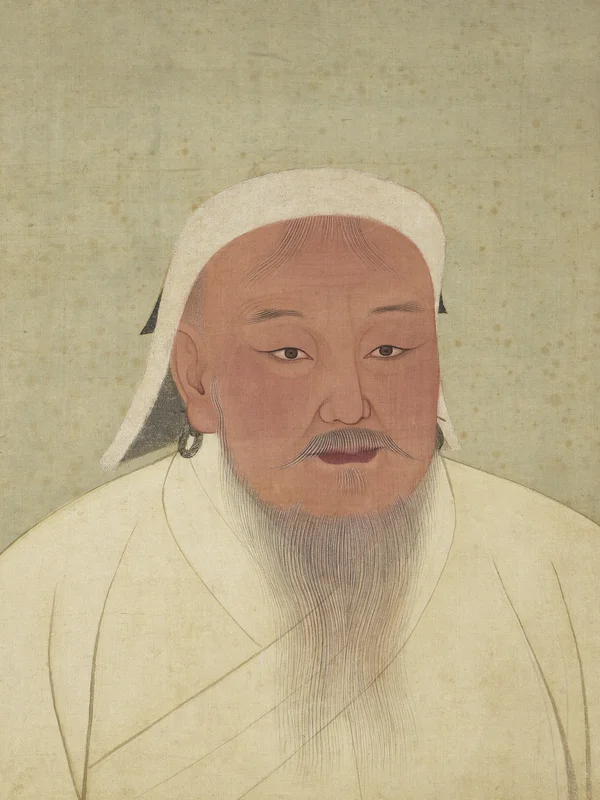

Founder and first khan of the Mongol Empire (1206-1227); born Temujin, he united the Mongol tribes and built the largest contiguous land empire in history.
Early Life
Temujin was born around 1162, the eldest child of Yesugei, a chieftain of the Borjigin clan, and his wife Hö'elün, in the Khentii Mountains of present-day Mongolia, near the Onon River. His father was poisoned by Tatars when Temujin was about nine, and his clan abandoned the family, leaving them in severe poverty. Temujin survived by fishing and foraging, was captured for a time by the Tayichiuds and escaped, and killed his half-brother Bekter in a dispute over food. He married Börte around 1178, and when she was captured by the Merkit tribe he rescued her with the help of his allies. These early hardships shaped his reliance on loyalty and merit rather than birth.
Education
Temujin received no formal education; the Mongols of his time had no written language of their own. He learned warfare, horsemanship and leadership in the steppe, and as ruler he ordered the adoption of the Uyghur script for writing Mongolian, employed Uyghur, Chinese and Muslim administrators and specialists, and built an administration that recorded laws, taxes and communications.
Career
Temujin rose to power by building alliances and defeating rival Mongol leaders, including his former friend Jamukha, whom he defeated in the early 1200s. In 1206 a kuriltai, an assembly of the Mongol tribes, proclaimed him Genghis Khan, meaning universal ruler. He then turned outward: he campaigned against the Western Xia from 1207, attacked the Jin dynasty in 1211 and captured its capital Zhongdu, present-day Beijing, in 1215, and in 1219 launched a campaign against the Khwarezmian Empire in Central Asia after its ruler executed Mongol merchants and an ambassador. His armies, organised into units of ten, a hundred, a thousand and ten thousand under commanders chosen for merit, used mobility, discipline, siege engineering learned from Chinese and Muslim specialists, and intelligence gathering. Alongside conquest he built institutions: the Yassa code of law, the yam postal relay system, a policy of religious tolerance, and support for trade. He died in August 1227 during a final campaign against the Western Xia, and his burial place was kept secret. His empire was divided among his four sons, and his third son Ögedei was elected his successor in 1229.
Achievements
Genghis Khan's central achievement was to unite the warring Mongol tribes into a single people and to build from them an empire that, at its height, stretched from the Pacific to Eastern Europe, the largest contiguous land empire in history. He did this through a meritocratic army organised on the decimal system, in which promotion depended on ability rather than birth, and through a code of law, the Yassa, and an administration that used the Uyghur script and a relay postal system, the yam. His campaigns conquered the Western Xia and the Jin dynasty in northern China and the Khwarezmian Empire in Central Asia. He also promoted trade along the Silk Road, protected merchants, and practised religious tolerance. After his death in 1227 his sons and grandsons continued to expand the empire he had founded.
- United the Mongol tribes and was proclaimed Genghis Khan at a kuriltai in 1206
- Founded the Mongol Empire, which became the largest contiguous land empire in history
- Built a meritocratic army organised on the decimal system, with units of ten, a hundred, a thousand and ten thousand
- Conquered the Western Xia and the Jin dynasty in northern China, capturing Zhongdu (Beijing) in 1215
- Defeated the Khwarezmian Empire in Central Asia in 1219-1221
- Promulgated the Yassa, a code of law for the empire
- Established the yam, a relay postal and messenger system across the empire
- Promoted trade along the Silk Road and protected merchants
- Encouraged religious tolerance and exempted religious leaders from taxation
- Adopted the Uyghur script for writing Mongolian and promoted literacy in administration
- Left an empire that was divided among his sons and continued to expand after his death under his son Ögedei
Legacy
Genghis Khan is remembered in two very different ways. In Mongolia he is revered as the founding father of the nation, and he was posthumously deified there. Across Eurasia his conquests caused immense destruction and loss of life, and his name became a byword for ruthless warfare. At the same time, historians credit his empire with unifying much of Eurasia under a single administration, securing the Silk Road, spreading technology and ideas, and creating institutions that his successors developed. The exact year of his birth is uncertain, sources giving a range between 1155 and 1167, and the exact day and cause of his death are also uncertain. Because the surviving sources, written in more than a dozen languages across Eurasia, disagree on many details of his life, this profile records only the points on which the sources broadly agree and notes where they differ.
Contributions
Genghis Khan's contribution was to unite the Mongol tribes and to found an empire that connected East and West under a single administration. His army, his legal code, his postal system and his policies on trade and religious tolerance shaped the political map of Eurasia for generations, and the empire he founded continued to expand under his sons and grandsons after his death.
Notable Works
- Yassa (legal code)
- Yam postal system
- Mongol Empire (founded 1206)
- Adoption of the Uyghur script for Mongolian
Milestones
- 1162 — Born Temujin in the Khentii Mountains (year approximate) Source: Wikipedia; Encyclopaedia Britannica
- 1171 — Father poisoned; family abandoned by the clan Source: Wikipedia
- 1178 — Married Börte Source: Wikipedia
- 1204 — Defeated rival Jamukha and united the Mongol tribes Source: Wikipedia
- 1206 — Proclaimed Genghis Khan at a kuriltai Source: Encyclopaedia Britannica
- 1207 — Began campaigns against the Western Xia Source: Wikipedia
- 1211 — Attacked the Jin dynasty in northern China Source: Wikipedia
- 1215 — Captured Zhongdu, the Jin capital Source: Encyclopaedia Britannica
- 1219 — Launched the campaign against the Khwarezmian Empire Source: Wikipedia
- 1221 — Khwarezmian Empire defeated Source: Wikipedia
- 1226 — Began final campaign against the Western Xia Source: Wikipedia
- 1227 — Died during the Western Xia campaign Source: Wikipedia; Encyclopaedia Britannica
- 1229 — Son Ögedei elected Great Khan Source: Wikipedia
Timeline
- 1162
Born Temujin in the Khentii Mountains of Mongolia (year approximate)
Approximate date Source: Wikipedia; Encyclopaedia Britannica - 1171
Father Yesugei poisoned by Tatars; the clan abandoned Temujin's family
Year only — exact date unknown Source: Wikipedia - 1178
Married Börte; later rescued her after her capture by the Merkit
Year only — exact date unknown Source: Wikipedia - 1204
Defeated his rival Jamukha and united the Mongol tribes
Year only — exact date unknown Source: Wikipedia - 1206
Proclaimed Genghis Khan at a kuriltai of the Mongol tribes
Year only — exact date unknown Source: Encyclopaedia Britannica - 1207
Began campaigns against the Western Xia
Year only — exact date unknown Source: Wikipedia - 1211
Attacked the Jin dynasty in northern China
Year only — exact date unknown Source: Wikipedia - 1215
Captured Zhongdu, the Jin capital (present-day Beijing)
Year only — exact date unknown Source: Encyclopaedia Britannica - 1219
Launched the campaign against the Khwarezmian Empire in Central Asia
Year only — exact date unknown Source: Wikipedia - 1221
Khwarezmian Empire defeated; Central Asia brought under Mongol rule
Year only — exact date unknown Source: Wikipedia - 1226
Began his final campaign against the Western Xia
Year only — exact date unknown Source: Wikipedia - 1227
Died during the Western Xia campaign; burial place kept secret
Year only — exact date unknown Source: Wikipedia; Encyclopaedia Britannica - 1229
His son Ögedei elected Great Khan, succeeding him
Year only — exact date unknown Source: Wikipedia
Related Personalities
Frequently Asked Questions
Who was Genghis Khan?
Genghis Khan was born Temujin, sometimes spelled Temüjin, around 1162 in the Khentii Mountains of present-day Mongolia. He was the eldest child of Yesugei, a chieftain of the Borjigin clan, and his wife Hö'elün. He took the title Genghis Khan, meaning universal ruler, in 1206.
Source: Encyclopaedia Britannica ; WikipediaWhen was Genghis Khan born?
The exact year of Genghis Khan's birth is not known. Sources give a range between 1155 and 1167, and 1162 is the year most commonly cited by historians. This profile records 1162 as an approximate date and notes the range.
Source: Wikipedia ; Encyclopaedia BritannicaWhat did Genghis Khan achieve?
Genghis Khan united the Mongol tribes, founded the Mongol Empire in 1206, and conquered the Western Xia, the Jin dynasty in northern China, and the Khwarezmian Empire in Central Asia. His empire became the largest contiguous land empire in history.
Source: Encyclopaedia BritannicaHow did Genghis Khan die?
Genghis Khan died in August 1227 during a campaign against the Western Xia. Sources give the date as either 18 or 25 August, and the cause is uncertain, variously reported as illness, wounds, or an accident. His burial place was kept secret and has never been found.
Source: Wikipedia ; Encyclopaedia BritannicaWhat happened to the Mongol Empire after Genghis Khan died?
After Genghis Khan's death, his empire was divided among his four sons: Jochi, Chagatai, Ögedei and Tolui. His third son Ögedei was elected Great Khan in 1229 and continued the expansion of the empire.
Source: Wikipedia ; Encyclopaedia BritannicaWhat was the Yassa?
The Yassa was the code of law attributed to Genghis Khan, covering military discipline, taxation, trade and social order. Its exact contents are not fully known, since no complete written copy survives, and much of what is known about it comes from later accounts.
Source: Encyclopaedia Britannica ; WikipediaSources & References
- Genghis Khan — Encyclopaedia Britannica — Encyclopaedia Britannica (accessed 13 November 2026)
- Genghis Khan — Wikipedia (cross-check) — Wikipedia (accessed 13 November 2026)
- Genghis Khan — New World Encyclopedia — New World Encyclopedia (accessed 13 November 2026)
- File:YuanEmperorAlbumGenghisPortrait.jpg — Wikimedia Commons (portrait file page) — Wikimedia Commons (accessed 13 November 2026)