Joseph Stalin
Leader of the Soviet Union · General Secretary of the Communist Party of the Soviet Union · Revolutionary · Author
1878–1953 · Born in Gori, Georgia, Russian Empire · 4 min read
- Verified: 13 November 2026
- Sources: 4
- Independently reviewed
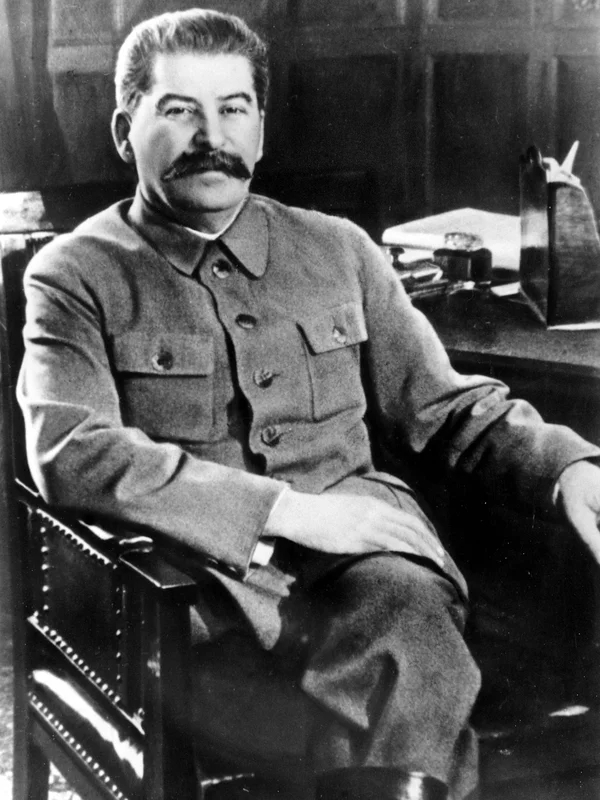

Georgian-born Soviet politician who led the Soviet Union from the 1920s until his death in 1953; he industrialised the country and led it through the Second World War, and his rule brought collectivisation, famine, purges and the Gulag camps.
Early Life
Joseph Stalin was born Ioseb Besarionis dze Jughashvili on 18 December 1878 in Gori, a town in Georgia in the Russian Empire, to Besarion Jughashvili, a cobbler, and Ekaterina Jughashvili. His birth date was traditionally given as 21 December 1879, but records in the Communist Party central archives confirmed the 1878 date. He grew up in poverty, was injured in childhood accidents that left his left arm impaired, and was a strong student at the church school in Gori. He won a scholarship to the theological seminary in Tiflis, now Tbilisi, where he began reading banned political literature and joined the Marxist movement.
Education
Stalin was educated at the church school in Gori and then at the theological seminary in Tiflis from 1894. He was expelled from the seminary in 1899 for missing examinations and for his political activity. He had no further formal education and learned politics through the revolutionary movement.
Career
Stalin joined the Russian Social Democratic Labour Party in 1901, sided with the Bolshevik faction, and was arrested and exiled to Siberia several times. He took part in the October Revolution of 1917 and held posts in the new Soviet government. After the death of Vladimir Lenin in 1924 he outmanoeuvred his rivals and became the dominant leader of the Soviet Union, holding the post of General Secretary of the Communist Party from 1922 to 1952 and serving as premier from 1941 to 1953. From 1928 he replaced Lenin's New Economic Policy with a centralised command economy under five-year plans, forcing agriculture into collective farms and building heavy industry at great speed. Collectivisation caused a great famine in 1932-1933, worst in Ukraine, where it is known as the Holodomor, and in Kazakhstan. Between 1936 and 1939 he ordered the Great Purge, in which at least 700,000 people were executed and more than a million were imprisoned, many in the Gulag system of forced labour camps. In 1939 he signed a non-aggression pact with Germany, and in June 1941 Germany invaded the Soviet Union. Stalin led the Soviet war effort through the Battle of Stalingrad in 1942-1943 to victory in Berlin in 1945, at the cost of very large Soviet losses. After the war he extended Soviet control over Eastern Europe, and the Soviet Union became a nuclear power in 1949. He died on 5 March 1953 in Moscow after a stroke. His successor, Nikita Khrushchev, denounced his rule in 1956 in a process known as de-Stalinisation.
Achievements
Stalin turned the Soviet Union from a largely agricultural country into an industrial power and a nuclear-armed superpower, and led it to victory over Germany in the Second World War. His five-year plans built heavy industry, railways and new cities, and the Soviet Union's role in defeating Germany at Stalingrad and in Berlin is a central part of his record. At the same time his policies caused the deaths of millions of Soviet citizens through famine, executions and the Gulag: historians' estimates of the total number of deaths from repression under his rule range from about 4 million to nearly 10 million, not counting famine deaths in some counts, and about 1.5 to 1.7 million people died in Gulag camps out of about 18 million who passed through them. The Soviet Union's industrial and military strength under Stalin was achieved through forced labour, deportations and political terror.
- Became General Secretary of the Communist Party of the Soviet Union in 1922
- Led the Soviet Union from the 1920s until his death in 1953
- Introduced the five-year plans from 1928 and industrialised the Soviet Union
- Led the Soviet Union to victory over Germany in the Second World War
- Oversaw the Soviet Union becoming a nuclear power in 1949
- Extended Soviet control over Eastern Europe after 1945
- Presided over the Battle of Stalingrad in 1942-1943, a turning point of the war
- Published Foundations of Leninism in 1924
Legacy
Stalin is remembered both as the leader who industrialised the Soviet Union and led it to victory in the Second World War, and as a dictator whose policies killed millions of his own citizens. His supporters point to industrialisation, the defeat of Germany and the rise of the Soviet Union to superpower status; the historical consensus, recorded by Britannica and by historians working with Soviet archives, is that these were achieved through collectivisation, famine, the Great Purge and the Gulag. After his death his successor Khrushchev denounced his rule, and debate about his record continues in Russia and elsewhere. The profile records both assessments without taking a side.
Contributions
Stalin's rule reshaped the Soviet Union and Europe: his five-year plans built the industrial base that allowed the Soviet Union to defeat Germany in the Second World War and to become a superpower, and his post-war policies set the borders and the division of Europe that defined the Cold War. The same policies established a system of political terror, forced labour camps and state control that became a model for other Communist states and a lasting subject of historical study.
Notable Works
- Foundations of Leninism (1924)
- The History of the Communist Party of the Soviet Union (Bolsheviks): Short Course (1938)
- Economic Problems of Socialism in the USSR (1952)
Milestones
- 1878 — Born on 18 December in Gori, Georgia, in the Russian Empire Source: Encyclopaedia Britannica
- 1901 — Joined the Russian Social Democratic Labour Party Source: Wikipedia
- 1917 — Took part in the October Revolution Source: Wikipedia
- 1922 — Became General Secretary of the Communist Party Source: Encyclopaedia Britannica
- 1928 — Launched the first five-year plan and forced collectivisation of agriculture Source: Encyclopaedia Britannica
- 1936 — Began the Great Purge, in which at least 700,000 people were executed Source: Wikipedia
- 1941 — Became premier; Germany invaded the Soviet Union in June Source: Encyclopaedia Britannica
- 1943 — Soviet victory at the Battle of Stalingrad Source: Wikipedia
- 1949 — The Soviet Union became a nuclear power Source: Wikipedia
- 1953 — Died on 5 March in Moscow after a stroke Source: Encyclopaedia Britannica
- 1956 — Khrushchev denounced Stalin's rule in his secret speech Source: Wikipedia
Timeline
- 18 December 1878
Born in Gori, Georgia, in the Russian Empire
Source: Encyclopaedia Britannica - 1899
Expelled from the theological seminary in Tiflis
Year only — exact date unknown Source: Wikipedia - 1901
Joined the Russian Social Democratic Labour Party
Year only — exact date unknown Source: Wikipedia - 1917
Took part in the October Revolution
Year only — exact date unknown Source: Wikipedia - 1922
Became General Secretary of the Communist Party
Year only — exact date unknown Source: Encyclopaedia Britannica - 1928
Launched the first five-year plan and forced collectivisation
Year only — exact date unknown Source: Encyclopaedia Britannica - 1932
Famine began in the Soviet Union following collectivisation
Year only — exact date unknown Source: Wikipedia - 1936
Began the Great Purge
Year only — exact date unknown Source: Wikipedia - 22 June 1941
Germany invaded the Soviet Union
Source: Wikipedia - 1943
Soviet victory at the Battle of Stalingrad
Year only — exact date unknown Source: Wikipedia - 8 May 1945
Germany surrendered; the war in Europe ended
Source: Wikipedia - 5 March 1953
Died in Moscow after a stroke
Source: Encyclopaedia Britannica
Related Personalities
Frequently Asked Questions
Who was Joseph Stalin?
Joseph Stalin (18 December 1878 - 5 March 1953) was a Georgian-born Soviet politician who led the Soviet Union from the 1920s until his death in 1953. He was General Secretary of the Communist Party from 1922 to 1952 and premier from 1941 to 1953, and he led the Soviet Union through industrialisation and the Second World War.
Source: Encyclopaedia Britannica ; WikipediaWhat was the Great Purge?
The Great Purge was the campaign of political repression in the Soviet Union between 1936 and 1939, in which at least 700,000 people were executed and more than a million were imprisoned, many in the Gulag system of forced labour camps. It was directed against people Stalin regarded as enemies of the regime, including party members, military officers and ordinary citizens.
Source: Wikipedia ; Encyclopaedia BritannicaWhat was the Gulag?
The Gulag was the Soviet system of forced labour camps run by the state security services. About 18 million people passed through the camps between 1930 and 1953, and historians estimate that between 1.5 and 1.7 million of them died there.
Source: WikipediaWhat was the Holodomor?
The Holodomor is the name given in Ukraine to the famine of 1932-1933, which followed the forced collectivisation of agriculture under Stalin. Historians estimate that millions of people died in the famine across the Soviet Union, with Ukraine and Kazakhstan the worst affected. Debate continues about whether the famine in Ukraine was deliberately aimed at Ukrainians.
Source: Encyclopaedia Britannica ; WikipediaHow many people died under Stalin's rule?
No single figure is agreed. Historians working with Soviet archives after the Soviet Union's dissolution have estimated the total number of deaths from repression at about 4 million to nearly 10 million, not counting famine deaths in some counts, and about 1.5 to 1.7 million people died in Gulag camps. Millions more died in the famine of 1932-1933.
Source: Wikipedia ; Encyclopaedia BritannicaHow did Stalin die?
Stalin died on 5 March 1953 in Moscow, after suffering a stroke. He was succeeded by Nikita Khrushchev, who in 1956 denounced Stalin's rule in a speech to the Communist Party.
Source: Encyclopaedia BritannicaSources & References
- Joseph Stalin — Encyclopaedia Britannica — Encyclopaedia Britannica (accessed 13 November 2026)
- Joseph Stalin — Wikipedia (cross-check) — Wikipedia (accessed 13 November 2026)
- Joseph Stalin — Biography.com — Biography.com (accessed 13 November 2026)
- File:Joseph Stalin, circa 1942.jpg — Wikimedia Commons (portrait file page) — Wikimedia Commons (accessed 13 November 2026)