Julius Caesar
Roman dictator · Military commander · Statesman · Author
100–44 BCE · Born in Rome, Roman Republic · 4 min read
- Verified: 13 November 2026
- Sources: 4
- Independently reviewed
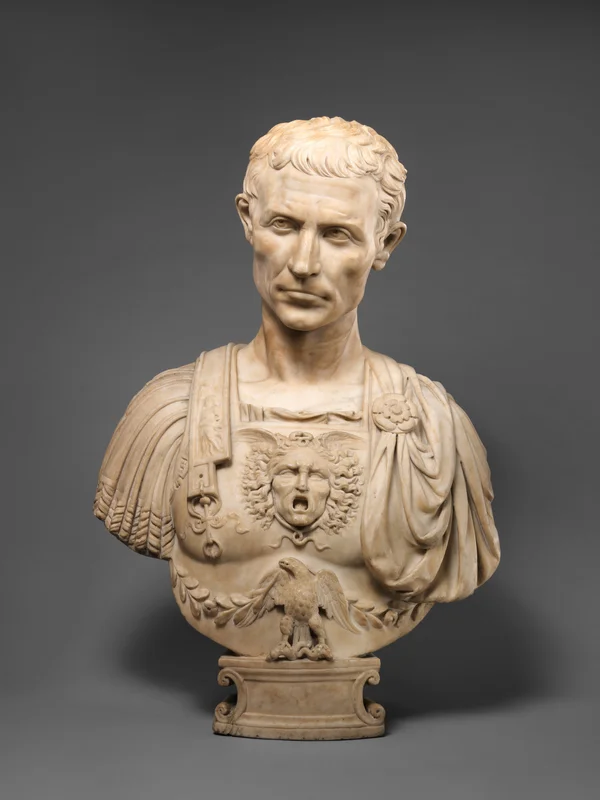

Roman general and statesman (100-44 BCE) who conquered Gaul, crossed the Rubicon to seize power as dictator of Rome, reformed the calendar, and was assassinated on the Ides of March.
Early Life
Gaius Julius Caesar was born in Rome in 100 BCE, into the patrician gens Julia, a family that claimed descent from Iulus, son of the Trojan hero Aeneas. His father, also named Gaius, died when Caesar was 16, leaving him head of the family. As a young man he served in the army in Asia, winning the civic crown for bravery at the Siege of Mytilene in 80 BCE. On his way to study in Rhodes in about 75 BCE he was captured by pirates, who held him for ransom; after his release he raised a fleet, captured the pirates and had them executed, an episode that became famous in his lifetime.
Education
Caesar was educated in Rome in rhetoric, literature and law, as befitted a young man of his class. In about 75 BCE he travelled to Rhodes to study rhetoric under Apollonius Molon, one of the most respected teachers of the age, who also taught Cicero. His own writings, above all the Commentaries on the Gallic War, became models of clear Latin prose and are still read as literature.
Career
Caesar rose through the offices of the Roman Republic: quaestor in 69 BCE, aedile in 65 BCE, pontifex maximus, the chief priest of Rome, in 63 BCE, and praetor in 62 BCE. In 60 BCE he formed an alliance with Pompey and Crassus, the First Triumvirate, and was elected consul for 59 BCE. As consul he passed land reforms and secured his command in Gaul, where he campaigned from 58 to 50 BCE, conquering the whole of Gaul and twice invading Britain. His victories made him rich and famous, and also made the Senate fear his power. In January 49 BCE, ordered to give up his command, he crossed the Rubicon river with his army, an act of rebellion that began a civil war. He defeated Pompey at Pharsalus in Greece in 48 BCE, then pursued him to Egypt, where he became involved with Cleopatra. By 45 BCE he had won the civil war and was master of the Roman world. He was made dictator, and in early 44 BCE dictator for life. He reformed the calendar, creating the Julian calendar, enlarged the Senate, extended citizenship and settled his veterans in colonies. On 15 March 44 BCE, the Ides of March, a group of more than sixty senators led by Brutus and Cassius stabbed him to death in the Senate house, fearing he meant to make himself king.
Achievements
Caesar's central achievements were military and political. In eight years he conquered Gaul, extending Roman rule to the Atlantic and the English Channel, and he was the first Roman general to cross the Rhine and to invade Britain. He won the civil war against Pompey and reorganised the Roman state as dictator, reforming the calendar, the administration and citizenship. The Julian calendar he created, with the advice of the astronomer Sosigenes, remained in use for more than sixteen centuries and is the basis of the calendar used today. His own accounts of his campaigns, the Commentaries on the Gallic War and on the Civil War, are among the most important surviving works of Latin literature.
- Conquered Gaul between 58 and 50 BCE, extending Roman rule to the Atlantic and the English Channel
- Won the Battle of Alesia in 52 BCE, defeating the Gallic leader Vercingetorix
- Became the first Roman general to cross the Rhine and to invade Britain
- Crossed the Rubicon in January 49 BCE and won the civil war against Pompey
- Defeated Pompey at the Battle of Pharsalus in 48 BCE
- Became dictator of Rome and, in early 44 BCE, dictator for life
- Created the Julian calendar, in effect from 45 BCE and the basis of the modern calendar
- Wrote the Commentaries on the Gallic War, a classic of Latin literature
- Enlarged the Senate and extended Roman citizenship to communities in Spain and northern Italy
Legacy
Caesar's assassination did not save the Republic. Within twenty years his adopted heir Octavian, later Augustus, had become the first Roman emperor, and the name Caesar became a title of rulers, surviving in the words Kaiser and Czar. The month of July is named for him, and his calendar governed the Western world until the Gregorian reform of 1582. He remains one of the most studied figures of the ancient world: admired as a general and a writer, and condemned as the man who destroyed the Republic. Ancient sources disagree on the details of his life, and this profile gives years only, where dates are disputed.
Contributions
Caesar's conquests joined Gaul to the Roman world and extended Rome's frontiers to the Atlantic, the Rhine and Britain. As dictator he reformed the calendar, the administration and citizenship, and his Commentaries remain a central source for the history of the period. His career ended the Roman Republic: the civil war he began and the power he gathered made the Empire that followed him possible.
Notable Works
- Commentaries on the Gallic War (c. 50 BCE)
- Commentaries on the Civil War (c. 45 BCE)
- Julian calendar (45 BCE)
Milestones
- 100 BCE — Born in Rome, into the patrician gens Julia Source: Encyclopaedia Britannica
- 80 BCE — Won the civic crown for bravery at the Siege of Mytilene Source: Wikipedia (Julius Caesar)
- 75 BCE — Captured by pirates on his way to study in Rhodes Source: Wikipedia (Julius Caesar)
- 63 BCE — Elected pontifex maximus, chief priest of Rome Source: Wikipedia (Julius Caesar)
- 60 BCE — Formed the First Triumvirate with Pompey and Crassus Source: Encyclopaedia Britannica
- 59 BCE — Served as consul of Rome Source: Encyclopaedia Britannica
- 58 BCE — Began the Gallic Wars Source: Encyclopaedia Britannica
- 52 BCE — Defeated Vercingetorix at Alesia, completing the conquest of Gaul Source: Encyclopaedia Britannica
- 49 BCE — Crossed the Rubicon and began the civil war Source: Encyclopaedia Britannica
- 48 BCE — Defeated Pompey at the Battle of Pharsalus Source: Encyclopaedia Britannica
- 45 BCE — The Julian calendar took effect Source: Encyclopaedia Britannica
- 44 BCE — Made dictator for life; assassinated on the Ides of March Source: Encyclopaedia Britannica
Timeline
- 100 BCE
Born in Rome, into the patrician gens Julia
Approximate date Source: Encyclopaedia Britannica - 80 BCE
Won the civic crown for bravery at the Siege of Mytilene
Approximate date Source: Wikipedia (Julius Caesar) - 75 BCE
Captured by pirates on his way to study in Rhodes; freed them and had them executed after his release
Approximate date Source: Wikipedia (Julius Caesar) - 63 BCE
Elected pontifex maximus, chief priest of Rome
Approximate date Source: Wikipedia (Julius Caesar) - 60 BCE
Formed the First Triumvirate with Pompey and Crassus
Approximate date Source: Encyclopaedia Britannica - 59 BCE
Served as consul of Rome
Approximate date Source: Encyclopaedia Britannica - 58 BCE
Began the Gallic Wars
Approximate date Source: Encyclopaedia Britannica - 55 BCE
Made the first Roman invasion of Britain
Approximate date Source: Wikipedia (Julius Caesar) - 52 BCE
Defeated Vercingetorix at Alesia, completing the conquest of Gaul
Approximate date Source: Encyclopaedia Britannica - 49 BCE
Crossed the Rubicon and began the civil war
Approximate date Source: Encyclopaedia Britannica - 48 BCE
Defeated Pompey at the Battle of Pharsalus
Approximate date Source: Encyclopaedia Britannica - 47 BCE
Won the Battle of Zela; reported to have said 'Veni, vidi, vici'
Approximate date Source: Wikipedia (Julius Caesar) - 45 BCE
The Julian calendar took effect
Approximate date Source: Encyclopaedia Britannica - 44 BCE
Made dictator for life
Approximate date Source: Encyclopaedia Britannica - 44 BCE
Assassinated on the Ides of March by senators led by Brutus and Cassius
Approximate date Source: Encyclopaedia Britannica
In Their Words
“Veni, vidi, vici.” Source: Suetonius, Lives of the Twelve Caesars, 'Julius Caesar' — Reported dispatch after Caesar's victory at Zela in 47 BCE, as recorded by Suetonius.
Related Personalities
Frequently Asked Questions
Who was Julius Caesar?
Julius Caesar (100-44 BCE) was a Roman general and statesman who conquered Gaul, won a civil war against Pompey, became dictator of Rome, reformed the calendar, and was assassinated on the Ides of March, 15 March 44 BCE.
Source: Encyclopaedia BritannicaHow did Julius Caesar die?
Caesar was assassinated on 15 March 44 BCE, the Ides of March, in the Senate house in Rome. A group of more than sixty senators led by Brutus and Cassius stabbed him, fearing he meant to make himself king.
Source: Encyclopaedia Britannica ; Wikipedia (Julius Caesar)What were the Gallic Wars?
The Gallic Wars were Caesar's campaigns in Gaul, modern France and Belgium, between 58 and 50 BCE. They ended with the defeat of the Gallic leader Vercingetorix at Alesia in 52 BCE and brought the whole of Gaul under Roman rule.
Source: Encyclopaedia BritannicaWhat is the Julian calendar?
The Julian calendar was the calendar reform Caesar introduced, with the advice of the astronomer Sosigenes. It took effect on 1 January 45 BCE, replacing the old Roman calendar with a solar year of 365 days and a leap year every four years. It remained in use for more than sixteen centuries and is the basis of the Gregorian calendar used today.
Source: Encyclopaedia Britannica ; Wikipedia (Julius Caesar)What does 'crossing the Rubicon' mean?
To 'cross the Rubicon' means to take a step from which there is no turning back. In January 49 BCE Caesar led his army across the Rubicon river, the boundary of Italy, in defiance of the Senate, an act of rebellion that began a civil war.
Source: Encyclopaedia BritannicaDid Caesar say 'Veni, vidi, vici'?
'Veni, vidi, vici', meaning 'I came, I saw, I conquered', is reported by the Roman historian Suetonius as Caesar's dispatch after his victory at Zela in 47 BCE. It is quoted with that attribution, not as a verbatim record.
Source: Encyclopaedia Britannica ; Wikipedia (Julius Caesar)Sources & References
- Julius Caesar — Encyclopaedia Britannica — Encyclopaedia Britannica (accessed 13 November 2026)
- Julius Caesar — Wikipedia (cross-check) — Wikipedia (accessed 13 November 2026)
- Julius Caesar — HISTORY — HISTORY (accessed 13 November 2026)
- File:Julius Caesar MET DP-12755-001.jpg — Wikimedia Commons (portrait file page) — Wikimedia Commons (accessed 13 November 2026)