Rosalind Franklin
Scientist · Chemist · X-ray crystallographer · Biophysicist
1920–1958 · Born in Notting Hill, London, England · 4 min read
- Verified: 13 November 2026
- Sources: 5
- Independently reviewed
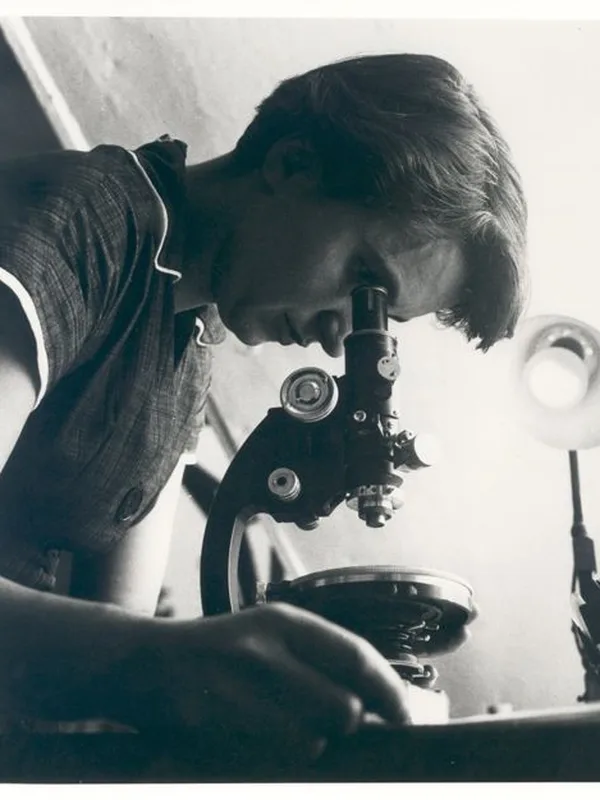

British X-ray crystallographer whose Photograph 51 provided the key evidence for DNA's double-helix structure; her later work founded structural virology.
Early Life
Rosalind Elsie Franklin was born on 25 July 1920 at 50 Chepstow Villas, Notting Hill, London, the second of five children of Ellis Arthur Franklin, a banker, and Muriel Frances Waley, in an affluent Anglo-Jewish family prominent in banking and publishing. She excelled in science at St Paul's Girls' School in London and decided at fifteen that she wanted to be a scientist. In 1938 she went to Newnham College, University of Cambridge, to study physical chemistry, graduating in 1941.
Education
Franklin studied physical chemistry at Newnham College, University of Cambridge, graduating in 1941. She received a research fellowship at Cambridge and earned her PhD in physical chemistry in 1945, with a thesis on the structure of coal and graphite.
Career
Franklin graduated in physical chemistry from Newnham College, Cambridge, in 1941 and earned her PhD there in 1945 with a thesis on the structure of coal. During the war she worked for the British Coal Utilisation Research Association, classifying coals and studying their structure. From 1947 to 1950 she worked at the Laboratoire Central des Services Chimiques de l'État in Paris, where she learned X-ray diffraction techniques. In 1951 she returned to England as a research associate in John Randall's biophysics unit at King's College London, where she was assigned to study DNA. Working with Raymond Gosling, she produced the diffraction images, including Photograph 51 in May 1952, that revealed the helix. In March 1953 she moved to Birkbeck College, London, where J. D. Bernal welcomed her into the crystallography laboratory; there she worked on tobacco mosaic virus with a team that included the young Aaron Klug, later a Nobel laureate. She was diagnosed with ovarian cancer in 1956 and continued working through treatment until her death on 16 April 1958, aged 37.
Achievements
Franklin's central achievement was her X-ray crystallography of DNA at King's College London. She established the density of DNA and, more importantly, that the molecule exists in a helical conformation, and she distinguished its two forms, A-DNA and B-DNA, according to the humidity around the fibre. In May 1952 she and her PhD student Raymond Gosling produced Photograph 51, the clearest X-ray diffraction image of B-form DNA, whose X-shaped pattern and measurements supplied the evidence James Watson and Francis Crick needed to complete their double-helix model. Her own paper on the structure, published in Nature on 25 April 1953 alongside theirs, confirmed the model with her data. At Birkbeck College from 1953 she turned the same methods to viruses, showing that tobacco mosaic virus is a helix of protein subunits with its RNA embedded in the inner wall, work that laid the foundations of structural virology. In a career of barely a decade she published 19 papers on coals and carbons, 5 on DNA and 21 on viruses.
- Established that the DNA molecule exists in a helical conformation and measured its density, at King's College London
- Produced Photograph 51 in May 1952 with her student Raymond Gosling, the clearest X-ray diffraction image of B-form DNA, which provided the key evidence for the double helix
- Published her DNA findings in Nature on 25 April 1953 alongside the Watson-Crick model paper
- Determined the helical structure of tobacco mosaic virus at Birkbeck College, showing its RNA was embedded in the protein shell as a single-strand helix
- Laid the foundations of the field of structural virology through her work on tobacco mosaic virus and polio virus
- Published 19 papers on coals and carbons, 5 on DNA and 21 on viruses in a career cut short at 37
Legacy
Franklin died four years before the 1962 Nobel Prize in Physiology or Medicine went to Watson, Crick and Maurice Wilkins for the determination of the DNA structure; the prize is not awarded posthumously, so she could not have shared it even had she lived to be nominated. Her contribution was under-recognised for decades, partly because Watson's account in The Double Helix (1968) presented her unfavourably. Later scholarship, including Brenda Maddox's biography Rosalind Franklin: The Dark Lady of DNA (2002) and a reassessment by Matthew Cobb and Nathaniel Comfort in Nature in 2023, restored her central role: she had established the helix herself and was close to the correct structure when the model was published. The Royal Society's Rosalind Franklin Award, established in 2003, honours outstanding women in science, engineering and technology, and her name is carried by a Mars rover, universities and research buildings.
Contributions
Franklin's contribution was methodological as much as evidential: she brought rigorous quantitative X-ray crystallography to biological molecules. Her careful control of fibre humidity, her precise measurements of DNA density and her insistence on distinguishing the A and B forms turned diffraction patterns into structural proof rather than suggestive pictures. Photograph 51 gave the helix its dimensions, and her analysis of the phosphate groups on the outside of the molecule ruled out competing models. In virology she applied the same discipline to tobacco mosaic virus, showing that a virus could be understood as a precise molecular machine, and her group established the methods on which structural virology was built.
Notable Works
- Photograph 51 (X-ray diffraction image of B-form DNA, May 1952)
- Franklin, R. E. and Gosling, R. G., 'Molecular configuration in sodium thymonucleate', Nature (25 April 1953)
- Franklin, R. E., 'Structure of tobacco mosaic virus', Nature (1955)
- Studies on the structure of coal and graphite (PhD thesis, 1945)
Milestones
- 1920 — Born on 25 July in Notting Hill, London Source: Encyclopaedia Britannica
- 1941 — Graduated in physical chemistry from Newnham College, Cambridge Source: Encyclopaedia Britannica
- 1945 — Earned her PhD in physical chemistry from Cambridge with a thesis on coal Source: Encyclopaedia Britannica
- 1951 — Joined King's College London to study the structure of DNA Source: Encyclopaedia Britannica
- 1952 — Produced Photograph 51 with Raymond Gosling, the clearest X-ray image of B-form DNA Source: Encyclopaedia Britannica; U.S. National Library of Medicine
- 1953 — Moved to Birkbeck College to work on virus structure; her DNA paper was published in Nature alongside the Watson-Crick model Source: Encyclopaedia Britannica
- 1955 — Published her work on the structure of tobacco mosaic virus Source: Encyclopaedia Britannica
- 1956 — Diagnosed with ovarian cancer; continued her research through treatment Source: Encyclopaedia Britannica; U.S. National Library of Medicine
- 1958 — Died in London, aged 37 Source: Encyclopaedia Britannica
- 1962 — Watson, Crick and Wilkins received the Nobel Prize for the DNA structure; the prize is not awarded posthumously Source: Encyclopaedia Britannica; NobelPrize.org
Timeline
- 25 July 1920
Born Rosalind Elsie Franklin at 50 Chepstow Villas, Notting Hill, London
Source: Encyclopaedia Britannica; U.S. National Library of Medicine - 1938
Entered Newnham College, University of Cambridge, to study physical chemistry
Year only — exact date unknown Source: Encyclopaedia Britannica - 1941
Graduated from Cambridge; received a fellowship to conduct research in physical chemistry
Year only — exact date unknown Source: Encyclopaedia Britannica - 1945
Earned her PhD in physical chemistry from the University of Cambridge, with a thesis on coal
Year only — exact date unknown Source: Encyclopaedia Britannica - 1947
Moved to Paris to work at the Laboratoire Central des Services Chimiques de l'État, learning X-ray diffraction
Year only — exact date unknown Source: Encyclopaedia Britannica; U.S. National Library of Medicine - 1951
Joined John Randall's biophysics unit at King's College London as a research associate to study DNA
Year only — exact date unknown Source: Encyclopaedia Britannica - 1952-05
With Raymond Gosling, produced Photograph 51, the clearest X-ray image of B-form DNA
Approximate date Source: Encyclopaedia Britannica; U.S. National Library of Medicine - 1953-01
Maurice Wilkins showed Photograph 51 to James Watson without Franklin's knowledge
Approximate date Source: Nature (Cobb & Comfort, 2023) - 1953-03
Moved to Birkbeck College, London, to work on the structure of viruses
Approximate date Source: Encyclopaedia Britannica - 25 April 1953
Her paper on DNA structure was published in Nature alongside the Watson-Crick model paper
Source: Encyclopaedia Britannica - 1956
Diagnosed with ovarian cancer while on a working trip to the United States; continued working through treatment
Year only — exact date unknown Source: Encyclopaedia Britannica; U.S. National Library of Medicine - 16 April 1958
Died in London, aged 37
Source: Encyclopaedia Britannica
Related Personalities
Frequently Asked Questions
Who was Rosalind Franklin?
Rosalind Franklin (1920-1958) was a British chemist and X-ray crystallographer whose work was central to understanding the molecular structures of DNA, RNA, viruses, coal and graphite. She is best known for Photograph 51, the X-ray image that provided the key evidence for DNA's double-helix structure.
Source: Encyclopaedia Britannica ; U.S. National Library of MedicineWhat is Photograph 51?
Photograph 51 was an X-ray diffraction image of B-form DNA taken by Franklin and her student Raymond Gosling in May 1952 at King's College London. Its X-shaped pattern and precise measurements showed that DNA is a helix, and it supplied the evidence Watson and Crick needed to complete their double-helix model, published in Nature on 25 April 1953.
Source: Encyclopaedia Britannica ; U.S. National Library of MedicineHow did Watson and Crick see Franklin's data?
In January 1953 Maurice Wilkins showed Photograph 51 to James Watson without Franklin's knowledge, and an unpublished Medical Research Council report containing her measurements reached Watson and Crick through Max Perutz. Her own paper was published in Nature on 25 April 1953 alongside theirs, supporting the model with her data.
Source: Nature (Cobb & Comfort, 2023) ; Encyclopaedia BritannicaWhy didn't Rosalind Franklin win the Nobel Prize?
Franklin did not receive the Nobel Prize because she had died in 1958, four years before the 1962 prize was awarded to Watson, Crick and Wilkins. The Nobel Prize is not awarded posthumously. Her contribution was under-recognised for decades and has since been reassessed, notably in a 2023 Nature article.
Source: Encyclopaedia Britannica ; Nature (Cobb & Comfort, 2023)What did Franklin do after the DNA work?
After leaving King's College in March 1953, Franklin worked at Birkbeck College, London, on the structure of viruses. She showed that tobacco mosaic virus is a helix of protein subunits with its RNA embedded in the inner wall, and laid the foundations of structural virology before her death from ovarian cancer in 1958.
Source: Encyclopaedia Britannica ; U.S. National Library of MedicineSources & References
- Rosalind Franklin — Encyclopaedia Britannica — Encyclopaedia Britannica (accessed 12 November 2026)
- Biographical Overview: Rosalind Franklin — Profiles in Science — U.S. National Library of Medicine (accessed 12 November 2026)
- Rosalind Franklin — Wikipedia (cross-check) — Wikipedia (accessed 12 November 2026)
- File:Rosalind Franklin.jpg — Wikimedia Commons (portrait file page) — Wikimedia Commons (accessed 12 November 2026)
- What Rosalind Franklin truly contributed to the discovery of the structure of DNA — Nature (accessed 12 November 2026)
Explore More
- More Scientists & Inventors
- Personalities from England
- Personalities from United Kingdom
- Personalities from France
- More scientists
- More chemists
- More x-ray crystallographers
- More biophysicists
- Famous people born in July
- Browse all personalities
Featured on these lists: