Pablo Neruda
Poet · Diplomat · Politician · Writer
1904–1973 · Born in Parral, Chile · 4 min read
- Verified: 13 November 2026
- Sources: 5
- Independently reviewed
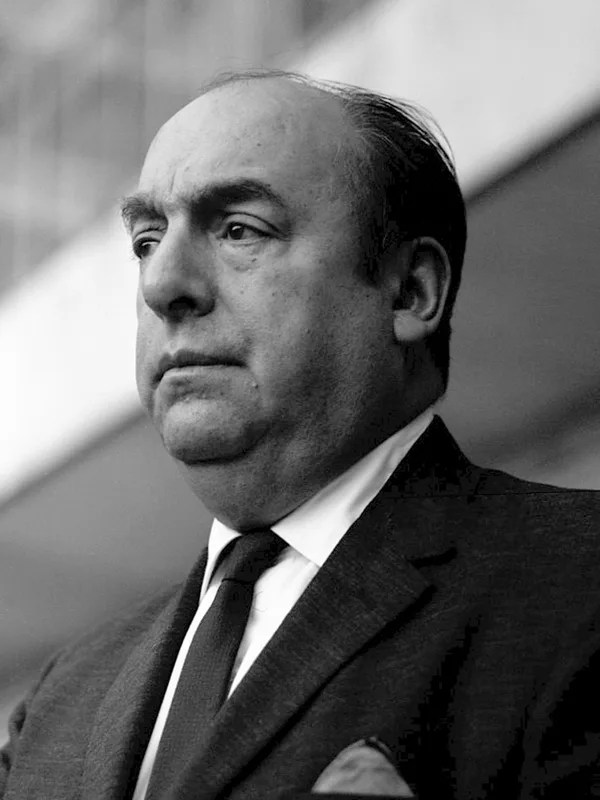

Chilean poet, diplomat and politician who won the Nobel Prize in Literature in 1971; his Twenty Love Poems and the epic Canto general made him Latin America's great poet.
Early Life
Pablo Neruda was born Ricardo Eliécer Neftalí Reyes Basoalto on 12 July 1904 in Parral, Chile, the son of José del Carmen Reyes, a railway worker, and Rosa Basoalto, a schoolteacher. His mother died within a month of his birth, and two years later the family moved to Temuco in southern Chile, where his father remarried. He was a precocious boy who began to write poetry at the age of ten, and at the Temuco Girls' School he was encouraged by its principal, the poet Gabriela Mistral, who would herself later win the Nobel Prize. He finished his secondary schooling in Temuco in 1920 and moved to Santiago in 1921 to study French at the university, but he soon gave himself to poetry full-time.
Career
Neruda began writing poetry at ten and publishing in local newspapers as a teenager, taking the pen name Pablo Neruda to avoid his father's disapproval; he legally adopted the name in 1946. He moved to Santiago in 1921 to study French, published Crepusculario in 1923 and Veinte poemas in 1924, and by twenty was one of Chile's best-known poets. Unable to live from poetry, he became a diplomat: honorary consul in Rangoon in 1927, then Colombo, Batavia in 1930, Buenos Aires in 1933, where he met Federico García Lorca, and Madrid in 1934. The Spanish Civil War turned him decisively toward politics; he wrote España en el corazón (1937) for the Republican cause and, as special consul in Paris in 1939, organised the migration of Spanish Republican refugees to Chile. As consul general in Mexico from 1940 he began Canto general. Elected senator in 1945, he joined the Communist Party, was expelled from the Senate in 1948 after denouncing President González Videla, and fled Chile on horseback across the Andes. In exile he visited the Soviet Union, Poland, Hungary and Mexico, and in 1950 published Canto general. He returned to Chile, and in 1971, the year of his Nobel Prize, became ambassador to France, a post he held until ill health brought him home in 1973.
Achievements
Neruda's achievement was to make Spanish poetry speak in every register, from the most intimate love lyric to the epic history of a continent. Veinte poemas de amor y una canción desesperada (1924), written when he was nineteen, became one of the most widely read books of poetry in Spanish; Residencia en la tierra (1933) remade the language in a surreal, anguished key; and Canto general (1950) turned the history of Latin America into a single epic, with 'Alturas de Macchu Picchu' at its centre. The Odas elementales (1954) celebrated ordinary things — salt, socks, a tomato — with humour and simplicity. In 1971 he received the Nobel Prize in Literature, the citation praising a poetry that 'with the action of an elemental force brings alive a continent's destiny and dreams'. He was also a working politician and diplomat, a senator and an ambassador, whose public life was as large as his books.
- Published Veinte poemas de amor y una canción desesperada (1924), his most popular book, at the age of nineteen
- Published Residencia en la tierra (1933), a landmark of modern Spanish poetry
- Published Canto general (1950), his epic poem celebrating Latin America
- Awarded the Nobel Prize in Literature in 1971
- Received the International Peace Prize in 1950 and the Stalin Peace Prize in 1953
- Served as a senator of Chile (1945–1948) and as ambassador to France (1971–1973)
- Organised the migration of Spanish Republican refugees to Chile from Paris in 1939
- His Odas elementales (1954) made poetry of everyday objects beloved across the Spanish-speaking world
Legacy
Neruda died on 23 September 1973 at the Santa María Clinic in Santiago, twelve days after the military coup that overthrew President Salvador Allende. He is remembered as perhaps the most important Latin American poet of the twentieth century, a writer whose love poems are memorised across the Spanish-speaking world and whose epic Canto general gave Latin America a poetic history of itself. His houses in Santiago, Valparaíso and Isla Negra are museums, and his work has been translated into dozens of languages. His death remains contested: the official cause was complications from prostate cancer, but a forensic investigation opened in 2011, and in 2023 an international panel confirmed the presence of the bacterium Clostridium botulinum in his remains without being able to conclude that it killed him. The dispute has become part of his story, a reminder of how closely his life was bound to the politics of Chile.
Contributions
Neruda's contribution was to give Latin America a poetry equal to its scale. His love poems made Spanish lyric poetry intimate and direct; Residencia en la tierra proved it could be strange and difficult; Canto general proved it could carry the whole history of a continent, from pre-Columbian civilisations to the wars of liberation and the struggles of the oppressed; and the Odas elementales proved it could celebrate a pair of socks. He showed that a poet could be a diplomat, a senator and a communist without ceasing to be a lyric poet, and his work carried Latin American literature into the world. His example — a poet who wrote for his people and paid for it with exile — shaped a generation of Latin American writers.
Notable Works
- Crepusculario (1923)
- Veinte poemas de amor y una canción desesperada (1924)
- Residencia en la tierra (1933)
- España en el corazón (1937)
- Canto general (1950)
- Odas elementales (1954)
- 'Alturas de Macchu Picchu' (1943)
- Cien sonetos de amor (1959)
Milestones
- 1904 — Born in Parral, Chile Source: Encyclopaedia Britannica
- 1921 — Moves to Santiago to study French and devote himself to poetry Source: Encyclopaedia Britannica
- 1923 — Publishes Crepusculario, his first book Source: Encyclopaedia Britannica
- 1924 — Publishes Veinte poemas de amor y una canción desesperada Source: Encyclopaedia Britannica
- 1927 — Becomes honorary consul in Rangoon Source: Encyclopaedia Britannica
- 1933 — Publishes Residencia en la tierra Source: Encyclopaedia Britannica
- 1937 — Writes España en el corazón for Republican Spain Source: Encyclopaedia Britannica
- 1939 — Organises migration of Spanish refugees to Chile from Paris Source: Encyclopaedia Britannica
- 1945 — Elected senator and joins the Communist Party Source: Encyclopaedia Britannica
- 1949 — Flees Chile across the Andes into exile Source: Encyclopaedia Britannica
- 1950 — Publishes Canto general Source: Encyclopaedia Britannica
- 1954 — Publishes Odas elementales Source: Encyclopaedia Britannica
- 1971 — Awarded the Nobel Prize in Literature Source: NobelPrize.org
- 1973 — Dies in Santiago, twelve days after the military coup Source: Encyclopaedia Britannica
Timeline
- 12 July 1904
Born Ricardo Eliécer Neftalí Reyes Basoalto in Parral, Chile
Source: Encyclopaedia Britannica; NobelPrize.org - 1906
Family moves to Temuco in southern Chile after his mother's death
Approximate date Source: Encyclopaedia Britannica - 1921
Moves to Santiago to study French; begins to devote himself to poetry
Year only — exact date unknown Source: Encyclopaedia Britannica; NobelPrize.org - 1923
Publishes his first book of poems, Crepusculario
Year only — exact date unknown Source: Encyclopaedia Britannica - 1924
Publishes Veinte poemas de amor y una canción desesperada, an instant success
Year only — exact date unknown Source: Encyclopaedia Britannica - 1927
Appointed honorary consul in Rangoon, beginning five years of diplomatic service in Asia
Year only — exact date unknown Source: Encyclopaedia Britannica - 1933
Appointed consul in Buenos Aires, where he meets Federico García Lorca
Year only — exact date unknown Source: Encyclopaedia Britannica - 1937
Writes España en el corazón in support of Republican Spain
Year only — exact date unknown Source: Encyclopaedia Britannica - 1939
As special consul in Paris, organises the migration of Spanish Republican refugees to Chile
Year only — exact date unknown Source: Encyclopaedia Britannica - 1943
Visits Machu Picchu in Peru, inspiring 'Alturas de Macchu Picchu'
Year only — exact date unknown Source: Encyclopaedia Britannica - 1945
Elected senator; joins the Communist Party
Year only — exact date unknown Source: Encyclopaedia Britannica - 1949-03
Flees Chile on horseback across the Andes into exile; expelled from the Senate in 1948
Approximate date Source: Encyclopaedia Britannica - 1950
Publishes Canto general, his epic poem of Latin America
Year only — exact date unknown Source: Encyclopaedia Britannica - 1971
Awarded the Nobel Prize in Literature; becomes ambassador to France
Year only — exact date unknown Source: NobelPrize.org; Encyclopaedia Britannica - 23 September 1973
Dies at the Santa María Clinic in Santiago, twelve days after the military coup
Source: Encyclopaedia Britannica; NobelPrize.org
Related Personalities
Frequently Asked Questions
Who was Pablo Neruda?
Pablo Neruda (1904–1973), born Ricardo Eliécer Neftalí Reyes Basoalto, was a Chilean poet, diplomat and politician who won the Nobel Prize in Literature in 1971. He is widely regarded as the most important Latin American poet of the twentieth century, and his love poems are read around the world.
Source: Encyclopaedia Britannica ; NobelPrize.orgWhat is Twenty Love Poems and a Song of Despair?
Veinte poemas de amor y una canción desesperada (1924), known in English as Twenty Love Poems and a Song of Despair, is Neruda's second book and his most popular work. Written when he was nineteen, its passionate poems of young love made him famous across the Spanish-speaking world.
Source: Encyclopaedia Britannica ; NobelPrize.orgWhy did Neruda win the Nobel Prize?
Neruda received the Nobel Prize in Literature in 1971 for a poetry that, in the Swedish Academy's words, 'with the action of an elemental force brings alive a continent's destiny and dreams'. The award recognised a lifetime of work spanning love poetry, political epic and odes to everyday objects.
Source: NobelPrize.org ; Encyclopaedia BritannicaHow did Pablo Neruda die?
Neruda died on 23 September 1973 at the Santa María Clinic in Santiago, twelve days after the military coup that overthrew President Salvador Allende. He was suffering from prostate cancer, and the official cause of death was given as complications from the disease, although the circumstances remain disputed.
Source: Encyclopaedia Britannica ; Wikipedia (Pablo Neruda)Was Neruda poisoned?
That question is still not settled. In 2023 an international panel of forensic experts confirmed that the bacterium Clostridium botulinum was present in a molar from Neruda's remains and had been there at his death, but the panel could not conclude that it killed him or that it was deliberately introduced. Chile's courts reopened the investigation in 2024.
Source: McMaster University ; Forensic Magazine ; Wikipedia (Pablo Neruda)What is Canto general?
Canto general (1950), or General Song, is Neruda's epic poem celebrating Latin America, its peoples, landscapes and history from pre-Columbian times to the twentieth century. Its centrepiece, 'Alturas de Macchu Picchu', was inspired by his visit to the Inca ruins in 1943 and is considered one of his finest poems.
Source: Encyclopaedia BritannicaSources & References
- Pablo Neruda | Biography, Poems, Books, & Facts — Encyclopaedia Britannica (accessed 13 November 2026)
- Pablo Neruda – Facts — NobelPrize.org (accessed 13 November 2026)
- Pablo Neruda — Wikipedia (accessed 13 November 2026)
- Forensic Tests Show Legendary Chilean Poet Pablo Neruda was Poisoned — Forensic Magazine (accessed 13 November 2026)
- File:Pablo Neruda 1963.jpg — Wikimedia Commons (portrait file page) — Wikimedia Commons (accessed 13 November 2026)
Explore More
- More Writers & Authors
- Personalities from Chile
- Personalities from France
- Personalities from Spain
- Personalities from Mexico
- More poets
- More diplomats
- More politicians
- More writers
- Famous people born in July
- Browse all personalities
Featured on these lists: