Margaret Thatcher
Prime Minister of the United Kingdom · Politician · Chemist · Author
1925–2013 · Born in Grantham, Lincolnshire, England · 4 min read
- Verified: 13 November 2026
- Sources: 4
- Independently reviewed
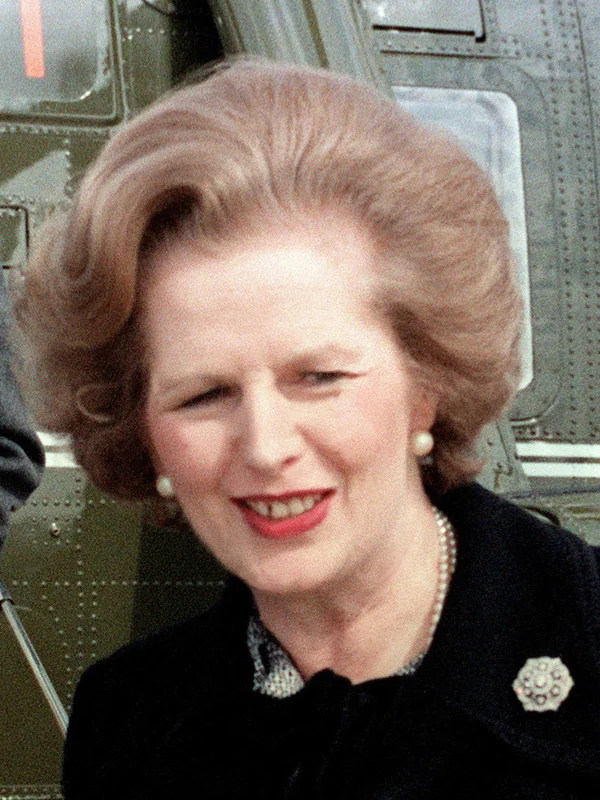

First woman to serve as prime minister of the United Kingdom (1979-1990) and the longest-serving British prime minister of the 20th century; known as the 'Iron Lady' for her free-market reforms and firm leadership.
Early Life
Margaret Hilda Roberts was born on 13 October 1925 in Grantham, Lincolnshire, the daughter of Alfred Roberts, a grocer and local councillor, and Beatrice Roberts. She grew up above her father's grocery shop, attended Grantham Girls' High School, and won a scholarship to Somerville College, Oxford, where she studied chemistry. She became president of the Oxford University Conservative Association in 1946.
Education
Thatcher graduated from Somerville College, Oxford, with a degree in chemistry in 1947 and worked briefly as a research chemist. She later studied law and was called to the Bar in 1954, practising as a barrister before entering Parliament.
Career
Thatcher was elected as the Conservative Member of Parliament for Finchley in 1959. She served as Secretary of State for Education and Science from 1970 to 1974 under Edward Heath, a post in which her decision to end free school milk for older primary-school children earned her the hostile nickname 'Milk Snatcher'. In 1975 she defeated Heath for the Conservative leadership, becoming the first woman to lead a major British political party. After the Conservatives won the 1979 general election she became prime minister on 4 May 1979. Her government privatised state-owned industries including British Telecom, British Gas and British Airways, reformed trade-union law, and cut direct taxes. In 1982 Argentina invaded the Falkland Islands and Britain retook them in a ten-week war. She won re-election in 1983 and 1987. In 1984 she survived an IRA bomb attack on the Grand Hotel in Brighton during the Conservative Party conference, and her government faced down the National Union of Mineworkers in the miners' strike of 1984-85. She negotiated a rebate from the European Community budget in 1984 and worked closely with US President Ronald Reagan while also engaging with the Soviet leader Mikhail Gorbachev as the Cold War drew to a close. Her later years in office were marked by the unpopular community charge, known as the poll tax. A leadership challenge in November 1990 forced her resignation; she left office on 28 November 1990 and was succeeded by John Major.
Achievements
Thatcher's central achievements were becoming Britain's first female prime minister, winning three consecutive general elections, and reshaping the British economy through privatisation, trade-union reform and lower direct taxation. She led Britain to victory in the Falklands War in 1982, negotiated a rebate from the European Community budget in 1984, and played a part in the diplomacy of the Cold War's final years alongside Ronald Reagan and Mikhail Gorbachev. Her government also sold council houses to their tenants under the Right to Buy scheme, expanded share ownership, and lowered the top rate of income tax, changes that reshaped British society well beyond her time in office. She was appointed to the Order of Merit in 1990 and made a life peer in 1992.
- Became the first woman to serve as prime minister of the United Kingdom in 1979
- Served as prime minister for eleven years (1979-1990), the longest-serving British prime minister of the 20th century
- Won three consecutive general elections, in 1979, 1983 and 1987
- Led Britain to victory in the Falklands War in 1982
- Carried out a wide programme of privatisation of state-owned industries
- Reformed trade-union law and curbed union power after the 1984-85 miners' strike
- Negotiated the British rebate from the European Community budget in 1984
- Worked with US President Ronald Reagan and Soviet leader Mikhail Gorbachev during the final years of the Cold War
- Appointed to the Order of Merit in 1990 and made a life peer as Baroness Thatcher in 1992
- Published the memoir The Downing Street Years in 1993
Legacy
Thatcher remains one of the most divisive figures in modern British history, and assessments of her legacy differ sharply. Supporters credit her with reviving the British economy, restoring national confidence after the Falklands War, and standing firm against the Soviet Union, while critics point to high unemployment in the early 1980s, the decline of manufacturing and mining communities, the poll tax, and a rise in inequality. Her nickname, the 'Iron Lady', was first used by the Soviet press and adopted by her supporters. After leaving office she wrote her memoirs, The Downing Street Years (1993) and The Path to Power (1995), and remained a public figure until ill health limited her appearances in her final years. She died of a stroke on 8 April 2013 in London, aged 87, and was given a ceremonial funeral at St Paul's Cathedral.
Contributions
Thatcher's contribution was to transform Britain's post-war political settlement: she reduced the role of the state in industry, weakened trade-union power, promoted home ownership and share ownership, and reasserted Britain's place as a military and diplomatic power. Her eleven years in office set the terms of British political debate for a generation after she left.
Notable Works
- The Downing Street Years (1993)
- The Path to Power (1995)
- Statecraft (2002)
Milestones
- 1925 — Born Margaret Hilda Roberts in Grantham, Lincolnshire Source: Encyclopaedia Britannica
- 1947 — Graduated from Oxford University with a degree in chemistry Source: Encyclopaedia Britannica
- 1959 — Elected Member of Parliament for Finchley Source: Wikipedia
- 1970 — Appointed Secretary of State for Education and Science Source: Encyclopaedia Britannica
- 1975 — Elected leader of the Conservative Party Source: Wikipedia
- 1979 — Became prime minister of the United Kingdom on 4 May Source: Encyclopaedia Britannica
- 1982 — Britain retook the Falkland Islands after the Argentine invasion Source: Wikipedia
- 1983 — Re-elected prime minister Source: Wikipedia
- 1984 — Survived the Brighton hotel bombing Source: Wikipedia
- 1987 — Won a third consecutive general election Source: Wikipedia
- 1990 — Resigned as prime minister on 28 November Source: Encyclopaedia Britannica
- 1992 — Made a life peer as Baroness Thatcher Source: Wikipedia
- 2013 — Died in London after a stroke, aged 87 Source: Encyclopaedia Britannica
Timeline
- 13 October 1925
Born Margaret Hilda Roberts in Grantham, Lincolnshire
Source: Encyclopaedia Britannica - 1947
Graduated from Somerville College, Oxford, with a degree in chemistry
Year only — exact date unknown Source: Encyclopaedia Britannica - 13 December 1951
Married Denis Thatcher
Source: Wikipedia - 8 October 1959
Elected Member of Parliament for Finchley
Source: Wikipedia - 1970
Appointed Secretary of State for Education and Science
Year only — exact date unknown Source: Encyclopaedia Britannica - 11 February 1975
Elected leader of the Conservative Party, the first woman to lead a major British party
Source: Wikipedia - 4 May 1979
Became prime minister of the United Kingdom
Source: Encyclopaedia Britannica - 2 April 1982
Argentina invaded the Falkland Islands; Britain retook them in a ten-week war
Source: Wikipedia - 9 June 1983
Re-elected prime minister in a general election
Source: Wikipedia - 12 October 1984
Survived the IRA bombing of the Grand Hotel, Brighton, during the Conservative conference
Source: Wikipedia - 11 June 1987
Won a third consecutive general election
Source: Wikipedia - 28 November 1990
Resigned as prime minister; succeeded by John Major
Source: Encyclopaedia Britannica - 8 April 2013
Died in London after suffering a stroke, aged 87
Source: Encyclopaedia Britannica
In Their Words
“The lady's not for turning.” Source: Margaret Thatcher, speech to the Conservative Party Conference, Brighton, 10 October 1980 — From her speech to the Conservative Party Conference in Brighton, 10 October 1980, in which she rejected calls for a change of economic policy. The phrase echoes the title of Christopher Fry's play The Lady's Not for Burning.
Related Personalities
Frequently Asked Questions
Who was Margaret Thatcher?
Margaret Thatcher (born 13 October 1925, died 8 April 2013) was a British politician who served as prime minister of the United Kingdom from 1979 to 1990. She was the first woman to hold the office and the longest-serving British prime minister of the 20th century.
Source: Encyclopaedia BritannicaHow long was Margaret Thatcher prime minister?
Thatcher served as prime minister for eleven years, from 4 May 1979 to 28 November 1990, winning three general elections (1979, 1983 and 1987). She resigned after a challenge to her leadership of the Conservative Party.
Source: Encyclopaedia Britannica ; WikipediaWhy was Margaret Thatcher called the Iron Lady?
The 'Iron Lady' was a nickname first used by the Soviet press for Thatcher's firm stance against communism and her uncompromising style of leadership. She embraced the name, and it became her best-known title.
Source: Encyclopaedia BritannicaWhat happened in the Falklands War?
In 1982 Argentina invaded the Falkland Islands, a British overseas territory in the South Atlantic. Thatcher sent a naval task force to retake the islands, and British forces succeeded after a ten-week war. The victory strengthened her position at home and contributed to her 1983 election win.
Source: Encyclopaedia Britannica ; WikipediaHow did Margaret Thatcher die?
Thatcher died on 8 April 2013 in London, aged 87, after suffering a stroke. She was given a ceremonial funeral at St Paul's Cathedral on 17 April 2013.
Source: Encyclopaedia Britannica ; WikipediaSources & References
- Margaret Thatcher — Encyclopaedia Britannica — Encyclopaedia Britannica (accessed 13 November 2026)
- Margaret Thatcher — Wikipedia (cross-check) — Wikipedia (accessed 13 November 2026)
- Margaret Thatcher Fast Facts — CNN — CNN (accessed 13 November 2026)
- File:Margaret Thatcher 1981.jpg — Wikimedia Commons (portrait file page) — Wikimedia Commons (accessed 13 November 2026)