Leo Tolstoy
Writer · Novelist · Philosopher
1828–1910 · Born in Yasnaya Polyana, Tula Province, Russian Empire · 3 min read
- Verified: 13 November 2026
- Sources: 4
- Independently reviewed
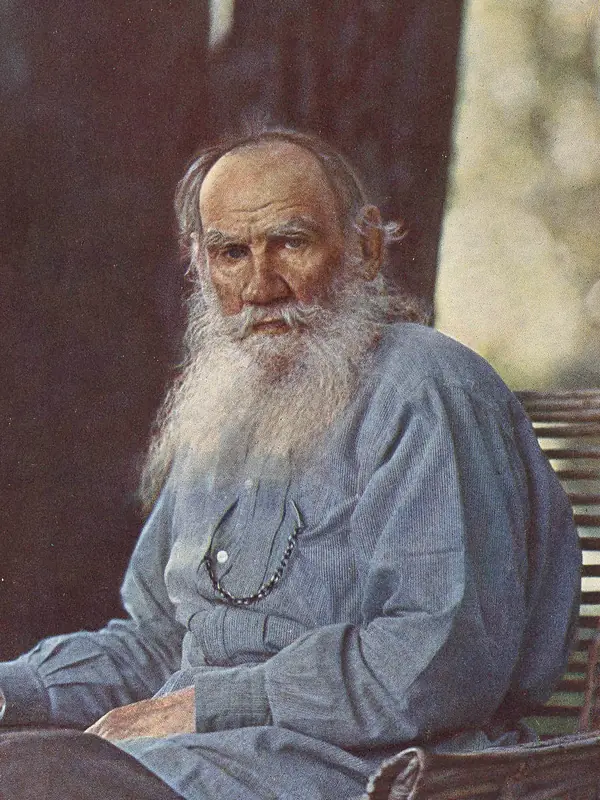

Russian writer (1828–1910), author of War and Peace and Anna Karenina, widely regarded as one of the greatest novelists of all time, and later a moral philosopher whose ideas influenced Gandhi and nonviolent resistance.
Early Life
Lev Nikolayevich Tolstoy was born on 9 September 1828 (New Style; 28 August Old Style) at Yasnaya Polyana, the family estate in Tula province, the fourth son of Count Nikolay Ilyich Tolstoy and Maria Nikolayevna Volkonskaya. His mother died in 1830, when he was two, and his father in 1837. He was raised by relatives, entered Kazan University in 1844 to study Oriental languages and then law, and left in 1847 without a degree. In 1851 he joined the army and served in the Caucasus and then, from November 1854 to August 1855, at Sevastopol during the Crimean War.
Education
Tolstoy studied Oriental languages and then law at Kazan University from 1844 to 1847 and left without a degree. He was largely self-educated after that, reading widely in history, philosophy and religion.
Career
Tolstoy published his first work, Childhood, in 1852 while serving as an army officer in the Caucasus, and won a wider reputation with the Sevastopol Sketches (1855–1856), drawn from his service in the Crimean War at Sevastopol. He married Sophia Behrs in 1862, and the couple settled at Yasnaya Polyana, where Tolstoy wrote his two masterpieces: War and Peace (1865–1869) and Anna Karenina (1875–1877), the latter serialised in the Russian Messenger. A spiritual crisis in the late 1870s produced his Confession (written 1879–1882) and a new moral teaching — the rejection of violence, of the state and of the established church. The Holy Synod excommunicated him in 1901. His last completed novel was Resurrection (1899). In the early hours of 28 October 1910 he left Yasnaya Polyana for good, intending to live simply and anonymously; he fell ill at Astapovo railway station and died of pneumonia there on 20 November 1910 (New Style), aged 82. He was buried at Yasnaya Polyana, without religious ceremony.
Achievements
Tolstoy's achievement is the psychological novel at its fullest reach. War and Peace, with its vast cast of characters and whole chapters of philosophy alongside the story of the Napoleonic invasion, and Anna Karenina, a study of love, family and society, are regularly ranked among the greatest novels ever written. In his later years he turned to moral and religious writing, and his doctrine of nonviolent resistance — set out in The Kingdom of God Is Within You — reached Gandhi, who called Tolstoy his teacher, and through him the nonviolent movements of the twentieth century.
- Wrote War and Peace (1865–1869), widely regarded as one of the greatest novels ever written
- Wrote Anna Karenina (1875–1877), often cited as the greatest realist novel
- Wrote The Death of Ivan Ilyich (1886), a masterclass in the study of a human life
- Developed a philosophy of nonviolent resistance, set out in The Kingdom of God Is Within You (1894), that influenced Gandhi and the civil rights movement
- Wrote Resurrection (1899), and supported the Doukhobors' emigration to Canada
Legacy
Tolstoy is regarded as one of the greatest novelists of all time, and War and Peace and Anna Karenina are central to the canon of world literature. His later moral writings made him a prophet of nonviolence: Gandhi corresponded with him in the last year of his life and acknowledged Tolstoy's influence, and his ideas passed through Gandhi into the civil rights movement. His family estate at Yasnaya Polyana is preserved as a museum.
Contributions
Tolstoy's novels set the standard for psychological realism: hundreds of characters whose inner lives are followed in detail, history and philosophy woven into the narrative, and moral questions treated as the business of fiction. His later doctrine of nonviolence, drawn from his reading of the Gospels, shaped Gandhi and the nonviolent movements of the twentieth century.
Notable Works
- War and Peace (1865–1869)
- Anna Karenina (1875–1877)
- Resurrection (1899)
- The Death of Ivan Ilyich (1886)
- Childhood, Boyhood and Youth (1852–1857)
- Sevastopol Sketches (1855–1856)
- The Cossacks (1863)
- A Confession (1879–1882)
- The Kingdom of God Is Within You (1894)
- Hadji Murat (published posthumously, 1912)
Milestones
- 1828 — Born on 9 September (New Style) at Yasnaya Polyana, Tula province Source: Encyclopaedia Britannica
- 1844 — Entered Kazan University; left without a degree in 1847 Source: Encyclopaedia Britannica
- 1852 — Published Childhood, his first work, while serving in the Caucasus Source: Encyclopaedia Britannica
- 1855 — Wrote the Sevastopol Sketches from his service at Sevastopol in the Crimean War Source: Encyclopaedia Britannica
- 1862 — Married Sophia Behrs; settled at Yasnaya Polyana Source: Encyclopaedia Britannica
- 1869 — War and Peace completed Source: Encyclopaedia Britannica
- 1877 — Anna Karenina completed (serialised 1875–1877) Source: Encyclopaedia Britannica
- 1886 — The Death of Ivan Ilyich published Source: Encyclopaedia Britannica
- 1899 — Resurrection published Source: Encyclopaedia Britannica
- 1901 — Excommunicated by the Holy Synod Source: Encyclopaedia Britannica
- 1910 — Died of pneumonia at Astapovo railway station on 20 November (New Style), aged 82 Source: Encyclopaedia Britannica
Timeline
- 9 September 1828
Born at Yasnaya Polyana, Tula province (28 August 1828 Old Style)
Source: Encyclopaedia Britannica - 1844
Entered Kazan University; left in 1847 without a degree
Year only — exact date unknown Source: Encyclopaedia Britannica - 1851
Joined the army; served in the Caucasus
Year only — exact date unknown Source: Encyclopaedia Britannica - 1852
Published Childhood, his first work
Year only — exact date unknown Source: Encyclopaedia Britannica - 1854
Served at Sevastopol during the Crimean War; wrote the Sevastopol Sketches
Year only — exact date unknown Source: Encyclopaedia Britannica - 1862
Married Sophia Behrs
Year only — exact date unknown Source: Encyclopaedia Britannica - 1869
War and Peace completed
Year only — exact date unknown Source: Encyclopaedia Britannica - 1877
Anna Karenina completed (serialised 1875–1877)
Year only — exact date unknown Source: Encyclopaedia Britannica - 1901
Excommunicated by the Holy Synod of the Russian Orthodox Church
Year only — exact date unknown Source: Encyclopaedia Britannica - 28 October 1910
Left Yasnaya Polyana for good, intending to live simply
Source: Encyclopaedia Britannica - 20 November 1910
Died of pneumonia at Astapovo railway station, aged 82 (7 November 1910 Old Style); buried at Yasnaya Polyana
Source: Encyclopaedia Britannica
Related Personalities
Frequently Asked Questions
Who was Leo Tolstoy?
Leo Tolstoy (1828–1910) was a Russian writer, the author of War and Peace and Anna Karenina. He is widely regarded as one of the greatest novelists of all time, and in later life became a moral philosopher whose doctrine of nonviolence influenced Gandhi.
Source: Encyclopaedia BritannicaWhat are Tolstoy's most famous books?
His two masterpieces are War and Peace (1865–1869), a vast novel of Russia during the Napoleonic invasion, and Anna Karenina (1875–1877), a study of love, marriage and society. His other major works include Childhood (1852), the Sevastopol Sketches (1855–1856), The Death of Ivan Ilyich (1886) and Resurrection (1899).
Source: Encyclopaedia BritannicaWhen was Tolstoy born and when did he die?
Tolstoy was born on 9 September 1828 New Style — 28 August 1828 in the Old Style (Julian) calendar used in Russia at the time — at Yasnaya Polyana, his family's estate in Tula province. He died on 20 November 1910 New Style (7 November Old Style) at Astapovo railway station, aged 82.
Source: Encyclopaedia BritannicaWhy was Tolstoy excommunicated?
The Holy Synod, the governing body of the Russian Orthodox Church, excommunicated Tolstoy in 1901 after he published works — including Resurrection and The Kingdom of God Is Within You — that rejected church doctrine, the state and violence, and called for a Christianity of love without priests, sacraments or coercion.
Source: Encyclopaedia BritannicaDid Tolstoy influence Gandhi?
Yes. Gandhi corresponded with Tolstoy in 1909–1910 and acknowledged him as a teacher. Tolstoy's doctrine of nonviolent resistance, set out in The Kingdom of God Is Within You (1894), shaped Gandhi's Satyagraha, and through Gandhi the nonviolent movements of the twentieth century.
Source: Encyclopaedia Britannica ; Wikipedia (Leo Tolstoy)Sources & References
- Leo Tolstoy — Encyclopaedia Britannica — Encyclopaedia Britannica (accessed 12 November 2026)
- Tolstoy, Leo (1828–1910) — Encyclopedia.com — Encyclopedia.com (accessed 12 November 2026)
- Leo Tolstoy — Wikipedia (cross-check) — Wikipedia (accessed 12 November 2026)
- File:L.N.Tolstoy Prokudin-Gorsky.jpg — Wikimedia Commons (portrait file page) — Wikimedia Commons (accessed 12 November 2026)
Explore More
- More Writers & Authors
- Personalities from Russia
- More writers
- More novelists
- More philosophers
- Famous people born in September
- Browse all personalities
Featured on these lists: