Jane Austen
Novelist · Writer
1775–1817 · Born in Steventon, Hampshire, England · 3 min read
- Verified: 13 November 2026
- Sources: 4
- Independently reviewed
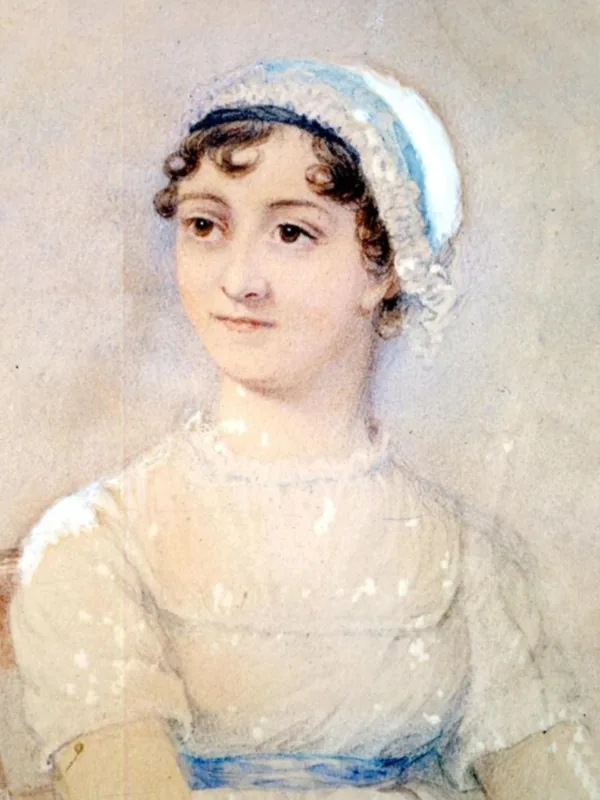

English novelist (1775–1817) whose six novels — including Pride and Prejudice and Emma — gave the novel its modern form through irony, free indirect discourse and the everyday life of the landed gentry.
Early Life
Jane Austen was born on 16 December 1775 at Steventon, Hampshire, the seventh of eight children of the Reverend George Austen, rector of Steventon, and Cassandra Leigh. She grew up in a lively, book-filled household, was briefly sent to boarding schools in Oxford, Southampton and Reading, and was otherwise educated at home, reading widely in her father's library. As a teenager she wrote comic stories, plays and parodies — her juvenilia — and by her early twenties she had drafted the first versions of three of her major novels. In 1801 her father retired and moved the family to Bath; he died in 1805, and after four unsettled years in Bath and Southampton, Jane, her sister Cassandra and their mother moved in 1809 into a cottage at Chawton, Hampshire, provided by her brother Edward.
Education
Austen had little formal schooling: short periods at boarding schools in Oxford, Southampton and Reading, and lessons at home. Most of her education came from her father's extensive library, her family's habit of reading aloud, and her own writing.
Career
Austen wrote the first version of Pride and Prejudice, then called First Impressions, between October 1796 and August 1797, and drafted Sense and Sensibility and Northanger Abbey in 1797–1799. None of it was published for years: a publisher rejected First Impressions, and Northanger Abbey, sold to a Bath publisher in 1803, was never issued. Publication finally came at Chawton. Sense and Sensibility appeared anonymously in 1811, Pride and Prejudice in 1813, Mansfield Park in 1814 and Emma in 1815, the last dedicated to the Prince Regent at his request. All four were published without her name, though her authorship was an open secret in literary circles. Her health failed in 1816; she began the satire Sanditon in January 1817, stopped work in March, and died at Winchester on 18 July 1817, aged 41. Persuasion and Northanger Abbey were published together posthumously in December 1817, with a biographical notice by her brother Henry that named her as their author for the first time.
Achievements
Austen's achievement was to take the novel of everyday life — courtship, money, family, social rank — and make it a vehicle for serious moral and psychological observation. Her ironic narration and her use of free indirect discourse, letting the reader hear a character's thoughts in the narrator's voice, shaped the modern novel. Pride and Prejudice, her best-known work, has never been out of print and is one of the most widely read novels in English. All six of her completed novels were written, revised or prepared for publication during the eight years she lived at Chawton, a burst of productivity that began when she was 35.
- Published four novels in her lifetime — Sense and Sensibility (1811), Pride and Prejudice (1813), Mansfield Park (1814) and Emma (1815) — all anonymously
- Wrote Pride and Prejudice, one of the most widely read and adapted novels in English literature
- Pioneered free indirect discourse and the ironic narrative voice that shaped the modern novel
- Completed six major novels, with Persuasion and Northanger Abbey published posthumously in December 1817
- Transformed the novel of manners into serious art, finding drama in the everyday life of the English landed gentry
Legacy
Austen won little fame in her lifetime, but her reputation grew steadily through the nineteenth century, helped by her nephew James Edward Austen-Leigh's Memoir of Jane Austen (1869). She is now regarded as one of the greatest English novelists, studied in schools and universities worldwide, and her novels have been adapted for stage, film and television more than almost any other author's. Her home at Chawton is preserved as Jane Austen's House museum.
Contributions
Austen gave the English novel its distinctly modern character: ordinary people in everyday situations, observed with irony and psychological precision, and narrated in a voice that slips between the author's judgement and the character's own thoughts. Her six novels established the novel of manners as a serious literary form and remain a model for the realist novel.
Notable Works
- Sense and Sensibility (1811)
- Pride and Prejudice (1813)
- Mansfield Park (1814)
- Emma (1815)
- Persuasion (1817, posthumous)
- Northanger Abbey (1817, posthumous)
- Sanditon (unfinished, begun 1817)
Milestones
- 1775 — Born on 16 December at Steventon, Hampshire, seventh of eight children of the Reverend George Austen Source: Encyclopaedia Britannica
- 1796 — Completed the first version of Pride and Prejudice, then called First Impressions, between October 1796 and August 1797 Source: Encyclopaedia Britannica
- 1809 — Moved with her mother and sister Cassandra to a cottage at Chawton, Hampshire, where she lived for the rest of her life Source: Encyclopaedia Britannica
- 1811 — Sense and Sensibility published anonymously — her first published novel Source: Encyclopaedia Britannica
- 1813 — Pride and Prejudice published Source: Encyclopaedia Britannica
- 1814 — Mansfield Park published Source: Encyclopaedia Britannica
- 1815 — Emma published, dedicated to the Prince Regent Source: Encyclopaedia Britannica
- 1817 — Died on 18 July at Winchester, aged 41; Persuasion and Northanger Abbey published posthumously in December 1817 Source: Encyclopaedia Britannica
Timeline
- 16 December 1775
Born at Steventon, Hampshire, England
Source: Encyclopaedia Britannica - 1796
Wrote the first version of Pride and Prejudice (as First Impressions)
Year only — exact date unknown Source: Encyclopaedia Britannica - 1801
Family moved to Bath after her father's retirement
Year only — exact date unknown Source: Encyclopaedia Britannica - 1809
Moved to Chawton Cottage, Hampshire
Year only — exact date unknown Source: Encyclopaedia Britannica - 1811
Sense and Sensibility published anonymously
Year only — exact date unknown Source: Encyclopaedia Britannica - 1813
Pride and Prejudice published
Year only — exact date unknown Source: Encyclopaedia Britannica - 1815
Emma published
Year only — exact date unknown Source: Encyclopaedia Britannica - 1817-01
Began Sanditon, left unfinished as her health failed
Approximate date Source: Encyclopaedia Britannica - 18 July 1817
Died at Winchester, Hampshire, aged 41; buried in Winchester Cathedral
Source: Encyclopaedia Britannica - 1817-12
Persuasion and Northanger Abbey published posthumously, with her name revealed by her brother Henry
Approximate date Source: Encyclopaedia Britannica
In Their Words
“It is a truth universally acknowledged, that a single man in possession of a good fortune, must be in want of a wife.” Source: Pride and Prejudice (1813), opening sentence; quoted in Encyclopaedia Britannica — The opening line of Pride and Prejudice.
Related Personalities
Frequently Asked Questions
Who was Jane Austen?
Jane Austen (1775–1817) was an English novelist, the author of six major novels including Sense and Sensibility, Pride and Prejudice, Mansfield Park, Emma, Persuasion and Northanger Abbey. She is regarded as one of the greatest English novelists and a founder of the modern novel of manners.
Source: Encyclopaedia BritannicaWhat did Jane Austen write?
Jane Austen wrote six major novels: Sense and Sensibility (1811), Pride and Prejudice (1813), Mansfield Park (1814), Emma (1815), Northanger Abbey (1817) and Persuasion (1817). Pride and Prejudice is one of the most widely read and adapted novels in English literature.
Source: Encyclopaedia BritannicaWhy were Jane Austen's novels published anonymously?
Like many women writers of her time, Austen published without her name on the title page — her books were credited only 'By a Lady' or to the author of the previous novel. Her authorship was an open secret in literary circles, and her name was first attached to her work in 1817.
Source: Encyclopaedia Britannica ; Wikipedia (Jane Austen)How did Jane Austen die?
Austen died on 18 July 1817 at Winchester, Hampshire, aged 41, after a period of declining health that began in early 1816. The exact cause of her illness is not known; modern medical writers have proposed Addison's disease, Hodgkin's disease or lupus, but none of these can be confirmed.
Source: Encyclopaedia BritannicaWhere did Jane Austen live and write?
She was born at Steventon, Hampshire, where her father was rector, lived in Bath from 1801 to 1806, and spent the last eight years of her life (1809–1817) at Chawton Cottage in Hampshire, where she wrote, revised and prepared all six of her novels for publication. The cottage is now Jane Austen's House museum.
Source: Encyclopaedia Britannica ; Wikipedia (Jane Austen)Sources & References
- Jane Austen — Encyclopaedia Britannica — Encyclopaedia Britannica (accessed 12 November 2026)
- Jane Austen — 1911 Encyclopaedia Britannica (Wikisource) — Wikisource (accessed 12 November 2026)
- Jane Austen — Wikipedia (cross-check) — Wikipedia (accessed 12 November 2026)
- File:Cassandra Austen-Jane Austen(c.1810).jpg — Wikimedia Commons (portrait file page) — Wikimedia Commons (accessed 12 November 2026)
Explore More
- More Writers & Authors
- Personalities from United Kingdom
- More novelists
- More writers
- Famous people born in December
- Browse all personalities
Featured on these lists: