Guglielmo Marconi
Inventor · Electrical engineer · Entrepreneur
1874–1937 · Born in Bologna, Italy · 4 min read
- Verified: 13 November 2026
- Sources: 5
- Independently reviewed
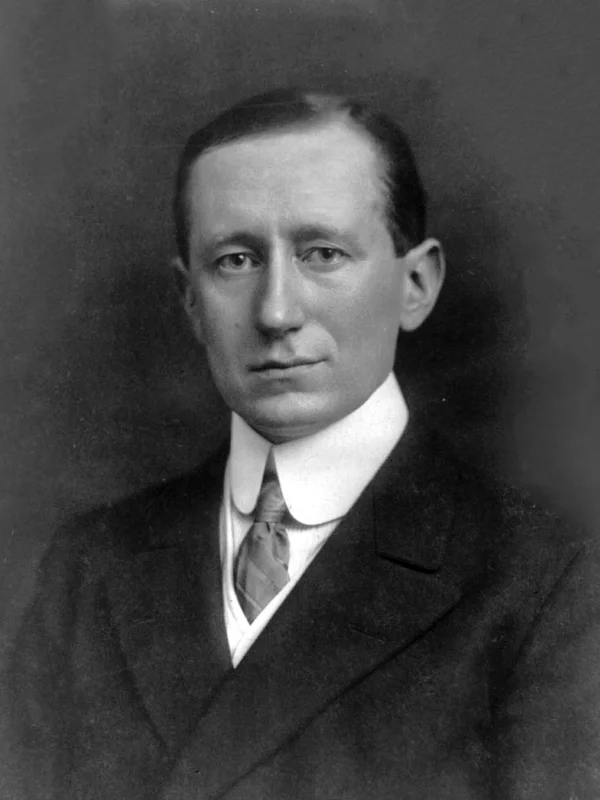

Italian inventor who built the first practical wireless telegraph, sent the first transatlantic radio signal in 1901, and shared the 1909 Nobel Prize in Physics.
Early Life
Guglielmo Marconi was born on 25 April 1874 in Bologna, Italy, the second son of Giuseppe Marconi, an Italian landowner, and Annie Jameson, an Irishwoman from the family that founded the Jameson whiskey distillery. He was educated privately and at a technical institute in Livorno, and he attended physics lectures by Augusto Righi at the University of Bologna, but he took no degree. As a young man he read about Heinrich Hertz's discovery of radio waves, and in 1894 he began experiments in the attic of his family's villa at Pontecchio, near Bologna, building a transmitter and receiver that could ring a bell across a room.
Education
Marconi was educated by private tutors and at a technical school in Livorno. He attended lectures in physics at the University of Bologna, where he studied the work of Augusto Righi on electromagnetic waves, but he never took a university degree. His education was largely practical, carried out in his own workshop, and he later said in his Nobel lecture that he had little formal scientific training.
Career
Marconi began experimenting with radio waves as a teenager at his family's villa near Bologna, after reading about Hertz's experiments. Finding little support in Italy, he moved to England in 1896, where he patented his wireless telegraph system and demonstrated it to the Post Office and the Royal Navy. In 1897 he founded the Wireless Telegraph & Signal Company in London, later the Marconi Company, and built stations on both sides of the Atlantic. The transatlantic signal of December 1901 made him world-famous, though some scientists doubted it at the time. Wireless telegraphy spread rapidly to ships, and in 1909 the rescue of passengers from the liner Republic, whose distress calls were sent by wireless, showed its value at sea. Marconi became a senator in Italy, served in the First World War, and in the 1920s turned to shortwave transmission, which proved far more efficient than the long waves he had used before. He died in Rome in 1937.
Achievements
Marconi's central achievement was to turn laboratory radio waves into a working communication system. Building on the experiments of Heinrich Hertz, he built transmitters and receivers that sent Morse code through the air, first over a few metres and then over kilometres. In 1896 he filed his British patent, in 1897 he founded the Wireless Telegraph & Signal Company, and in 1899 he sent signals across the English Channel. His best-known feat came on 12 December 1901, when he reported receiving the Morse letter S across the Atlantic, from Poldhu in Cornwall to Signal Hill in Newfoundland. In 1909 he shared the Nobel Prize in Physics with Karl Ferdinand Braun. His later work on shortwave radio became the basis of nearly all modern long-distance radio, and his system gave ships a way to call for help at sea.
- Built the first practical wireless telegraph system, sending Morse signals through the air without wires
- Received the first transatlantic radio signal on 12 December 1901, the letter S sent from Cornwall to Newfoundland
- Founded the Wireless Telegraph & Signal Company in London in 1897, the first company built around radio
- Filed the famous British patent 7777 in 1900 for tuned wireless telegraphy, letting stations work on different wavelengths
- Shared the 1909 Nobel Prize in Physics with Karl Ferdinand Braun for contributions to wireless telegraphy
- Sent the first signals across the English Channel in 1899, linking Dover and Wimereux
- Pioneered shortwave wireless communication in the 1920s, the basis of nearly all modern long-distance radio
Legacy
Marconi is remembered as the inventor who made radio a practical reality. Others discovered radio waves, but Marconi built the first system that sent messages over long distances without wires, organised the companies, stations and operators that ran it, and proved it at sea and across the Atlantic. Radio grew from his wireless telegraphy into broadcasting, navigation and, eventually, television and mobile communication. The Nobel Prize he shared in 1909 recognised wireless telegraphy as a new branch of physics and engineering. His name is still attached to the Marconi Company and to the radio stations and awards that followed him, and the 1901 transatlantic signal is remembered as the moment the world became connected without wires.
Contributions
Marconi's contribution was to make radio waves useful. Hertz had shown that radio waves existed, but they were a laboratory curiosity; Marconi built transmitters, receivers and aerials that sent Morse signals over hills, across the Channel and finally across the Atlantic. He also built the business around the invention, with patents, stations, trained operators and shipping contracts, so that wireless telegraphy became a service rather than an experiment. That service saved lives at sea, carried news across oceans, and became the foundation of broadcasting and of all modern wireless communication, from radio and television to mobile phones.
Notable Works
- Wireless telegraph system (1896)
- British patent 12039 for wireless telegraphy (1897)
- Wireless Telegraph & Signal Company, founded 1897
- First transatlantic radio signal (1901)
- British patent 7777 for tuned wireless telegraphy (1900)
- Shortwave wireless communication (1920s)
Milestones
- 1874 — Born on 25 April in Bologna, Italy Source: Encyclopaedia Britannica
- 1894 — Began experimenting with radio waves near Bologna Source: ThoughtCo
- 1895 — Sent radio signals over a hill, the first wireless signals over distance Source: NobelPrize.org
- 1896 — Moved to England and filed a British patent for wireless telegraphy Source: Encyclopaedia Britannica
- 1897 — Received British patent 12039 and founded the Wireless Telegraph & Signal Company Source: Encyclopaedia Britannica
- 1899 — Sent the first wireless signals across the English Channel Source: Encyclopaedia Britannica
- 1900 — Filed British patent 7777 for tuned wireless telegraphy Source: ThoughtCo
- 1901 — Reported the first transatlantic radio signal on 12 December Source: Encyclopaedia Britannica; NobelPrize.org
- 1909 — Shared the Nobel Prize in Physics with Karl Ferdinand Braun Source: NobelPrize.org
- 1909 — Wireless distress calls from the Republic helped save her passengers Source: ThoughtCo
- 1912 — Wireless telegraphy from the Titanic brought rescue ships to the scene Source: ThoughtCo
- 1930 — Became president of the Royal Academy of Italy Source: Wikipedia
- 1937 — Died on 20 July in Rome, aged 63 Source: Encyclopaedia Britannica
Timeline
- 25 April 1874
Born in Bologna, Italy, to Giuseppe Marconi and Annie Jameson
Source: Encyclopaedia Britannica; NobelPrize.org - 1894
Began experimenting with radio waves at his family's villa near Bologna
Year only — exact date unknown Source: Encyclopaedia Britannica; ThoughtCo - 1895
Sent radio signals over a hill near his home, the first wireless signals over distance
Year only — exact date unknown Source: NobelPrize.org; ThoughtCo - 1896
Moved to England and filed a British patent for his wireless telegraph system
Year only — exact date unknown Source: Encyclopaedia Britannica - 1897
Received British patent 12039 and founded the Wireless Telegraph & Signal Company in London
Year only — exact date unknown Source: Encyclopaedia Britannica; ThoughtCo - 1899
Sent the first wireless signals across the English Channel, from Dover to Wimereux
Year only — exact date unknown Source: Encyclopaedia Britannica - 1900
Filed British patent 7777 for tuned wireless telegraphy
Year only — exact date unknown Source: Encyclopaedia Britannica; ThoughtCo - 12 December 1901
Reported receiving the first transatlantic radio signal, the letter S, at Signal Hill, Newfoundland
Source: Encyclopaedia Britannica; NobelPrize.org - 1909
Shared the Nobel Prize in Physics with Karl Ferdinand Braun
Year only — exact date unknown Source: NobelPrize.org; Encyclopaedia Britannica - 1909-01
Wireless distress calls from the liner Republic helped rescuers save her passengers
Approximate date Source: Encyclopaedia Britannica; ThoughtCo - 1912
Wireless telegraphy from the Titanic brought rescue ships to the scene after she struck an iceberg
Year only — exact date unknown Source: Encyclopaedia Britannica; ThoughtCo - 1930
Became president of the Royal Academy of Italy
Year only — exact date unknown Source: Wikipedia - 20 July 1937
Died in Rome, Italy, aged 63
Source: Encyclopaedia Britannica; NobelPrize.org
Related Personalities
Frequently Asked Questions
Who was Guglielmo Marconi?
Guglielmo Marconi (1874–1937) was an Italian inventor and electrical engineer who built the first practical wireless telegraph system, the ancestor of radio. He sent Morse signals through the air without wires, first over short distances and then, in 1901, across the Atlantic Ocean. In 1909 he shared the Nobel Prize in Physics for his contributions to wireless telegraphy.
Source: Encyclopaedia Britannica ; NobelPrize.orgDid Marconi invent radio?
Marconi did not discover radio waves; Heinrich Hertz had shown they existed in the 1880s. What Marconi did was build the first practical system for sending messages with them, combining a transmitter, a receiver and an aerial into a wireless telegraph that sent Morse code through the air.
He also organised the patents, stations and companies that turned it into a working service for ships, governments and news agencies.
Source: Encyclopaedia Britannica ; NobelPrize.orgWhat happened in Marconi's transatlantic experiment of 1901?
On 12 December 1901 Marconi reported receiving the Morse letter S, three dots, at Signal Hill in St. John's, Newfoundland, sent from a transmitter at Poldhu in Cornwall, England, more than 3,000 kilometres away. It was the first reported radio signal across the Atlantic Ocean.
Some scientists doubted the faint signal at the time, but Marconi's later transatlantic wireless service proved long-distance radio worked.
Source: Encyclopaedia Britannica ; NobelPrize.orgWhy did Marconi win the Nobel Prize in 1909?
Marconi shared the 1909 Nobel Prize in Physics with the German physicist Karl Ferdinand Braun, in recognition of their contributions to the development of wireless telegraphy. Braun's tuned circuits made it possible for stations to transmit and receive on particular wavelengths without interfering with each other.
That tuning was essential for reliable radio, and Marconi's share recognised his practical system and its long-distance achievements.
Source: NobelPrize.org ; Encyclopaedia BritannicaHow did Marconi's wireless telegraphy save lives at sea?
Wireless telegraphy gave ships a way to call for help at sea, where no telegraph cable could reach them. In January 1909 the liner Republic sent a wireless distress call after a collision off Massachusetts, and rescue ships reached her in time to save most of her passengers.
Three years later, wireless calls from the Titanic brought rescue ships to the scene, and the disaster led to rules requiring ships to keep a wireless watch at all times.
Source: Encyclopaedia Britannica ; ThoughtCoWhat is Marconi's legacy today?
Marconi's work on shortwave radio in the 1920s became the basis of nearly all modern long-distance radio. Short waves, reflected by the upper atmosphere, travel much further than long waves with far less power, which made international broadcasting, long-distance telephony and later shortwave services practical.
His wireless telegraphy also grew into radio broadcasting, television and mobile communication, all of which use the radio waves he first put to work.
Source: Encyclopaedia Britannica ; NobelPrize.orgSources & References
- Guglielmo Marconi — Encyclopaedia Britannica — Encyclopaedia Britannica (accessed 13 November 2026)
- Guglielmo Marconi — Facts (Nobel Prize in Physics 1909) — NobelPrize.org (accessed 13 November 2026)
- Guglielmo Marconi — Wikipedia — Wikipedia (accessed 13 November 2026)
- Biography of Guglielmo Marconi, Italian Inventor — ThoughtCo (accessed 13 November 2026)
- File:Guglielmo Marconi.jpg — Wikimedia Commons (portrait file page) — Wikimedia Commons (accessed 13 November 2026)
Explore More
- More Scientists & Inventors
- Personalities from Italy
- Personalities from United Kingdom
- More inventors
- More electrical engineers
- More entrepreneurs
- Famous people born in April
- Browse all personalities
Featured on these lists: