Alexander Graham Bell
Inventor · Engineer · Scientist
1847–1922 · Born in Edinburgh, Scotland · 3 min read
- Verified: 13 November 2026
- Sources: 5
- Independently reviewed
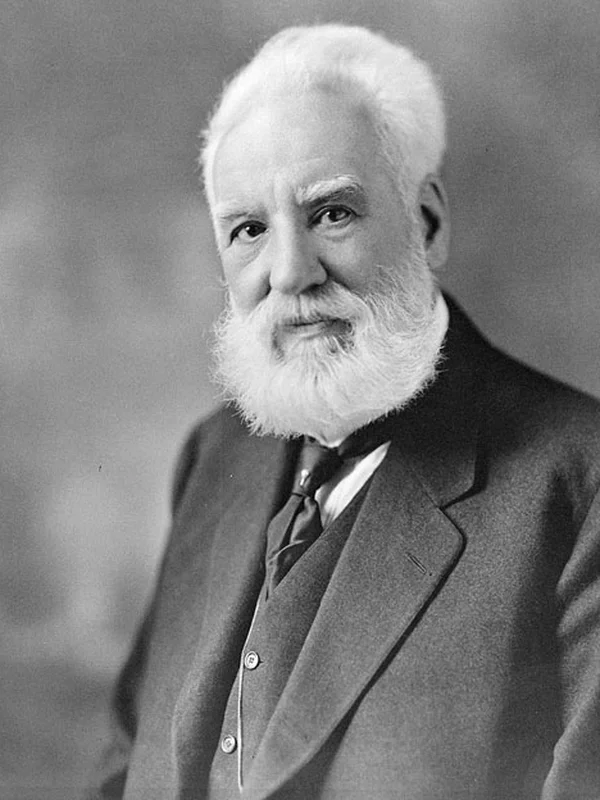

Scottish-born inventor who patented the first practical telephone in 1876, co-founded the Bell Telephone Company, and helped found the journal Science and the National Geographic Society.
Early Life
Alexander Bell was born on 3 March 1847 in Edinburgh, Scotland, to Alexander Melville Bell, a teacher of elocution, and Eliza Grace Bell. The name Graham was added when he was eleven. Both his mother and his wife were deaf, and his father and grandfather worked on speech and elocution, which shaped his lifelong interest in sound and hearing. He was educated in Edinburgh, at the Royal High School and the University of Edinburgh, and his family moved to London in 1865. After the deaths of his two brothers from tuberculosis, the family emigrated to Canada in 1870, settling near Brantford, Ontario.
Education
Bell was educated at the Royal High School in Edinburgh and attended the University of Edinburgh, where he studied subjects including anatomy and physiology. He did not take a degree. His real training was in his father's system of visible speech, a method of teaching the deaf to speak by showing the positions of the lips, tongue and throat for each sound.
Career
Bell's career began in teaching the deaf. He taught his father's visible-speech system in Britain, moved with his family to Canada in 1870, and in 1871 went to Boston to teach at the Boston School for Deaf Mutes. In 1873 he became professor of vocal physiology at Boston University. His work on speech led him to experiment with transmitting sound electrically, first through a harmonic telegraph and then through the telephone. After the telephone patent of 1876 and the founding of the Bell Telephone Company in 1877, he continued to invent at the Volta Laboratory in Washington, D.C., working on the phonograph, the photophone, the audiometer and a metal detector used in an attempt to locate the bullet in the assassinated President Garfield. In later life he experimented with tetrahedral kites, hydrofoils and aviation through the Aerial Experiment Association, founded in 1907. He became a United States citizen in 1882 and spent his later years at Beinn Bhreagh, his estate in Nova Scotia, where he died in 1922.
Achievements
Bell's central achievement was the telephone, patented in 1876. His experiments with a multiple telegraph led him to a device that turned the vibrations of speech into electrical undulations and back into sound, and on 10 March 1876 he spoke the first intelligible sentence over a wire to his assistant Thomas Watson. The Bell Telephone Company, founded in 1877, carried the invention into homes and businesses, and by 1886 more than 150,000 people in the United States owned telephones. Bell's other inventions included the photophone of 1880, which transmitted speech on light, and an improved phonograph using wax cylinders. He also helped found the journal Science and the National Geographic Society, which he led as president from 1898 to 1903, and he served as a regent of the Smithsonian Institution.
- Patented the first practical telephone in 1876, turning speech into electrical signals that could travel along a wire
- Spoke the first intelligible sentence by telephone on 10 March 1876: 'Watson, come here, I want you'
- Co-founded the Bell Telephone Company in 1877, the ancestor of the modern telephone industry
- Invented the photophone in 1880, which sent speech on a beam of light, a forerunner of fibre-optic communication
- Improved the phonograph with a wax-coated cylinder in 1886, making sound recording practical
- Helped found the journal Science in 1883 and was a founder of the National Geographic Society in 1888, serving as its president from 1898 to 1903
- Founded the Volta Laboratory in Washington, D.C., in 1880, where he worked on the phonograph, the audiometer and aids for the deaf
Legacy
Bell is remembered as the inventor of the telephone, the device that made instant voice communication over distance part of everyday life. The telephone network built on his patent grew into the modern communications system, and his photophone anticipated communication by light. His work for the deaf, including the founding of the Alexander Graham Bell Association for the Deaf and Hard of Hearing, continued after his death. The unit of sound intensity, the bel, and its tenth, the decibel, were named in his honour. His papers are held by the Library of Congress, and his Nova Scotia home, Beinn Bhreagh, is preserved as the Alexander Graham Bell National Historic Site.
Contributions
Bell's contribution was to make the human voice travel by wire. Others had sent coded signals by telegraph, but Bell's telephone carried speech itself, turning sound into electrical undulations and back again. That single change made it possible for people to talk to each other across towns, countries and eventually continents in real time. His photophone, which carried speech on a beam of light, pointed towards a second revolution, optical communication, that arrived a century later. Alongside the inventions, his teaching of the deaf and his support for the journal Science and the National Geographic Society spread scientific knowledge to a wide public.
Notable Works
- The telephone (patented 1876)
- The photophone (1880)
- Improved phonograph with wax cylinder (1886)
- Bell Telephone Company, co-founded 1877
- The journal Science, founded 1883
- National Geographic Society, co-founded 1888
Milestones
- 1847 — Born on 3 March in Edinburgh, Scotland Source: Encyclopaedia Britannica
- 1870 — Emigrated with his family to Canada Source: Encyclopaedia Britannica
- 1871 — Went to Boston to teach visible speech to the deaf Source: Encyclopaedia Britannica
- 1873 — Became professor of vocal physiology at Boston University Source: Wikipedia
- 1876 — Filed the telephone patent application on 14 February; received patent 174,465 on 7 March Source: Encyclopaedia Britannica; Wikipedia
- 1876 — Spoke the first intelligible sentence by telephone to Thomas Watson on 10 March Source: Encyclopaedia Britannica
- 1877 — Co-founded the Bell Telephone Company Source: Encyclopaedia Britannica
- 1880 — Invented the photophone and founded the Volta Laboratory Source: Encyclopaedia Britannica; Linda Hall Library
- 1882 — Became a United States citizen Source: Encyclopaedia Britannica
- 1883 — Helped found the journal Science Source: Linda Hall Library
- 1888 — Co-founded the National Geographic Society Source: Linda Hall Library
- 1898 — Became president of the National Geographic Society and a Smithsonian regent Source: Linda Hall Library
- 1915 — Made the first ceremonial transcontinental telephone call Source: Wikipedia
- 1922 — Died on 2 August at Beinn Bhreagh, Nova Scotia, aged 75 Source: Encyclopaedia Britannica
Timeline
- 3 March 1847
Born in Edinburgh, Scotland, to Alexander Melville Bell and Eliza Grace Bell
Source: Encyclopaedia Britannica; Wikipedia - 1870
Emigrated with his family to Canada, settling near Brantford, Ontario
Year only — exact date unknown Source: Encyclopaedia Britannica - 1871
Went to Boston to teach visible speech at the Boston School for Deaf Mutes
Year only — exact date unknown Source: Encyclopaedia Britannica - 1873
Became professor of vocal physiology at Boston University
Year only — exact date unknown Source: Encyclopaedia Britannica; Wikipedia - 14 February 1876
Filed his telephone patent application, hours before Elisha Gray filed a caveat for a similar device
Source: Encyclopaedia Britannica; Wikipedia - 7 March 1876
Received United States patent 174,465 for the telephone
Source: Encyclopaedia Britannica; Wikipedia - 10 March 1876
Spoke the first intelligible sentence by telephone to Thomas Watson: 'Watson, come here, I want you'
Source: Encyclopaedia Britannica; Wikipedia - 1877
Co-founded the Bell Telephone Company; married Mabel Hubbard
Year only — exact date unknown Source: Encyclopaedia Britannica; Wikipedia - 1880
Invented the photophone with Charles Sumner Tainter and founded the Volta Laboratory in Washington, D.C.
Year only — exact date unknown Source: Encyclopaedia Britannica; Linda Hall Library - 1882
Became a United States citizen
Year only — exact date unknown Source: Encyclopaedia Britannica - 1883
Helped found the journal Science
Year only — exact date unknown Source: Linda Hall Library; Encyclopaedia Britannica - 1888
Co-founded the National Geographic Society
Year only — exact date unknown Source: Linda Hall Library; Encyclopaedia Britannica - 1898
Became president of the National Geographic Society and a regent of the Smithsonian Institution
Year only — exact date unknown Source: Linda Hall Library - 1915-01
Made the first ceremonial transcontinental telephone call, from New York to Thomas Watson in San Francisco
Approximate date Source: Wikipedia; Encyclopaedia Britannica - 2 August 1922
Died at Beinn Bhreagh, Nova Scotia, Canada, aged 75
Source: Encyclopaedia Britannica; Linda Hall Library
Related Personalities
Frequently Asked Questions
Who was Alexander Graham Bell?
Alexander Graham Bell (1847–1922) was a Scottish-born inventor, scientist and teacher of the deaf, best known for patenting the first telephone in 1876. Born in Edinburgh, he worked in Scotland, Canada and the United States, and his research into speech and hearing led directly to the telephone. He also co-founded the Bell Telephone Company and helped found the journal Science.
Source: Encyclopaedia Britannica ; WikipediaWhat did Alexander Graham Bell invent, and when?
Bell patented the telephone in 1876 after years of research into speech and hearing, work shaped by the fact that his mother and wife were both deaf. He filed his patent application on 14 February 1876 and received United States patent 174,465 on 7 March 1876.
On 10 March 1876 he spoke the first intelligible sentence by telephone to his assistant, Thomas Watson.
Source: Encyclopaedia Britannica ; WikipediaDid Bell really invent the telephone, or did Elisha Gray?
Bell filed his telephone patent application on 14 February 1876, just hours before Elisha Gray filed a caveat describing a similar device. The Patent Office awarded the patent to Bell on 7 March 1876, and Gray challenged it in the courts, without success.
Earlier experimenters such as Antonio Meucci and Philipp Reis had also worked on transmitting speech electrically, so Bell is credited with the first practical patented telephone rather than with the idea alone.
Source: Encyclopaedia Britannica ; WikipediaWhat were the first words spoken on the telephone?
Bell's first words by telephone were spoken on 10 March 1876 to his assistant Thomas Watson, in the next room: 'Watson, come here, I want you.' The sentence is often quoted in slightly different forms, but the meaning is the same, and it was the first intelligible sentence transmitted by telephone.
Watson heard it clearly through the receiver and came to Bell's room.
Source: Encyclopaedia Britannica ; WikipediaWhat was Bell's photophone?
The photophone, invented by Bell in 1880 with Charles Sumner Tainter, sent speech on a beam of light instead of along a wire. A vibrating mirror varied the light, and a selenium cell at the other end turned it back into sound.
Bell called it his greatest invention, and although it had no practical use at the time, it was a forerunner of fibre-optic communication, which also carries information on light.
Source: Encyclopaedia Britannica ; Linda Hall LibraryWhat did Bell do besides inventing the telephone?
Bell helped found the journal Science in 1883, which later became the official journal of the American Association for the Advancement of Science. In 1888 he was one of the founders of the National Geographic Society and served as its president from 1898 to 1903, shaping its magazine into an illustrated publication for general readers.
He also served as a regent of the Smithsonian Institution from 1898 until his death.
Source: Linda Hall Library ; Encyclopaedia BritannicaSources & References
- Alexander Graham Bell — Encyclopaedia Britannica — Encyclopaedia Britannica (accessed 13 November 2026)
- Alexander Graham Bell — Wikipedia — Wikipedia (accessed 13 November 2026)
- Alexander Graham Bell — Scientist of the Day — Linda Hall Library (accessed 13 November 2026)
- Alexander Graham Bell — New World Encyclopedia — New World Encyclopedia (accessed 13 November 2026)
- File:Alexander Graham Bell.jpg — Wikimedia Commons (portrait file page) — Wikimedia Commons (accessed 13 November 2026)
Explore More
- More Scientists & Inventors
- Personalities from United Kingdom
- Personalities from United States
- Personalities from Canada
- More inventors
- More engineers
- More scientists
- Famous people born in March
- Browse all personalities
Featured on these lists: