Thomas Edison
Inventor · Businessman · Electrical engineer
1847–1931 · Born in Milan, Ohio, United States · 3 min read
- Verified: 13 November 2026
- Sources: 4
- Independently reviewed
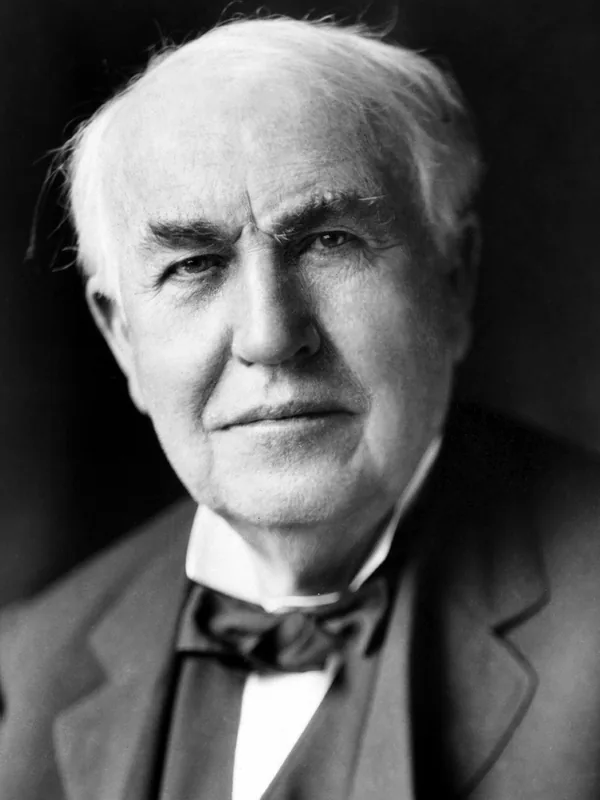

American inventor who held 1,093 US patents, including the phonograph and a practical incandescent lamp, and built the first commercial electric power system.
Early Life
Thomas Alva Edison was born on 11 February 1847 in Milan, Ohio, the seventh and last child of Samuel and Nancy Edison. The family moved to Port Huron, Michigan, when he was a child. He received only a few months of formal schooling and was largely taught at home by his mother, learning through reading and experiment. As a boy he worked on the railways, where he learned telegraphy, and he began his career as a telegraph operator in 1863.
Education
Edison had little formal schooling. He was educated mainly at home by his mother and taught himself through reading, experiment and his work as a telegraph operator.
Career
Edison began work as a telegraph operator in 1863 and received his first patent, for an electric vote recorder, in 1869. He moved his work to Menlo Park, New Jersey, in 1876, where he built the first industrial research laboratory. There he developed the carbon-button transmitter for the telephone in 1877 and unveiled the tinfoil phonograph in December 1877. In 1878 he turned to electric lighting, and in October 1879 his laboratory produced a durable incandescent lamp; he filed the patent in November 1879 and it was granted in January 1880. In September 1882 his Pearl Street station began supplying electricity to customers in lower Manhattan. In 1886 he married Mina Miller and built a larger laboratory at West Orange, New Jersey, where his team developed the commercial phonograph, motion-picture equipment and the alkaline storage battery. Edison General Electric, formed in 1889, merged into the General Electric Company in 1892.
Achievements
Edison's achievements were built on systems rather than single devices. The phonograph of 1877 was the first machine that could record and play back sound. His incandescent lamp of 1879 only mattered because he also built the generators, wiring, switches and meters around it: the Pearl Street station in lower Manhattan, opened in September 1882, was the first permanent commercial central power system. He held 1,093 US patents, and his Menlo Park laboratory, founded in 1876, became the model for the industrial research laboratory. In the early 1890s his laboratory also developed the kinetograph camera and the kinetoscope viewer, early steps toward the motion-picture industry.
- Held 1,093 US patents, a record for a single inventor, covering electric light and power, sound recording, telegraphy, telephony and storage batteries
- Invented the phonograph in 1877, the first device able to record and reproduce sound
- Developed a commercially practical incandescent lamp in 1879 and the first permanent commercial central power system, opened at Pearl Street, New York, in September 1882
- Created the world's first industrial research laboratory at Menlo Park, New Jersey, in 1876
- Led the early development of motion-picture technology, including the kinetograph camera and the kinetoscope viewer
Legacy
Edison is remembered as America's most prolific inventor and as the man who made electric light a practical, everyday service rather than a laboratory curiosity. His Menlo Park laboratory set the pattern for organised industrial research, with teams of specialists working under one roof. His promotion of direct current against the alternating current systems of George Westinghouse and Nikola Tesla, a commercial rivalry known as the War of the Currents, ended with alternating current becoming the standard for long-distance power distribution. His work on sound recording and motion pictures also helped create two new industries.
Contributions
Edison's central contribution was the industrial research laboratory and the complete system: he did not only invent a lamp, he built the power station, the distribution network and the meters that made electric lighting a service people could buy. The same approach shaped the phonograph and early motion-picture equipment, where his laboratory combined invention, manufacturing and marketing.
Notable Works
- Phonograph (1877)
- Carbon-button telephone transmitter (1877)
- Practical incandescent lamp and electric lighting system (1879)
- Pearl Street central power station (1882)
- Kinetograph camera and kinetoscope (early 1890s)
- Alkaline storage battery
Milestones
- 1847 — Born on 11 February in Milan, Ohio, United States Source: Encyclopaedia Britannica
- 1863 — Began his career as a telegraph operator Source: Encyclopaedia Britannica
- 1869 — Received his first patent, for an electric vote recorder Source: Wikipedia (Thomas Edison)
- 1876 — Established the first industrial research laboratory at Menlo Park, New Jersey Source: Encyclopaedia Britannica
- 1877 — Unveiled the phonograph and developed the carbon-button telephone transmitter Source: Encyclopaedia Britannica
- 1879 — Produced a durable incandescent lamp and filed the electric-lamp patent Source: Encyclopaedia Britannica; Wikipedia (Thomas Edison)
- 1882 — Pearl Street station opened, the first permanent commercial central power system Source: Encyclopaedia Britannica
- 1886 — Married Mina Miller and built the West Orange laboratory Source: Encyclopaedia Britannica
- 1892 — Edison General Electric merged into the General Electric Company Source: Wikipedia (Thomas Edison)
- 1931 — Died in West Orange, New Jersey Source: Encyclopaedia Britannica
Timeline
- 11 February 1847
Born in Milan, Ohio, United States
Source: Encyclopaedia Britannica - 1863
Began his career as a telegraph operator
Year only — exact date unknown Source: Encyclopaedia Britannica - 1869
Received his first patent, for an electric vote recorder
Year only — exact date unknown Source: Wikipedia (Thomas Edison) - 1876
Established the first industrial research laboratory at Menlo Park, New Jersey
Year only — exact date unknown Source: Encyclopaedia Britannica - 1877-12
Unveiled the tinfoil phonograph, the first device to record and reproduce sound
Approximate date Source: Encyclopaedia Britannica - 1879-10
Laboratory produced a durable incandescent lamp; the patent was filed in November 1879 and granted in January 1880
Approximate date Source: Encyclopaedia Britannica; Wikipedia (Thomas Edison) - 1882-09
Pearl Street station in lower Manhattan began supplying electricity to customers, the first permanent commercial central power system
Approximate date Source: Encyclopaedia Britannica - 1886
Married Mina Miller and built a new laboratory at West Orange, New Jersey
Year only — exact date unknown Source: Encyclopaedia Britannica - 1892
Edison General Electric merged into the General Electric Company
Year only — exact date unknown Source: Wikipedia (Thomas Edison) - 18 October 1931
Died in West Orange, New Jersey, aged 84
Source: Encyclopaedia Britannica
Related Personalities
Frequently Asked Questions
Who was Thomas Edison?
Thomas Edison was an American inventor and entrepreneur whose inventions included the electric light bulb, the phonograph and the motion picture camera. He created the world's first industrial research laboratory at Menlo Park, New Jersey, in 1876. He held 1,093 US patents, more than any other individual of his time.
Source: Encyclopaedia BritannicaDid Thomas Edison invent the light bulb?
No. Earlier inventors had made incandescent lamps, but they were short-lived or impractical. Edison's achievement was a durable high-resistance lamp together with a complete system of generators, wiring and meters, demonstrated in 1879 and put into commercial service at Pearl Street in 1882.
Source: Encyclopaedia Britannica ; Wikipedia (Thomas Edison)What was the phonograph?
The phonograph, unveiled in December 1877, was the first device able to record sound and play it back. A stylus indented sound vibrations onto a cylinder wrapped in tinfoil, and the same stylus could reproduce the sound. It was the first success of its kind and the foundation of the recording industry.
Source: Encyclopaedia BritannicaHow many patents did Edison hold?
Edison held 1,093 US patents, more than any other individual of his time. He invented the phonograph in 1877, the first device able to record and reproduce sound. He developed a commercially practical incandescent lamp in 1879 and the first permanent commercial central power system.
Source: Encyclopaedia BritannicaWhy was Edison called the Wizard of Menlo Park?
The nickname came from his laboratory at Menlo Park, New Jersey, founded in 1876. The phonograph and the electric light made him world-famous, and the press presented him as a homespun genius working wonders in a small New Jersey town, though his laboratory was in fact a systematic, team-based operation.
Source: Encyclopaedia BritannicaSources & References
- Thomas Edison — Encyclopaedia Britannica — Encyclopaedia Britannica (accessed 12 November 2026)
- Thomas Edison — Menlo Park | Britannica — Encyclopaedia Britannica (accessed 12 November 2026)
- Thomas Edison — Wikipedia (cross-check) — Wikipedia (accessed 12 November 2026)
- File:Thomas Edison2-crop.jpg — Wikimedia Commons (portrait file page) — Wikimedia Commons (accessed 12 November 2026)
Explore More
- More Scientists & Inventors
- Personalities from United States
- More inventors
- More businessmans
- More electrical engineers
- Famous people born in February
- Browse all personalities
Featured on these lists: