Wolfgang Amadeus Mozart
Composer · Pianist · Violinist · Organist
1756–1791 · Born in Salzburg, Archbishopric of Salzburg (now Austria) · 4 min read
- Verified: 13 November 2026
- Sources: 3
- Independently reviewed
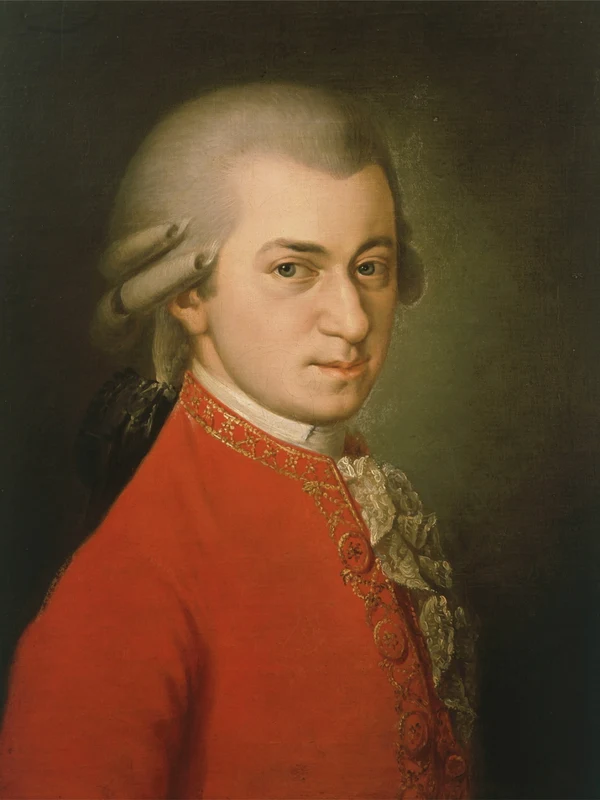

Austrian composer of the Classical era and child prodigy who wrote more than 600 works, including The Marriage of Figaro, Don Giovanni and The Magic Flute, before his death at 35.
Early Life
Wolfgang Amadeus Mozart was born on 27 January 1756 in Salzburg, in what is now Austria, the seventh child of Leopold Mozart, a violinist and composer in the service of the Prince-Archbishop of Salzburg, and Anna Maria Pertl Mozart. He was baptised Johannes Chrysostomus Wolfgangus Theophilus Mozart the following day. Of the couple's seven children, only Wolfgang and his elder sister Maria Anna survived infancy. He showed extraordinary musical ability from the age of three, playing the keyboard and composing short pieces by the age of five. His father, recognising the gift, devoted himself to his son's education and promotion. From 1762 the family toured Europe, exhibiting the two children as prodigies before royalty and the public, and the young Mozart absorbed the musical styles of every country he visited.
Education
Mozart received no formal schooling. His education was directed by his father Leopold, who taught him keyboard, violin and composition, and by the musicians he met on the family's tours. In London in 1764-65 he studied with Johann Christian Bach, the youngest son of Johann Sebastian Bach, whose graceful style influenced his early symphonies. In Italy in 1770 he studied counterpoint with Padre Giovanni Battista Martini in Bologna and passed the examination for admission to the Accademia Filarmonica at the age of fourteen. He also learned from the operas he heard in Italy and from the Mannheim orchestra, whose dynamic effects shaped his orchestral writing. His education was therefore practical and European in scope: lessons, travel, performance and constant composition.
Career
Mozart's professional career began as a child prodigy touring Europe with his father Leopold and his sister Maria Anna, known as Nannerl. Between 1762 and 1773 the family toured the courts of Munich, Vienna, Paris, London, The Hague and Italy, where the young Mozart met Johann Christian Bach in London and studied counterpoint with Padre Giovanni Battista Martini in Bologna. In 1772 he was appointed concertmaster at the Salzburg court, and in 1779 he became court organist, but he found the position restrictive. In 1781, after a quarrel with Archbishop Colloredo, he left Salzburg service and settled in Vienna as a freelance musician, supporting himself by teaching, composing on commission and giving subscription concerts. The Vienna years produced his great operas, the late piano concertos and the final symphonies. His last year, 1791, was extraordinarily productive: The Magic Flute, La clemenza di Tito, the Clarinet Concerto and the Requiem, which he left unfinished when he fell ill in the autumn and died on 5 December.
Achievements
Mozart's achievement was the sheer range and quality of his output: more than 600 works in every form of his time, composed in a career of barely thirty years. His operas The Marriage of Figaro, Don Giovanni, Così fan tutte and The Magic Flute remain central to the operatic repertoire, and his last three symphonies, written in 1788, are among the greatest in the form. His piano concertos, written largely for his own performances in Vienna, reshaped the concerto, and his string quartets and quintets set a standard for chamber music. He also wrote major sacred music, including the unfinished Requiem and the Mass in C minor. Few composers have matched his combination of melodic invention, structural mastery and dramatic instinct, and his music has remained continuously performed since his death.
- Composed his first symphony at the age of eight in 1764
- Wrote his first opera, La finta semplice, at the age of twelve in 1768
- Appointed concertmaster to the Archbishop of Salzburg in 1772 at the age of sixteen
- Admitted to the Accademia Filarmonica in Bologna in 1770 after passing its examination
- Premiered The Marriage of Figaro in Vienna in 1786
- Premiered Don Giovanni in Prague in 1787
- Composed his final three symphonies, including the Jupiter Symphony, in six weeks in 1788
- Premiered The Magic Flute in Vienna in 1791, two months before his death
- Composed more than 600 works across opera, symphony, concerto, chamber music and sacred music
- His Requiem, left unfinished at his death, was completed by Franz Xaver Süssmayr and remains one of the most performed choral works
Legacy
Mozart is remembered as one of the greatest composers in the history of Western music and as the defining figure of the Classical era, alongside Haydn and Beethoven. His music is admired for its melodic grace, its clarity of form and its emotional range, from the comedy of Figaro to the darkness of Don Giovanni and the solemnity of the Requiem. His influence on later composers was immense: Beethoven studied his works closely, and the Classical style he perfected became the foundation of nineteenth-century music. The circumstances of his early death at thirty-five, and the myths that grew around it, including the unfounded rumour that he was poisoned by Antonio Salieri, have kept his story alive in popular culture, most famously in the play and film Amadeus. His birthplace in Salzburg is now a museum, and his works are among the most performed in the world.
Contributions
Mozart's contribution was to bring the Classical style to its highest point. He perfected the forms he inherited, the symphony, the concerto, the string quartet and opera buffa, and filled them with a melodic invention and dramatic intelligence that later composers treated as a model. His piano concertos joined soloist and orchestra in a genuine dialogue, his operas made ordinary characters sing with psychological truth, and his late symphonies showed how much expressive weight the Classical form could carry. He demonstrated that a composer could live as a freelance artist in a great city rather than as a court servant, a path Beethoven and later composers followed.
Notable Works
- The Marriage of Figaro (1786)
- Don Giovanni (1787)
- Così fan tutte (1790)
- The Magic Flute (1791)
- Requiem in D minor (1791, unfinished)
- Symphony No. 40 in G minor (1788)
- Symphony No. 41 in C major, Jupiter (1788)
- Eine kleine Nachtmusik (1787)
- Piano Concerto No. 21 in C major (1785)
- Clarinet Concerto in A major (1791)
Milestones
- 1756 — Born on 27 January in Salzburg Source: Encyclopaedia Britannica
- 1762 — Began touring Europe as a child prodigy with his father and sister Source: Encyclopaedia Britannica
- 1764 — Composed his first symphony in London at the age of eight Source: Encyclopaedia Britannica
- 1768 — Wrote his first opera, La finta semplice, at the age of twelve Source: Encyclopaedia Britannica
- 1770 — Admitted to the Accademia Filarmonica in Bologna Source: Encyclopaedia Britannica
- 1772 — Appointed concertmaster at the Salzburg court Source: Encyclopaedia Britannica
- 1781 — Left Salzburg service and settled in Vienna as a freelance musician Source: Encyclopaedia Britannica
- 1782 — Married Constanze Weber; composed the Haydn Quartets Source: Wikipedia
- 1786 — The Marriage of Figaro premiered in Vienna Source: Wikipedia
- 1787 — Don Giovanni premiered in Prague Source: Wikipedia
- 1788 — Composed his final three symphonies in six weeks Source: Encyclopaedia Britannica
- 1791 — The Magic Flute premiered in Vienna; died on 5 December leaving the Requiem unfinished Source: Wikipedia; Encyclopaedia Britannica
Timeline
- 27 January 1756
Born in Salzburg, baptised the next day as Johannes Chrysostomus Wolfgangus Theophilus Mozart
Source: Encyclopaedia Britannica - 1762
First concert tour with his father and sister, performing before royalty in Munich and Vienna
Year only — exact date unknown Source: Encyclopaedia Britannica - 1764
Composed his first symphony in London at the age of eight
Year only — exact date unknown Source: Encyclopaedia Britannica; Wikipedia - 1768
Wrote his first opera, La finta semplice, at the age of twelve
Year only — exact date unknown Source: Encyclopaedia Britannica - 1770
Admitted to the Accademia Filarmonica in Bologna after studying counterpoint with Padre Martini
Year only — exact date unknown Source: Encyclopaedia Britannica - 1772
Appointed concertmaster at the Salzburg court
Year only — exact date unknown Source: Encyclopaedia Britannica - 3 July 1778
His mother, Anna Maria Mozart, died in Paris during their tour
Source: Wikipedia - 1781
Left Salzburg service after a quarrel with Archbishop Colloredo and settled in Vienna as a freelance musician
Year only — exact date unknown Source: Encyclopaedia Britannica - 4 August 1782
Married Constanze Weber in Vienna
Source: Wikipedia - 1 May 1786
The Marriage of Figaro premiered at the Burgtheater in Vienna
Source: Wikipedia - 29 October 1787
Don Giovanni premiered in Prague
Source: Wikipedia - 1788
Composed his final three symphonies, Nos. 39, 40 and 41, in six weeks
Year only — exact date unknown Source: Encyclopaedia Britannica - 30 September 1791
The Magic Flute premiered in Vienna
Source: Wikipedia - 5 December 1791
Died in Vienna at the age of thirty-five, leaving the Requiem unfinished
Source: Encyclopaedia Britannica
Related Personalities
Frequently Asked Questions
Who was Wolfgang Amadeus Mozart?
Wolfgang Amadeus Mozart (1756-1791) was an Austrian composer of the Classical era and one of the greatest composers in Western music. A child prodigy, he composed more than 600 works, including the operas The Marriage of Figaro, Don Giovanni and The Magic Flute, before his death at the age of thirty-five.
Source: Encyclopaedia BritannicaWhen and where was Mozart born?
Mozart was born on 27 January 1756 in Salzburg, in what is now Austria, the son of Leopold Mozart, a violinist and composer at the court of the Prince-Archbishop of Salzburg. He was baptised Johannes Chrysostomus Wolfgangus Theophilus Mozart.
Source: Encyclopaedia Britannica ; WikipediaHow many works did Mozart compose?
Mozart composed more than 600 works, including 41 symphonies, 27 piano concertos, 23 operas and stage works, string quartets and quintets, and sacred music including the Requiem. His best-known works include The Marriage of Figaro, Don Giovanni, The Magic Flute, the Jupiter Symphony, Eine kleine Nachtmusik and the Clarinet Concerto.
Source: Encyclopaedia Britannica ; WikipediaWhat are Mozart's most famous operas?
Mozart's most famous operas are The Marriage of Figaro (1786), Don Giovanni (1787), Così fan tutte (1790) and The Magic Flute (1791). Figaro and Don Giovanni were written with the librettist Lorenzo Da Ponte, while The Magic Flute, a German-language opera with spoken dialogue, premiered in Vienna two months before Mozart's death.
Source: Encyclopaedia BritannicaHow did Mozart die?
Mozart died in Vienna on 5 December 1791 at the age of thirty-five, and the cause of his death is not known with certainty. The official record gave 'severe miliary fever', and later researchers have proposed rheumatic fever, streptococcal infection, kidney disease and influenza among many other explanations. The story that he was poisoned by Antonio Salieri has no supporting evidence.
Source: Encyclopaedia Britannica ; WikipediaWhy is Mozart considered so important?
Mozart is considered one of the greatest composers in Western music because of the range, quality and influence of his work. He perfected the symphony, the concerto, the string quartet and opera in the Classical style, and his music has remained continuously performed since his death. Beethoven studied his works closely, and the Classical forms Mozart refined shaped nineteenth-century music.
Source: Encyclopaedia BritannicaSources & References
- Wolfgang Amadeus Mozart — Encyclopaedia Britannica — Encyclopaedia Britannica (accessed 13 November 2026)
- Wolfgang Amadeus Mozart — Wikipedia (cross-check) — Wikipedia (accessed 13 November 2026)
- File:Barbara Krafft - Porträt Wolfgang Amadeus Mozart (1819).jpg — Wikimedia Commons (portrait file page) — Wikimedia Commons (accessed 13 November 2026)