Ludwig van Beethoven
Composer · Pianist
1770–1827 · Born in Bonn, Electorate of Cologne (now Germany) · 3 min read
- Verified: 13 November 2026
- Sources: 5
- Independently reviewed
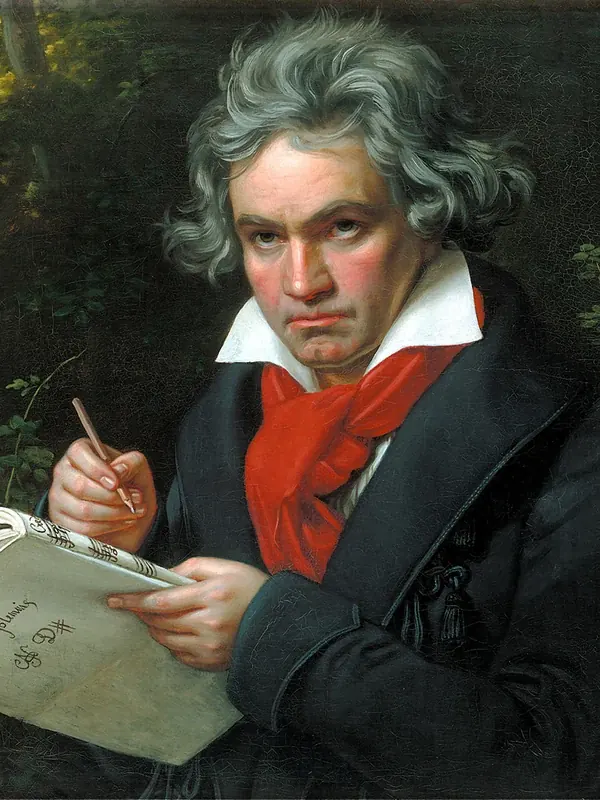

German composer who bridged the Classical and Romantic eras; author of nine symphonies, 32 piano sonatas and the Missa Solemnis, much of it written while deaf.
Early Life
Ludwig van Beethoven was born in Bonn, in the Electorate of Cologne, into a musical family. His grandfather, also named Ludwig van Beethoven, was Kapellmeister at the electoral court, and his father Johann was a court singer who tried to make his son into a child prodigy. Beethoven gave his first public performance as a pianist at the age of seven and had his first composition published in 1783. He studied with the court organist Christian Gottlob Neefe in Bonn and visited Vienna in 1787, where he is reported to have met Mozart. In November 1792 he moved to Vienna to study with Haydn.
Education
Beethoven studied music in Bonn with Christian Gottlob Neefe, the court organist, who taught him composition. In Vienna he studied with Joseph Haydn from 1792, and also took lessons from Johann Georg Albrechtsberger in counterpoint and Antonio Salieri in vocal composition.
Career
Beethoven was a court musician in Bonn for nine years before moving to Vienna in November 1792 to study with Joseph Haydn, where he remained for the rest of his life. He first made his name in Vienna as a pianist and composer, and his First Symphony appeared in 1800. From about 1798 his hearing began to fail; he described his distress in the Heiligenstadt Testament, a letter to his brothers written in October 1802. His middle period produced the Eroica Symphony (1803–04), the Fifth and Sixth Symphonies (1808) and Fidelio, first performed in 1805 and revised to its final form in 1814. By the 1820s he was profoundly deaf, yet his late period produced the Missa Solemnis (1819–23), the Ninth Symphony, premiered in Vienna on 7 May 1824, and the late string quartets of 1825–26. He died in Vienna on 26 March 1827, and thousands attended his funeral.
Achievements
Beethoven composed nine symphonies, 32 piano sonatas, 16 string quartets, five piano concertos and a violin concerto, along with his only opera, Fidelio, and the Missa Solemnis. His Third Symphony, the Eroica, his Fifth Symphony and his Ninth Symphony, whose finale sets Schiller's Ode to Joy for chorus and soloists, are among the most performed works in classical music. Much of his most important music, including the Ninth Symphony and the late string quartets, was composed after he had become profoundly deaf. The Ode to Joy was adopted as the anthem of Europe in 1985.
- Composed nine symphonies, including the Eroica (No. 3), the Fifth and the Ninth with its choral finale setting Schiller's Ode to Joy
- Composed 32 piano sonatas, 16 string quartets, five piano concertos and one violin concerto
- Wrote his only opera, Fidelio (first performed 1805, revised 1814)
- Composed the Missa Solemnis (1819–1823)
- Composed many of his most important works, including the Ninth Symphony and the late string quartets, while profoundly deaf
- The final movement of the Ninth Symphony, the Ode to Joy, was adopted as the anthem of Europe in 1985
Legacy
Beethoven is widely regarded as the greatest composer who ever lived, and the dominant musical figure in the transition from the Classical to the Romantic era. He widened the scope of the symphony, sonata, concerto and string quartet, and in the Ninth Symphony he combined vocal and instrumental music in a way never before attempted. His deafness, and the fact that his greatest works were written while he could not hear them, have made him a symbol of artistic determination. His music remains among the most performed in the classical repertoire.
Contributions
Beethoven's contribution to music was to carry the forms of the Classical era — symphony, sonata, quartet, concerto — to a new scale and expressive range, and to make the composer, rather than the patron, the centre of musical life. The Eroica, the Fifth and the Ninth Symphonies, the 32 piano sonatas and the late string quartets reshaped what instrumental music could say, and the Ode to Joy became a shared symbol far beyond the concert hall.
Notable Works
- Nine Variations on a March by Dressler (1783)
- Symphony No. 1 (1800)
- Symphony No. 3, Eroica (1803–04)
- Symphony No. 5 (1808)
- Symphony No. 6, Pastoral (1808)
- Piano Sonata No. 14, Moonlight Sonata (1801)
- Fidelio (1805, revised 1814)
- Violin Concerto (1806)
- Missa Solemnis (1819–23)
- Symphony No. 9, Choral (1824)
Milestones
- 1778 — Gave his first public performance as a pianist, aged seven Source: Encyclopaedia Britannica; Wikipedia
- 1783 — Had his first composition published Source: Encyclopaedia Britannica
- 1787 — Visited Vienna, where he is reported to have met Mozart Source: Encyclopaedia Britannica
- 1792 — Moved to Vienna to study with Joseph Haydn Source: Encyclopaedia Britannica
- 1800 — His First Symphony appeared Source: Encyclopaedia Britannica; Wikipedia
- 1802 — Wrote the Heiligenstadt Testament about his failing hearing Source: Encyclopaedia Britannica; EBSCO
- 1804 — Composed the Eroica Symphony (No. 3) Source: Encyclopaedia Britannica
- 1805 — Fidelio, his only opera, first performed Source: Encyclopaedia Britannica
- 1808 — Fifth and Sixth Symphonies premiered in Vienna Source: Encyclopaedia Britannica
- 1814 — Fidelio revised to its final form Source: Encyclopaedia Britannica; Wikipedia
- 1823 — Completed the Missa Solemnis Source: Encyclopaedia Britannica
- 1824 — Ninth Symphony premiered at the Kärntnertor Theatre in Vienna Source: Encyclopaedia Britannica; EBSCO
- 1827 — Died in Vienna, aged 56 Source: Encyclopaedia Britannica
Timeline
- 16 December 1770
Born in Bonn, Electorate of Cologne (traditional date; baptised 17 December 1770)
Approximate date Source: Encyclopaedia Britannica; Wikipedia - 1778
Gave his first public performance as a pianist, aged seven
Year only — exact date unknown Source: Encyclopaedia Britannica; Wikipedia - 1783
Had his first composition published (Nine Variations on a March by Dressler)
Year only — exact date unknown Source: Encyclopaedia Britannica - 1792-11
Moved to Vienna to study with Joseph Haydn
Approximate date Source: Encyclopaedia Britannica - 1800
His First Symphony appeared
Year only — exact date unknown Source: Encyclopaedia Britannica; Wikipedia - 1802-10
Wrote the Heiligenstadt Testament, a letter to his brothers about his failing hearing
Approximate date Source: Encyclopaedia Britannica; EBSCO - 1804
Composed the Eroica Symphony (No. 3)
Year only — exact date unknown Source: Encyclopaedia Britannica - 1805
Fidelio, his only opera, first performed
Year only — exact date unknown Source: Encyclopaedia Britannica - 1808
Fifth and Sixth Symphonies premiered in Vienna
Year only — exact date unknown Source: Encyclopaedia Britannica - 1814
Fidelio revised to its final form
Year only — exact date unknown Source: Encyclopaedia Britannica; Wikipedia - 1823
Completed the Missa Solemnis
Year only — exact date unknown Source: Encyclopaedia Britannica - 7 May 1824
Ninth Symphony premiered at the Kärntnertor Theatre in Vienna
Source: Encyclopaedia Britannica; EBSCO - 26 March 1827
Died in Vienna, aged 56
Source: Encyclopaedia Britannica
In Their Words
“I will seize fate by the throat; it shall certainly never wholly overcome me.” Source: Letter to Franz Gerhard Wegeler, 16 November 1801 (Beethoven-Haus Bonn, Wegeler Collection); English translation in Beethoven's Letters, trans. Lady Wallace (1866) — Letter to his friend and physician Franz Gerhard Wegeler, Vienna, 16 November 1801, written as his hearing was failing. Original German: 'Ich will dem Schicksal in den Rachen greifen, ganz niederbeugen soll es mich gewiss nicht.' Autograph held by Beethoven-Haus Bonn.
Related Personalities
Frequently Asked Questions
Who was Ludwig van Beethoven?
Ludwig van Beethoven (1770–1827) was a German composer and pianist, the dominant musical figure in the transition from the Classical to the Romantic era. His works include nine symphonies, 32 piano sonatas, 16 string quartets, the opera Fidelio and the Missa Solemnis.
Source: Encyclopaedia BritannicaWas Beethoven deaf?
He was not born deaf. His hearing began to fail from about 1798, and by about 1819 he was totally deaf. He continued to compose, and many of his most important works — including the Ninth Symphony, premiered in 1824 — were written while he could not hear. The cause of his deafness is not settled.
Source: Encyclopaedia BritannicaWhat are Beethoven's most famous works?
His most famous works include the Third Symphony (Eroica), the Fifth Symphony, the Sixth Symphony (Pastoral), the Seventh Symphony and the Ninth Symphony with its Ode to Joy finale; the Moonlight Sonata and the Pathétique Sonata for piano; the Violin Concerto; the opera Fidelio; and the Missa Solemnis.
Source: Encyclopaedia BritannicaWhat is the Heiligenstadt Testament?
The Heiligenstadt Testament is a letter Beethoven wrote in October 1802, while staying in the village of Heiligenstadt outside Vienna, to his brothers Carl and Johann. In it he described his despair over his worsening hearing and his resolve to live for his art. He never sent it; it was found among his papers after his death.
Source: Encyclopaedia Britannica ; EBSCOWhen was Beethoven born?
Beethoven was born in Bonn in December 1770 and baptised on 17 December 1770, the first recorded date in his life. He bridged the Classical and Romantic eras and composed nine symphonies, much of it while deaf. He composed nine symphonies, five piano concertos and one opera, Fidelio.
Source: Encyclopaedia Britannica ; WikipediaSources & References
- Ludwig van Beethoven — Encyclopaedia Britannica — Encyclopaedia Britannica (accessed 12 November 2026)
- Ludwig van Beethoven — Wikipedia (cross-check) — Wikipedia (accessed 12 November 2026)
- Beethoven's Ninth Symphony — EBSCO Research Starters — EBSCO (accessed 12 November 2026)
- Symphony No. 9 in D minor, Op. 125 — BSO — Boston Symphony Orchestra (accessed 12 November 2026)
- File:Beethoven.jpg — Wikimedia Commons (portrait file page) — Wikimedia Commons (accessed 12 November 2026)