Vladimir Putin
President of Russia · Prime Minister of Russia · Intelligence officer · Lawyer
b. 1952 · Born in Leningrad, Soviet Union (now Saint Petersburg, Russia) · 4 min read
- Verified: 13 November 2026
- Sources: 4
- Independently reviewed
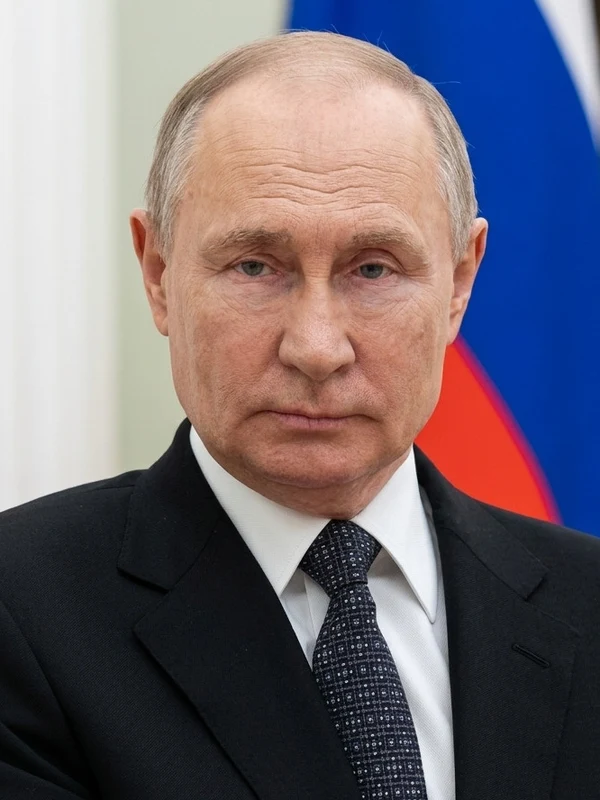

President of Russia from 2000 to 2008 and from 2012 to the present; former KGB foreign intelligence officer and Russia's longest-serving leader since Stalin.
Early Life
Vladimir Vladimirovich Putin was born on 7 October 1952 in Leningrad, in the Soviet Union, now Saint Petersburg, Russia. He was the only surviving child of Vladimir Spiridonovich Putin, a factory worker and former naval conscript, and Maria Ivanovna Putina. He grew up in a communal apartment in Leningrad and attended school there, taking up judo and sambo as a teenager. He studied law at Leningrad State University, where he was recruited by the KGB.
Education
Putin attended school in Leningrad and studied law at Leningrad State University, graduating in 1975. He later earned a candidate of sciences degree in economics, the Russian equivalent of a doctorate, from the St Petersburg Mining Institute in 1997.
Career
Putin studied law at Leningrad State University, graduating in 1975, and then joined the KGB, serving as a foreign intelligence officer for 16 years, including a posting in Dresden, East Germany, from 1985 to 1990. He left the service in 1991 and worked in the administration of St Petersburg under Mayor Anatoly Sobchak. He moved to Moscow in 1996, became director of the Federal Security Service (FSB) in 1998, and was appointed prime minister in August 1999, during the second war in Chechnya. When President Boris Yeltsin resigned on 31 December 1999, Putin became acting president, and he was elected president on 26 March 2000 and inaugurated on 7 May 2000. He was re-elected in 2004. Barred by the constitution from a third consecutive term, he served as prime minister from 2008 to 2012 under President Dmitry Medvedev, then returned to the presidency in 2012. In 2007 he gave a widely noted speech at the Munich Security Conference criticising the United States' role in world affairs, and in 2008 Russia fought a brief war with Georgia. In 2015 Russia began a military intervention in Syria in support of President Bashar al-Assad. He was re-elected in 2018 and again in March 2024, and was inaugurated for a further term on 7 May 2024.
Achievements
Putin's central achievement, in terms of longevity, is his continuous leadership of Russia since 1999: president from 2000 to 2008, prime minister from 2008 to 2012, and president again from 2012, winning re-election in 2018 and 2024. He restored central authority after the instability of the 1990s, oversaw economic growth in the 2000s driven by energy exports, and rebuilt Russia's military. Russia hosted the 2014 Winter Olympics in Sochi and the 2018 FIFA World Cup under his leadership. Constitutional amendments signed into law in 2021 allow him to seek two further terms. By 2024 he had become Russia's longest-serving leader since Joseph Stalin. His rule is also defined by the full-scale invasion of Ukraine in 2022, which Russia calls a special military operation and which Ukraine and Western governments describe as a war of aggression.
- Graduated in law from Leningrad State University in 1975
- Served as a KGB foreign intelligence officer for 16 years, rising to the rank of lieutenant colonel
- Became acting president of Russia on 31 December 1999
- Elected president of Russia in 2000 and re-elected in 2004
- Served as prime minister of Russia from 2008 to 2012
- Returned to the presidency in 2012 and was re-elected in 2018
- Oversaw Russia's hosting of the 2014 Winter Olympics in Sochi and the 2018 FIFA World Cup
- Signed constitutional amendments into law in 2021 allowing him to seek two further presidential terms
- Re-elected president in March 2024 and inaugurated for a fifth term on 7 May 2024
- Became Russia's longest-serving leader since Joseph Stalin
Legacy
Putin's legacy is contested. Supporters credit him with restoring stability and national pride after the disorder of the 1990s, rebuilding the Russian military and asserting Russia's interests abroad. In the 2000s, high oil and gas prices brought strong economic growth and rising living standards in Russia, which supporters cite as a central achievement of his early presidencies, alongside the reassertion of state control over major energy companies and the national television channels. Critics point to the concentration of power in the presidency, restrictions on independent media and political opposition, and the wars in Chechnya, Georgia, Syria and Ukraine. The 2014 annexation of Crimea and the 2022 invasion of Ukraine drew international condemnation and sanctions, while Russia maintains that its actions were justified by security concerns. In March 2023 the International Criminal Court issued an arrest warrant for Putin over the alleged deportation of Ukrainian children; Russia rejects the court's jurisdiction. Because he is a living person whose presidency continues, this profile records only documented milestones and will need regular updating from reliable sources.
Contributions
Putin's contribution has been to centralise power in Russia and to reassert the country's influence in its neighbourhood and beyond, after a decade in which Russia's global standing had declined. His long rule reshaped Russian politics around the presidency, and his foreign policy, including the annexation of Crimea and the invasion of Ukraine, redrew the security map of Europe.
Notable Works
- Munich Security Conference speech (2007)
- Constitutional amendments of 2020
- 2014 Winter Olympics in Sochi
- 2018 FIFA World Cup in Russia
Milestones
- 1952 — Born on 7 October in Leningrad Source: Encyclopaedia Britannica
- 1975 — Graduated in law and joined the KGB Source: Encyclopaedia Britannica
- 1985 — Posted to Dresden, East Germany Source: Encyclopaedia Britannica
- 1991 — Left the KGB; joined the St Petersburg administration Source: Encyclopaedia Britannica
- 1998 — Moved to Moscow; appointed director of the FSB Source: Encyclopaedia Britannica
- 1999 — Appointed prime minister; became acting president on 31 December Source: Encyclopaedia Britannica
- 2000 — Elected president on 26 March; inaugurated on 7 May Source: Encyclopaedia Britannica
- 2004 — Re-elected president for a second term Source: Encyclopaedia Britannica
- 2008 — Became prime minister under Dmitry Medvedev Source: Encyclopaedia Britannica
- 2012 — Returned to the presidency Source: Encyclopaedia Britannica
- 2014 — Russia annexed Crimea; Sochi Winter Olympics held Source: Encyclopaedia Britannica
- 2018 — Re-elected president for a fourth term Source: Encyclopaedia Britannica
- 2021 — Signed constitutional amendments allowing two further terms Source: Encyclopaedia Britannica
- 2022 — Russia launched a full-scale invasion of Ukraine Source: Encyclopaedia Britannica
- 2024 — Re-elected president; inaugurated on 7 May 2024 Source: Encyclopaedia Britannica
Timeline
- 7 October 1952
Born in Leningrad, Soviet Union
Source: Encyclopaedia Britannica - 1975
Graduated in law from Leningrad State University and joined the KGB
Year only — exact date unknown Source: Encyclopaedia Britannica - 1985
Posted to Dresden, East Germany, as a KGB foreign intelligence officer
Year only — exact date unknown Source: Encyclopaedia Britannica - 1991
Left the KGB and joined the St Petersburg city administration
Year only — exact date unknown Source: Encyclopaedia Britannica - 1996
Moved to Moscow to work in the presidential administration
Year only — exact date unknown Source: Encyclopaedia Britannica - 1998
Appointed director of the Federal Security Service (FSB)
Year only — exact date unknown Source: Encyclopaedia Britannica - 9 August 1999
Appointed prime minister of Russia
Source: Encyclopaedia Britannica - 31 December 1999
Became acting president when Boris Yeltsin resigned
Source: Encyclopaedia Britannica - 26 March 2000
Elected president of Russia
Source: Encyclopaedia Britannica - 7 May 2000
Inaugurated as president
Source: Encyclopaedia Britannica - 14 March 2004
Re-elected president for a second term
Source: Encyclopaedia Britannica - 8 May 2008
Became prime minister under President Dmitry Medvedev
Source: Encyclopaedia Britannica - 7 May 2012
Returned to the presidency, inaugurated for a third term
Source: Encyclopaedia Britannica - 2014
Russia annexed Crimea; hosted the Winter Olympics in Sochi
Year only — exact date unknown Source: Encyclopaedia Britannica - 18 March 2018
Re-elected president for a fourth term
Source: Encyclopaedia Britannica - 5 April 2021
Signed constitutional amendments into law allowing two further presidential terms
Source: Encyclopaedia Britannica - 24 February 2022
Russia launched a full-scale invasion of Ukraine
Source: Encyclopaedia Britannica - 17 March 2023
The International Criminal Court issued an arrest warrant for Putin
Source: Wikipedia - 17 March 2024
Re-elected president; inaugurated for a further term on 7 May 2024
Source: Encyclopaedia Britannica
Related Personalities
Frequently Asked Questions
How old is Vladimir Putin?
Vladimir Putin was born on 7 October 1952 in Leningrad, Soviet Union (now Saint Petersburg, Russia), so Putin is 74 years old as of November 2026. Putin's age changes every year on 7 October. He is the president of Russia.
Source: Encyclopaedia BritannicaWho is Vladimir Putin?
Vladimir Putin is a Russian politician and former intelligence officer who has served as president of Russia from 2000 to 2008 and from 2012 to the present, and as prime minister from 1999 to 2000 and from 2008 to 2012.
Source: Encyclopaedia BritannicaHow did Vladimir Putin become president?
Putin became acting president on 31 December 1999, when President Boris Yeltsin resigned. He was elected president on 26 March 2000 and inaugurated on 7 May 2000. He was re-elected in 2004, served as prime minister from 2008 to 2012, returned to the presidency in 2012, and was re-elected in 2018 and 2024.
Source: Encyclopaedia Britannica ; WikipediaDid Vladimir Putin work for the KGB?
Putin worked as a KGB foreign intelligence officer for 16 years, rising to the rank of lieutenant colonel, including a posting in Dresden, East Germany, from 1985 to 1990. He left the service in 1991.
Source: Encyclopaedia BritannicaHow long has Vladimir Putin been in power?
Putin was re-elected in March 2024 and inaugurated for a further term on 7 May 2024. Constitutional amendments signed into law in 2021 allow him to seek two further six-year terms, which could keep him in office until 2036.
Source: Encyclopaedia Britannica ; WikipediaWhat happened between Russia and Ukraine in 2022?
In February 2022 Russia launched a full-scale invasion of Ukraine. Russia describes it as a special military operation, while Ukraine and Western governments describe it as a war of aggression. In March 2023 the International Criminal Court issued an arrest warrant for Putin over the alleged deportation of Ukrainian children; Russia rejects the court's jurisdiction.
Source: Encyclopaedia Britannica ; WikipediaSources & References
- Vladimir Putin — Encyclopaedia Britannica — Encyclopaedia Britannica (accessed 13 November 2026)
- Vladimir Putin — Wikipedia (cross-check) — Wikipedia (accessed 13 November 2026)
- Vladimir Putin — Biography, President of Russia — President of Russia (Kremlin) (accessed 13 November 2026)
- File:Vladimir Putin (2026 02 23) (cropped).jpg — Wikimedia Commons (portrait file page) — Wikimedia Commons (accessed 13 November 2026)