Jalal al-Din Muhammad Rumi
Poet and Sufi mystic · Poet · Sufi mystic · Islamic scholar · Theologian
1207–1273 · Born in Balkh, present-day Afghanistan · 4 min read
- Verified: 13 November 2026
- Sources: 6
- Independently reviewed
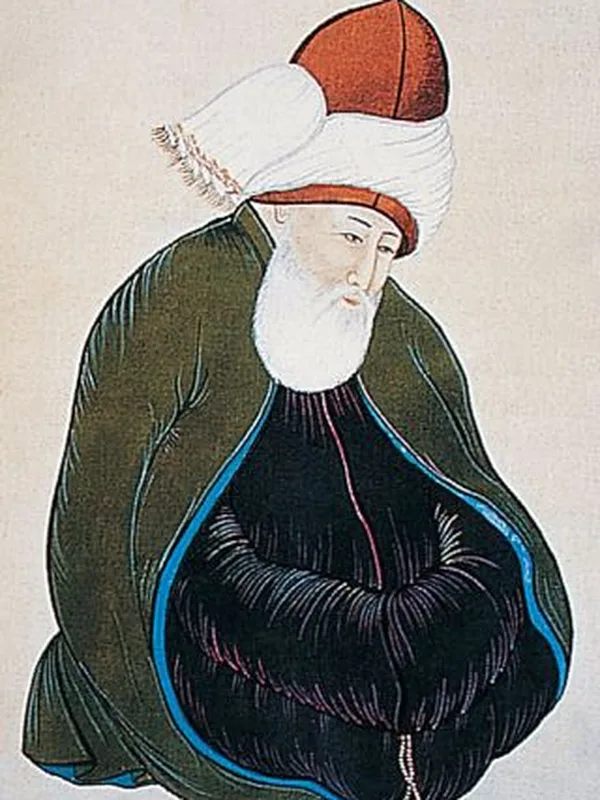

13th-century Persian poet, Sufi mystic and scholar whose Masnavi and Divan-e Shams made him one of the world's most widely read poets; born near Balkh, he lived and taught in Konya.
Early Life
Jalal al-Din Muhammad Rumi was born on 30 September 1207 in or near Balkh, a city of Greater Khorasan in what is now Afghanistan. His father, Baha al-Din Walad, was a noted theologian, jurist and mystic known to his followers as Sultan al-Ulama, 'Sultan of the Scholars'. Around 1212, with the Mongol armies advancing on Central Asia, the family left Balkh and travelled for years through Persia, Baghdad, Mecca and Damascus before settling in Konya, in present-day Turkey, in 1228. Rumi was educated by his father and studied in Aleppo and Damascus, training in Islamic law, theology and mysticism.
Education
Rumi was educated by his father, Baha al-Din Walad, a noted mystical theologian, author and teacher. He studied in Aleppo and Damascus, training in Islamic jurisprudence and theology, and was mentored in his early years by his father's disciple Burhan al-Din Muhaqqiq. His formal learning was in the Hanafi legal tradition; his poetic education came later, through his meeting with Shams al-Din Tabrizi.
Career
Rumi succeeded his father, Baha al-Din Walad, as head of the madrasa in Konya when his father died in 1231, and for the next thirteen years he taught Islamic law and theology as a respected scholar. His life changed in 1244, when he met the wandering dervish Shams al-Din Tabrizi in Konya; the two became inseparable, and under Shams's influence Rumi began composing the lyric poetry that fills the Divan-e Shams. After Shams disappeared from Konya, Rumi turned to his disciples Salah al-Din Zarkub and then Husam al-Din Chalabi as companions, and at Chalabi's request he began dictating the Masnavi around 1262, working on it for the last twelve years of his life. He died in Konya on 17 December 1273 and was buried beside his father; his tomb, the Green Tomb, became a shrine and is now the Mevlana Museum. His followers, organised by his son Sultan Walad, founded the Mevlevi order after his death.
Achievements
Rumi's achievement is a body of Persian poetry that has been read, translated and sung for seven and a half centuries. The Masnavi-ye Ma'navi, dictated in the last decade of his life to his disciple Husam al-Din Chalabi, is a six-book poem of some 25,000-26,000 rhyming couplets weaving stories, Qur'anic commentary, fables and metaphysics into a single spiritual teaching; many Sufis have held it second in importance only to the Qur'an. The Divan-e Shams-e Tabrizi gathers some 3,300 lyric poems and nearly 2,000 quatrains written out of his love and grief for Shams al-Din Tabrizi. His prose discourses, Fihi ma fihi, and his sermons, Majalis-e Sab'a, record his teaching in his own voice. Encyclopaedia Britannica calls him 'the greatest Sufi mystic and poet in the Persian language', and the Mevlevi Sema ceremony of his order was inscribed by UNESCO as Intangible Cultural Heritage in 2008.
- Composed the Masnavi-ye Ma'navi (Spiritual Couplets), a six-book didactic poem of some 25,000-26,000 couplets, regarded as one of the greatest works of mystical poetry
- Composed the Divan-e Shams-e Tabrizi (Divan-e Kabir), a collection of some 3,300 lyric poems and nearly 2,000 quatrains inspired by Shams al-Din Tabrizi
- Wrote Fihi ma fihi (In It What Is in It), a collection of his discourses, and the Majalis-e Sab'a (Seven Sermons)
- Succeeded his father as head of the madrasa in Konya in 1231, leading its teaching for over forty years
- His followers, organised by his son Sultan Walad, founded the Mevlevi (Mawlawiyya) order, known for the sema ceremony of the 'whirling dervishes'
- Described by Encyclopaedia Britannica as 'the greatest Sufi mystic and poet in the Persian language'
- The Mevlevi Sema ceremony was inscribed by UNESCO on its Representative List of the Intangible Cultural Heritage of Humanity in 2008
Legacy
Rumi is remembered as the greatest Sufi mystic and poet in the Persian language, and his works are among the most translated and widely read of all Persian literature. The Mevlevi order founded by his followers spread his teaching across Anatolia and the Ottoman world, and its sema ceremony — the turning dance of the 'whirling dervishes' — is performed to this day. His tomb in Konya remains a place of pilgrimage for visitors of many faiths, and his birthday and death anniversary are observed in Turkey, Iran, Afghanistan and beyond. In the English-speaking world he became widely known through translations, above all the versions of Coleman Barks, though scholars note that those free renderings differ greatly from Rumi's Persian originals — a reason this profile quotes no verse from him.
Contributions
Rumi's contribution was to give Sufi mysticism its most enduring poetic voice. In the Masnavi he turned theology into story, using fables, everyday scenes and Qur'anic commentary to teach the soul's longing for union with the divine. In the Divan-e Shams he made the lyric poem a record of spiritual love and loss. His teaching joined law and mysticism rather than opposing them: he remained a jurist and preacher while insisting that music, poetry and dance could be paths to God. The Mevlevi order carried that teaching into a living practice, and his work continues to be read across religious and linguistic boundaries as a poetry of love, tolerance and the search for meaning.
Notable Works
- Masnavi-ye Ma'navi (Spiritual Couplets) (c. 1262-1273)
- Divan-e Shams-e Tabrizi (Divan-e Kabir)
- Fihi ma fihi (In It What Is in It)
- Majalis-e Sab'a (Seven Sermons)
- Maktubat (Letters)
Milestones
- 1207 — Born on 30 September in or near Balkh, present-day Afghanistan (birthplace disputed — see fact notes) Source: Encyclopaedia Britannica; Dar al-Masnavi
- 1212 — Family leaves Balkh ahead of the Mongol advance and travels westward Source: Encyclopaedia Britannica; Academy of American Poets
- 1228 — Family settles in Konya, in present-day Turkey Source: Encyclopaedia Britannica; Wikipedia
- 1231 — Father Baha al-Din Walad dies; Rumi succeeds him as head of the madrasa in Konya Source: Academy of American Poets; Encyclopedia.com
- 1244 — Meets the wandering dervish Shams al-Din Tabrizi in Konya Source: Encyclopaedia Britannica; Encyclopedia.com
- 1247 — Shams al-Din disappears from Konya; Rumi turns to poetry in his grief Source: Encyclopedia.com; Dar al-Masnavi
- 1262 — Begins dictating the Masnavi to his disciple Husam al-Din Chalabi Source: Encyclopedia.com; Academy of American Poets
- 1273 — Dies in Konya on 17 December, aged 66; buried beside his father under the Green Tomb Source: Encyclopaedia Britannica; Academy of American Poets
- 1273 — His followers, organised by his son Sultan Walad, found the Mevlevi order Source: Encyclopedia.com; Wikipedia
Timeline
- 30 September 1207
Born in or near Balkh, present-day Afghanistan (some scholars argue Wakhsh, present-day Tajikistan)
Approximate date Source: Encyclopaedia Britannica; Dar al-Masnavi - 1212
Family leaves Balkh ahead of the Mongol advance; travels through Persia, Baghdad, Mecca and Damascus
Approximate date Source: Encyclopaedia Britannica; Academy of American Poets - 1228
Family settles in Konya, in present-day Turkey
Year only — exact date unknown Source: Encyclopaedia Britannica; Wikipedia - 1231
Father Baha al-Din Walad dies; Rumi succeeds him as head of the madrasa in Konya
Year only — exact date unknown Source: Academy of American Poets; Encyclopedia.com - 1244
Meets the wandering dervish Shams al-Din Tabrizi in Konya
Year only — exact date unknown Source: Encyclopaedia Britannica; Encyclopedia.com - 1247
Shams al-Din disappears from Konya (the date is given as 1247 or 1248 in different sources)
Approximate date Source: Encyclopedia.com; Dar al-Masnavi - 1262
Begins dictating the Masnavi to his disciple Husam al-Din Chalabi
Approximate date Source: Encyclopedia.com; Academy of American Poets - 17 December 1273
Dies in Konya, aged 66; buried beside his father under the Green Tomb
Source: Encyclopaedia Britannica; Academy of American Poets - 1273
His followers, organised by his son Sultan Walad, found the Mevlevi order
Year only — exact date unknown Source: Encyclopedia.com; Wikipedia
Related Personalities
Frequently Asked Questions
Who was Rumi?
Jalal al-Din Muhammad Rumi (1207-1273), known in the West as Rumi and in the Muslim world as Mawlana or Mevlana, was a 13th-century Persian poet, Islamic scholar and Sufi mystic. He wrote the Masnavi and the Divan-e Shams, and his followers founded the Mevlevi order of 'whirling dervishes'.
Source: Encyclopaedia Britannica ; Academy of American PoetsWhere was Rumi born?
He was born in or near Balkh, in present-day Afghanistan, on 30 September 1207, according to most general references including Encyclopaedia Britannica. Some scholars argue he was born in Wakhsh, in present-day Tajikistan. His family left the region around 1212 and settled in Konya, in present-day Turkey, in 1228, where he lived and worked for the rest of his life.
Source: Encyclopaedia Britannica ; Dar al-MasnaviWhat is the Masnavi?
The Masnavi-ye Ma'navi (Spiritual Couplets) is Rumi's masterwork: a six-book didactic poem of some 25,000-26,000 rhyming couplets, dictated from about 1262 to his disciple Husam al-Din Chalabi. It weaves fables, Qur'anic commentary and metaphysics into a teaching on the soul's longing for God, and many Sufis hold it second in importance only to the Qur'an.
Source: Encyclopaedia Britannica ; Encyclopedia.comWho was Shams al-Din Tabrizi?
Shams al-Din Tabrizi was a wandering dervish whom Rumi met in Konya in 1244. Their intense companionship transformed Rumi from a scholar into a mystic poet; after Shams disappeared from Konya, Rumi poured his love and grief into the lyric poems of the Divan-e Shams, named for Shams.
Source: Encyclopaedia Britannica ; Encyclopedia.comWhat are the whirling dervishes?
The 'whirling dervishes' are members of the Mevlevi order, founded by Rumi's followers after his death. Their sema ceremony is a turning dance performed to music and verse as a form of meditation and worship. UNESCO inscribed the Mevlevi Sema ceremony on its Representative List of the Intangible Cultural Heritage of Humanity in 2008.
Source: Encyclopedia.com ; UNESCO (via Persian Bell)Sources & References
- Rumi — Encyclopaedia Britannica — Encyclopaedia Britannica (accessed 12 November 2026)
- About Jalal al-Din Rumi — Academy of American Poets (accessed 12 November 2026)
- The Life and Works of Mawlana Jalal al-Din Balkhi-Rumi — Dar al-Masnavi (Ibrahim Gamard) (accessed 12 November 2026)
- Rumi, Jalaluddin (1207-1273) — Encyclopedia.com — Encyclopedia.com (accessed 12 November 2026)
- Rumi — Wikipedia — Wikipedia (accessed 12 November 2026)
- File:Mevlana-celaleddin-i-rumi-1.jpg — Wikimedia Commons (portrait file page) — Wikimedia Commons (accessed 12 November 2026)
Explore More
- More Writers & Authors
- Personalities from Afghanistan
- Personalities from Turkey
- More poet and sufi mystics
- More poets
- More sufi mystics
- More islamic scholars
- More theologians
- Famous people born in September
- Browse all personalities
Featured on these lists: