Muhammad Iqbal
Poet and philosopher · Poet · Philosopher · Barrister · Politician
1877–1938 · Born in Sialkot, Punjab, British India (now Pakistan) · 4 min read
- Verified: 13 November 2026
- Sources: 5
- Independently reviewed
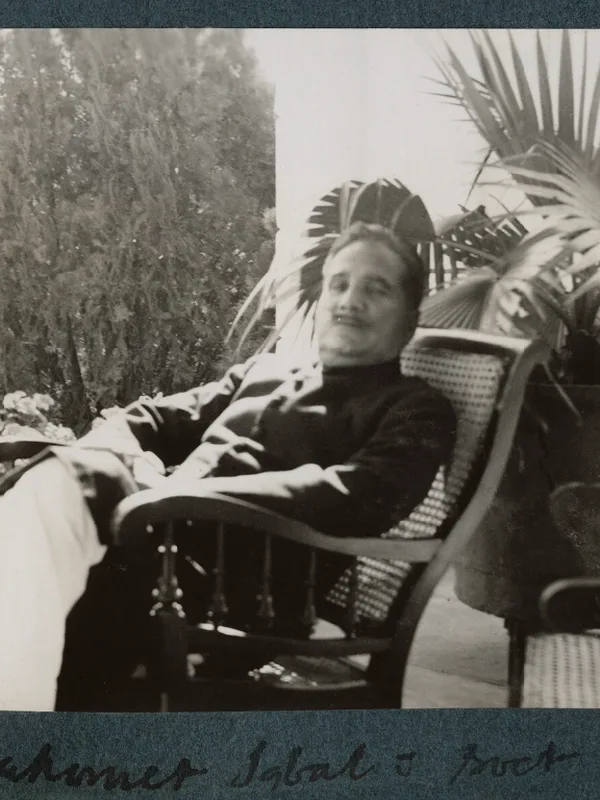

Poet, philosopher and barrister known as Pakistan's national poet, whose Persian and Urdu verse and philosophy of khudi (selfhood) shaped the intellectual case for Pakistan.
Early Life
Muhammad Iqbal was born on 9 November 1877 in Sialkot, a town in the Punjab of British India (now in Pakistan), into a Kashmiri Muslim family of modest means. His father, Sheikh Noor Muhammad, was a tailor, and his mother was Imam Bibi. He was schooled at Scotch Mission College in Sialkot, where the scholar Shams al-Ulama Sayyid Mir Hasan taught him classical Persian, Arabic and Islamic literature, and then at Government College Lahore, where he studied philosophy, English literature and Arabic.
Education
Iqbal took his BA in philosophy, English literature and Arabic from Government College Lahore in 1897 and his MA in philosophy in 1899. In 1905 he travelled to Europe: he studied philosophy at Trinity College, Cambridge, under J. M. E. McTaggart, took a second BA in 1906 and an MA in 1907, and trained in law at Lincoln's Inn in London. He spent part of 1907 in Heidelberg studying German, and in November 1907 the University of Munich awarded him a PhD in philosophy for his thesis The Development of Metaphysics in Persia, published in London in 1908. He was called to the Bar at Lincoln's Inn in July 1908.
Career
After returning from Europe in 1908, Iqbal practised law in Lahore and taught philosophy at Government College Lahore. He wrote poetry in Urdu and Persian while building a legal practice, and from the 1920s he moved steadily into public life. He was elected to the Punjab Legislative Council in 1927 and served until 1930. In December 1930 he presided over the All-India Muslim League's annual session at Allahabad and delivered the address that proposed a separate political future for the Muslims of north-west India. In 1931 and 1932 he represented Indian Muslims at the Round Table Conferences in London, and in 1932 he presided over the League's Lahore session. In his last years he corresponded with Muhammad Ali Jinnah, urging him to lead the Muslim League, and he continued writing until his death in 1938, nine years before Pakistan was established.
Achievements
Iqbal's central achievement was a body of poetry and philosophy that gave Indian Muslims a language of self-respect and political purpose. Asrar-e-Khudi (1915) introduced khudi, the cultivation of the self, as the answer to passivity and decline; its English translation by R. A. Nicholson in 1920 carried the idea to Western readers. Bang-e-Dara (1924) gathered his Urdu verse, including the poems Shikwa and Jawab-e-Shikwa, and Javid Nama (1932) took the Persian poet Rumi as a guide through the heavens. In prose, The Reconstruction of Religious Thought in Islam (1930) argued that Islamic thought could engage fully with modern philosophy and science. In politics, his Allahabad Address of 29 December 1930 proposed bringing the Muslim-majority provinces of north-west India into a single self-governing unit, the idea that later took the shape of Pakistan. He was knighted in 1922, and after his death Pakistan adopted him as its national poet.
- Published Asrar-e-Khudi (The Secrets of the Self) in Persian in 1915, setting out his philosophy of khudi (selfhood)
- Delivered the Allahabad Address on 29 December 1930, proposing a self-governing political unit for the Muslim-majority provinces of north-west India — the intellectual foundation of the Pakistan Movement
- Wrote Javid Nama (1932), a Persian spiritual epic guided by the poet Rumi, and Bal-e-Jibril (1935), among the most celebrated works of Urdu and Persian poetry
- Published The Reconstruction of Religious Thought in Islam (1930 lectures), a synthesis of Islamic theology and modern philosophy
- Knighted in 1922 for his services to literature
- Elected to the Punjab Legislative Council in 1927 and served as president of the All-India Muslim League's annual session in 1930
- Represented Indian Muslims at the second and third Round Table Conferences in London in 1931 and 1932
- Recognised as the national poet of Pakistan; his birthday, 9 November, is observed as Iqbal Day
Legacy
Iqbal died in Lahore on 21 April 1938 and is buried beside the Badshahi Mosque. He is remembered in Pakistan as the national poet and the ideological founder of the country: his birthday, 9 November, is observed as Iqbal Day, his verse is taught in schools, and his Allahabad Address is treated as the first formal statement of the idea that became Pakistan. Beyond Pakistan, his Persian poetry is read across Iran, Afghanistan and Central Asia, and The Reconstruction of Religious Thought in Islam remains a standard text in modern Islamic philosophy. The Iqbal Academy Pakistan preserves his manuscripts and letters, including his correspondence with Jinnah from 1936 to 1937.
Contributions
Iqbal's contribution was to join poetry, philosophy and politics into a single project. His philosophy of khudi argued that the individual self, strengthened through action, love and obedience to God, was the basis of both personal dignity and collective revival. His Persian and Urdu poetry carried that philosophy to a mass audience, and his political writing — above all the Allahabad Address — translated it into a concrete proposal for a Muslim political future in north-west India. His lectures on the reconstruction of religious thought argued that Islam's intellectual tradition was compatible with modern science and philosophy, an argument that continues to shape debates in Muslim thought today.
Notable Works
- Asrar-e-Khudi (The Secrets of the Self) (1915)
- Rumuz-e-Bekhudi (The Secrets of Selflessness) (1918)
- Payam-e-Mashriq (Message from the East) (1923)
- Bang-e-Dara (The Call of the Marching Bell) (1924)
- Zabur-e-Ajam (Persian Psalms) (1927)
- Javid Nama (Book of Eternity) (1932)
- Bal-e-Jibril (Gabriel's Wing) (1935)
- Zarb-e-Kalim (The Rod of Moses) (1936)
- Armaghan-e-Hijaz (Gift of the Hijaz) (1938, posthumous)
- The Reconstruction of Religious Thought in Islam (1930 lectures; 1934)
- Shikwa (1909) and Jawab-e-Shikwa (1913)
Milestones
- 1877 — Born on 9 November in Sialkot, Punjab, British India (now Pakistan) Source: Encyclopedia.com; Iqbal Academy Pakistan
- 1897 — Takes BA in philosophy, English literature and Arabic from Government College Lahore Source: Wikipedia (cross-checked)
- 1899 — Takes MA in philosophy from Government College Lahore Source: Encyclopedia.com; Wikipedia
- 1905 — Travels to Europe; enters Trinity College, Cambridge Source: Iqbal Academy Pakistan; Wikipedia
- 1907 — University of Munich awards him a PhD for The Development of Metaphysics in Persia Source: Encyclopedia.com; Iqbal Academy Pakistan
- 1908 — Called to the Bar at Lincoln's Inn, London; returns to Lahore to practise law Source: Iqbal Academy Pakistan
- 1915 — Publishes Asrar-e-Khudi (The Secrets of the Self), setting out his philosophy of khudi Source: Encyclopedia.com; Iqbal Academy Pakistan
- 1922 — Knighted for his services to literature Source: Encyclopedia.com
- 1924 — Publishes Bang-e-Dara, his first Urdu poetry collection Source: Iqbal Academy Pakistan
- 1927 — Elected to the Punjab Legislative Council Source: Encyclopedia.com
- 1930 — Delivers the Allahabad Address on 29 December, proposing a self-governing Muslim unit in north-west India Source: Encyclopedia.com; Pakistan Times
- 1932 — Publishes Javid Nama, a Persian spiritual epic guided by Rumi Source: Encyclopedia.com; Iqbal Academy Pakistan
- 1938 — Dies in Lahore on 21 April, aged 60; buried beside the Badshahi Mosque Source: Encyclopedia.com; Pakistan Times
Timeline
- 9 November 1877
Born in Sialkot, Punjab, British India (now Pakistan)
Source: Encyclopedia.com; Iqbal Academy Pakistan - 1897
Takes BA in philosophy, English literature and Arabic from Government College Lahore
Year only — exact date unknown Source: Wikipedia (cross-checked) - 1899
Takes MA in philosophy from Government College Lahore
Year only — exact date unknown Source: Encyclopedia.com; Wikipedia - 1905
Travels to Europe; enters Trinity College, Cambridge
Year only — exact date unknown Source: Iqbal Academy Pakistan; Wikipedia - 1907
University of Munich awards him a PhD for The Development of Metaphysics in Persia
Year only — exact date unknown Source: Encyclopedia.com; Iqbal Academy Pakistan - 1908
Called to the Bar at Lincoln's Inn, London; returns to Lahore
Year only — exact date unknown Source: Iqbal Academy Pakistan - 1915
Publishes Asrar-e-Khudi (The Secrets of the Self) in Persian
Year only — exact date unknown Source: Encyclopedia.com; Iqbal Academy Pakistan - 1922
Knighted for his services to literature
Year only — exact date unknown Source: Encyclopedia.com - 1924
Publishes Bang-e-Dara, his first Urdu poetry collection
Year only — exact date unknown Source: Iqbal Academy Pakistan - 1927
Elected to the Punjab Legislative Council
Year only — exact date unknown Source: Encyclopedia.com - 29 December 1930
Delivers the Allahabad Address as president of the All-India Muslim League session
Source: Encyclopedia.com; Pakistan Times - 1932
Publishes Javid Nama; attends the third Round Table Conference in London
Year only — exact date unknown Source: Encyclopedia.com; Iqbal Academy Pakistan - 21 April 1938
Dies in Lahore, aged 60; buried beside the Badshahi Mosque
Source: Encyclopedia.com; Pakistan Times
Related Personalities
Frequently Asked Questions
Who was Allama Iqbal?
Muhammad Iqbal (1877-1938), known as Allama Iqbal, was a poet, philosopher, barrister and political thinker from Sialkot in British India. He wrote celebrated poetry in Urdu and Persian, developed the philosophy of khudi (selfhood), and is recognised as Pakistan's national poet.
Source: Encyclopaedia Britannica (via Encyclopedia.com); Iqbal Academy PakistanWhat is Iqbal's philosophy of khudi?
Khudi, usually translated as selfhood, is Iqbal's central philosophical idea: the individual self should be strengthened through action, love and faith until it reaches its fullest realisation. Iqbal set it out in his Persian poem Asrar-e-Khudi (The Secrets of the Self, 1915) as an answer to passivity and decline.
Source: Encyclopedia.com ; Iqbal Academy PakistanWhat was the Allahabad Address?
On 29 December 1930, presiding over the All-India Muslim League's annual session at Allahabad, Iqbal proposed bringing Punjab, the North-West Frontier Province, Sind and Baluchistan into a single self-governing unit. The speech is regarded as the first formal statement of the idea that later became Pakistan.
Source: Encyclopedia.com ; Pakistan TimesWhy is Iqbal called Pakistan's national poet?
He is Pakistan's national poet because his poetry and political writing supplied the intellectual foundations of the Pakistan Movement: the Allahabad Address, his letters to Jinnah, and his verse on Muslim selfhood and revival. He died in 1938, nine years before Pakistan was established.
Source: Pakistan Times ; Iqbal Academy PakistanWhere is Iqbal buried?
Iqbal died in Lahore on 21 April 1938 and is buried beside the Badshahi Mosque in Lahore. He is remembered in Pakistan as the national poet and the ideological founder of the country, and his birthday, 9 November, is observed as Iqbal Day.
Source: Pakistan Times ; Urdu Poetry LibrarySources & References
- Iqbal, Muhammad 1877-1938 — Encyclopedia.com — Encyclopedia.com (Encyclopaedia of Islam / International Encyclopedia of the Social Sciences) (accessed 12 November 2026)
- Muhammad Iqbal — Wikipedia — Wikipedia (accessed 12 November 2026)
- Allama Iqbal's Biography — adapted from Mustansir Mir, Iqbal (Iqbal Academy Pakistan, 2008) — Iqbal Academy Pakistan (via Walid Iqbal) (accessed 12 November 2026)
- Allama Muhammad Iqbal — Biography — Pakistan Times (accessed 12 November 2026)
- File:Sir Muhammad Iqbal 1935 by Lady Ottoline Morrell.png — Wikimedia Commons (portrait file page) — Wikimedia Commons (accessed 12 November 2026)
Explore More
- More Writers & Authors
- Personalities from Pakistan
- Personalities from United Kingdom
- Personalities from Germany
- More poet and philosophers
- More poets
- More philosophers
- More barristers
- More politicians
- Famous people born in November
- Browse all personalities
Featured on these lists: