Johannes Gutenberg
Inventor
1400–1468 · Born in Mainz, Germany · 3 min read
- Verified: 13 November 2026
- Sources: 5
- Independently reviewed
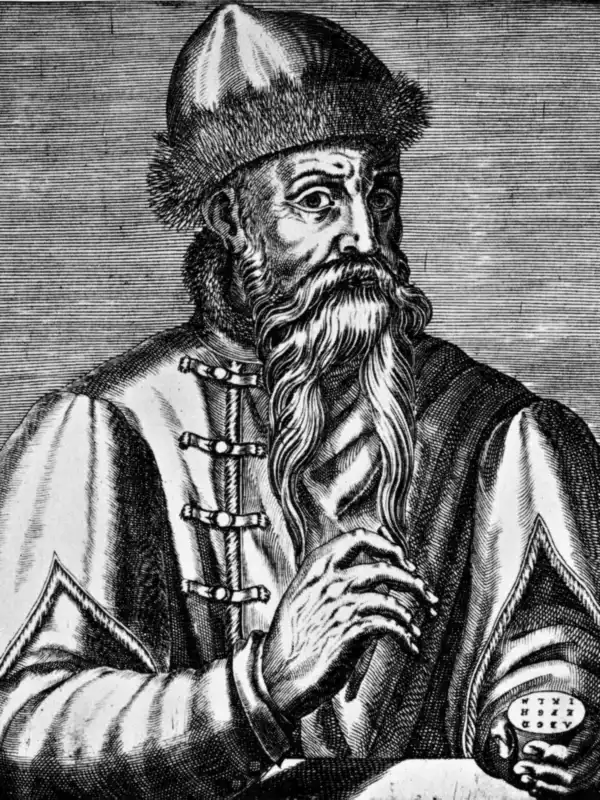

German inventor who built the first mechanised printing press in Europe and printed the Gutenberg Bible by 1455, making books affordable and spreading knowledge across Europe.
Early Life
Johannes Gutenberg was born in Mainz, in what is now Germany, around 1400, the son of a patrician family. No birth record survives, and scholars estimate his birth between 1393 and 1406, with 1400 the year commonly assigned. He trained in metalwork, probably as a goldsmith, a craft his family practised, and the skill shaped everything he later did: his press depended on casting precise metal letters, on alloys and on the hand mould. Mainz was a wealthy city on the Rhine, and Gutenberg grew up among merchants and craftsmen. He was exiled from the city during a struggle between its guilds and patricians and moved to Strasbourg, where he lived for more than a decade before returning to Mainz.
Career
Gutenberg was a goldsmith and metalworker from a patrician family of Mainz, and almost everything known about him comes from legal and financial documents rather than personal records. Exiled from Mainz during a struggle between the city's guilds and patricians, he moved to Strasbourg, probably between 1428 and 1430, where records place him from 1434 to 1444 and where he was experimenting with printing by 1438. He returned to Mainz by 1448 and in 1449–1450 borrowed money from the financier Johann Fust to build his workshop and print the Bible. The partnership ended in a lawsuit in 1455, recorded in the Helmasperger notarial instrument, and Fust took over the workshop with Gutenberg's foreman Peter Schöffer. Gutenberg continued to print smaller works, probably in Mainz and Eltville, and in 1465 the Archbishop of Mainz made him a gentleman of his court, with a pension. He died in Mainz in early 1468.
Achievements
Gutenberg's central achievement was the movable-type printing press, the first mechanised press known in Europe. He combined several elements into one working system: reusable metal type cast in a hand mould from an alloy that melted readily and cooled quickly, an oil-based ink that adhered to metal type and transferred well to paper and vellum, and a screw press, adapted from those used for wine and oil, that applied firm, even pressure. With this system his workshop in Mainz printed the Forty-Two-Line Bible, completed by 1455, in about 180 copies, the first large book printed from movable type in the West. The press made it possible for the first time in Europe to manufacture large numbers of books at relatively little cost, and its basic elements of typesetting remained in use for some 500 years.
- Designed and built the first known mechanised printing press in Europe, combining movable metal type, oil-based ink and a screw press
- Printed the Gutenberg Bible, the Forty-Two-Line Bible, completed by 1455, the first large book printed from movable type in the West
- Developed a system for casting reusable metal type in quantity, with an alloy that melted readily and cooled quickly into durable letters
- Created the hand mould for casting type and the oil-based ink that adhered to metal type and transferred cleanly to paper and vellum
- Made it possible, for the first time in Europe, to manufacture large numbers of books at relatively little cost
- His press became the model for printing across Europe, and its basic elements of typesetting remained in use for some 500 years
Legacy
Gutenberg is remembered as the inventor who brought printing to Europe and changed who could own knowledge. Before his press, books were copied by hand, slowly and at great cost, and were owned mainly by churches, universities and the rich; after it, books could be made in hundreds of copies and sold at prices that scholars, merchants and towns could afford. The press carried the Renaissance, the Reformation and the Scientific Revolution, because ideas could now spread faster than they could be suppressed. Printing shops using his system spread across Europe within a few decades. The Gutenberg Museum in Mainz, founded in 1900, preserves his work, and his Bible is regarded as one of the finest books ever printed.
Contributions
Gutenberg's contribution was to mechanise the making of books. Printing with movable type already existed in Korea, but Gutenberg's system was the first in Europe to combine all the parts into a practical whole: type that could be cast in quantity and reused, ink that worked with metal type, and a press that printed whole pages at a stroke. That combination turned book-making from hand copying into manufacturing, and the price of books fell sharply. The result was an information revolution: within a generation, printed books carried new ideas across Europe, and the spread of literacy, science and religious debate that followed would have been impossible without his press.
Notable Works
- Movable-type printing press (c. 1440)
- Gutenberg Bible, the Forty-Two-Line Bible (1454–55)
- Hand mould for casting metal type
- Oil-based printing ink
- Letters of indulgence (1454–55)
Milestones
- 1400 — Born in Mainz, Germany (estimated c. 1400; scholars give 1393–1406) Source: Encyclopaedia Britannica; Wikipedia
- 1428 — Exiled from Mainz; moved to Strasbourg Source: Encyclopaedia Britannica
- 1438 — Experimenting with printing in Strasbourg Source: Encyclopaedia Britannica
- 1440 — Developed his movable-type printing press Source: Wikipedia
- 1448 — Returned to Mainz and sought backing for his workshop Source: Gutenberg Foundation
- 1449 — Received a first loan of 800 guilders from Johann Fust Source: Gutenberg Foundation
- 1452 — Received a further loan from Fust; printing of the Bible began Source: Gutenberg Foundation
- 1455 — The Forty-Two-Line Bible was completed in Mainz Source: Encyclopaedia Britannica
- 1455 — Fust sued Gutenberg; the Helmasperger instrument records the case on 6 November Source: Gutenberg Foundation
- 1457 — Fust and Peter Schöffer printed the Mainz Psalter, the first dated printed book Source: Gutenberg Foundation
- 1465 — Made a gentleman of the Archbishop of Mainz's court, with a pension Source: Wikipedia
- 1468 — Died in Mainz in early 1468 Source: Encyclopaedia Britannica
Timeline
- 1400
Born in Mainz, Germany (estimated; scholars give 1393–1406, with 1400 commonly assigned)
Approximate date Source: Encyclopaedia Britannica; Wikipedia - 1428
Exiled from Mainz during a struggle between the guilds and the patricians; moved to Strasbourg
Approximate date Source: Encyclopaedia Britannica - 1438
Experimenting with printing in Strasbourg
Approximate date Source: Encyclopaedia Britannica - 1440
Developed his movable-type printing press, combining cast type, oil-based ink and a screw press
Approximate date Source: Encyclopaedia Britannica; Wikipedia - 1448
Returned to Mainz and sought backing for his printing workshop
Year only — exact date unknown Source: Encyclopaedia Britannica; Gutenberg Foundation - 1449
Received a first loan of 800 guilders from the financier Johann Fust to build printing equipment
Year only — exact date unknown Source: Gutenberg Foundation - 1452
Received a further loan from Fust for the work of the books; printing of the Bible began
Year only — exact date unknown Source: Gutenberg Foundation - 1455
The Forty-Two-Line Bible was completed in Mainz, in about 180 copies
Year only — exact date unknown Source: Encyclopaedia Britannica; Gutenberg Foundation - 6 November 1455
The Helmasperger notarial instrument records Fust's lawsuit against Gutenberg; Fust took over the workshop
Source: Gutenberg Foundation - 1457
Fust and Peter Schöffer printed the Mainz Psalter, the first dated printed book
Year only — exact date unknown Source: Encyclopaedia Britannica; Gutenberg Foundation - 1465
The Archbishop of Mainz made Gutenberg a gentleman of his court, with a pension
Year only — exact date unknown Source: Wikipedia; Encyclopaedia Britannica - 1468
Died in Mainz, probably in early February; buried in the Franciscan church there
Approximate date Source: Encyclopaedia Britannica; Gutenberg Foundation
Related Personalities
Frequently Asked Questions
Who was Johannes Gutenberg?
Johannes Gutenberg (about 1400–1468) was a German inventor and printer who designed and built the first known mechanised printing press in Europe. His press used reusable movable metal type, oil-based ink and a screw press to print whole pages at a stroke.
With it, his workshop in Mainz printed the Gutenberg Bible, completed by 1455, the first large book printed from movable type in the West.
Source: Encyclopaedia Britannica ; WikipediaHow did Gutenberg's printing press work?
Gutenberg's press combined three elements into one working system: movable metal type, cast in a hand mould from an alloy that melted readily and cooled into durable letters; an oil-based ink that adhered to metal type and transferred cleanly to paper and vellum; and a screw press.
The press was adapted from presses used for wine and oil, and it applied firm, even pressure to the printing surface. Together the three elements let a workshop print hundreds of copies of a book, where scribes had made one at a time.
Source: Encyclopaedia Britannica ; Gutenberg FoundationWhat was the Gutenberg Bible?
The Gutenberg Bible, also called the Forty-Two-Line Bible because each page has two columns of 42 lines, was printed in Mainz in 1454–55. About 180 copies were made, roughly 35 on vellum and the rest on paper, and 49 copies still survive in whole or in part. It was the
first large book printed from movable type in the West, and it is admired for the quality of its printing, which at the time was so fine that some readers thought it was handwritten.
Source: Encyclopaedia Britannica ; Gutenberg FoundationDid Gutenberg invent printing?
No, Gutenberg did not invent movable type printing in the world as a whole. Movable type was used in Korea in the 14th century, before his press, and printing from blocks existed in China earlier still. His achievement was the first mechanised movable-type press in Europe.
It combined cast metal type, oil-based ink and a screw press into a practical system for mass-producing books. That system, not the idea of movable type alone, is what changed Europe.
Source: Encyclopaedia Britannica ; WikipediaWhen was Gutenberg born, and why is the date uncertain?
Gutenberg was born in Mainz around 1400, but no birth record survives, so the year is an estimate. Scholars place his birth between 1393 and 1406, based on a later document showing that he had come of age by 1420, and 1400 is the year commonly assigned to him. The
tradition that he was born on 24 June, the feast of St John the Baptist, has no surviving evidence behind it. His death, in Mainz in early 1468, is also dated only approximately.
Source: Encyclopaedia Britannica ; WikipediaWhy did Gutenberg lose his printing workshop?
Gutenberg borrowed money from the Mainz financier Johann Fust, 800 guilders in 1449–50 for equipment and a further 800 guilders in 1452–53 for the work of the books. In November 1455 Fust sued him for repayment with interest, in a case recorded in the Helmasperger notarial instrument.
Fust won, took over the workshop and its equipment, and went into partnership with Gutenberg's foreman, Peter Schöffer, while Gutenberg lost the presses and much of the finished Bible stock.
Source: Gutenberg Foundation ; Encyclopaedia BritannicaSources & References
- Johannes Gutenberg — Encyclopaedia Britannica — Encyclopaedia Britannica (accessed 13 November 2026)
- Johannes Gutenberg — Wikipedia — Wikipedia (accessed 13 November 2026)
- Johannes Gutenberg — Gutenberg Foundation (Gutenberg Museum) — Gutenberg Foundation (accessed 13 November 2026)
- Johannes Gutenberg summary — Encyclopaedia Britannica — Encyclopaedia Britannica (accessed 13 November 2026)
- File:Johannes Gutenberg.jpg — Wikimedia Commons (portrait file page) — Wikimedia Commons (accessed 13 November 2026)
Explore More
- More Scientists & Inventors
- Personalities from Germany
- Personalities from France
- More inventors
- Browse all personalities
Featured on these lists: