Johan Cruyff
Footballer · Forward · Football manager
1947–2016 · Born in Amsterdam, Netherlands · 3 min read
- Verified: 13 November 2026
- Sources: 5
- Independently reviewed
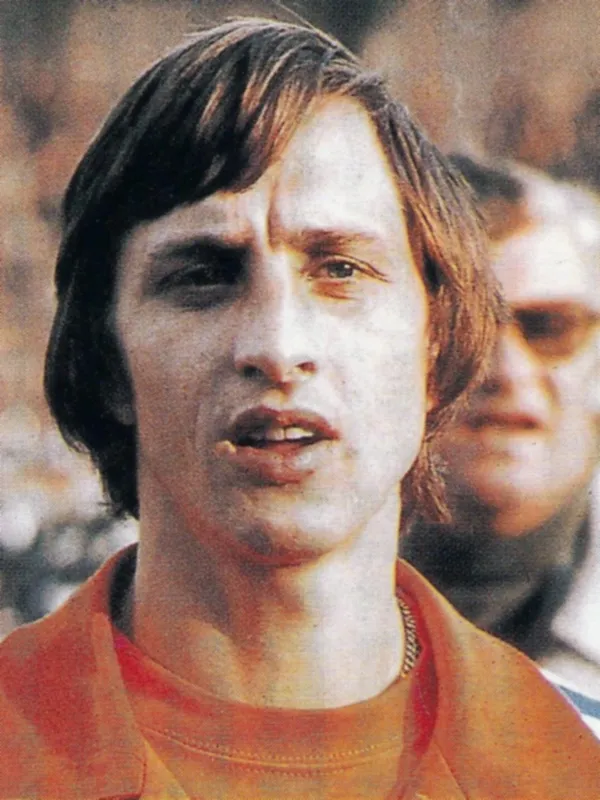

Dutch footballer and manager, the star of Total Football who won three Ballon d'Or awards with Ajax and the Netherlands, then built Barcelona's 'Dream Team'.
Early Life
Hendrik Johannes Cruijff was born on 25 April 1947 in Amsterdam, Netherlands, a short walk from Ajax's old De Meer stadium, where his father worked as a greengrocer supplying the club. His father died when Cruyff was 12, and the young Cruyff worked at the stadium as a boy. He joined the Ajax youth system on his tenth birthday and was fast-tracked into the first team, making his debut in November 1964 and scoring Ajax's only goal in a 3–1 defeat.
Career
Cruyff joined the Ajax youth system on his tenth birthday and made his first-team debut in November 1964, aged 17. Under coach Rinus Michels he became the star of Total Football, winning six Dutch league titles in his first spell plus three European Cups, before moving to Barcelona in 1973 for a then world-record fee. With Barcelona he won the Spanish league in 1974, the club's first title in 14 years. He later played in the United States, returned to Ajax, and finished his playing career with Feyenoord in 1984, winning the Dutch league and cup double. As a manager he led Ajax from 1985 to 1988, winning the Cup Winners' Cup in 1987, then managed Barcelona from 1988 to 1996, winning 11 trophies including four straight league titles and the 1992 European Cup at Wembley. He left management in 1996 and remained an influential adviser to both clubs.
Achievements
As a player Cruyff won the Ballon d'Or three times, in 1971, 1973 and 1974 — the first player to do so — and led Ajax to three consecutive European Cups in 1971, 1972 and 1973, winning eight Dutch league titles across his two spells at the club. He scored 33 goals in 48 appearances for the Netherlands and led the Dutch to the final of the 1974 World Cup, winning the Golden Ball as the tournament's best player. As a manager he won the Cup Winners' Cup with Ajax in 1987 and then built Barcelona's 'Dream Team', which won four consecutive La Liga titles from 1991 to 1994 and the club's first European Cup in 1992. In 1999 he was voted European Player of the Century.
- Won the Ballon d'Or three times, in 1971, 1973 and 1974 — the first player to win the award three times
- Won three consecutive European Cups with Ajax, in 1971, 1972 and 1973, and eight Dutch league titles
- Led the Netherlands to the final of the 1974 World Cup and won the Golden Ball as the tournament's best player
- Scored 33 goals in 48 appearances for the Netherlands
- As Barcelona manager, built the 'Dream Team' that won four consecutive La Liga titles (1991–1994) and the club's first European Cup in 1992
- Won the European Cup Winners' Cup as manager of Ajax in 1987
- Voted European Player of the Century in 1999 in an IFFHS election
Legacy
Cruyff is widely regarded as one of the greatest and most influential figures in football history. As a player he was the on-field conductor of Total Football, the Dutch style that changed how the game was played in the 1970s. As a manager he rebuilt Barcelona around youth, possession and positional play, founding the La Masia-based approach that produced the club's later dominance and shaped managers including Pep Guardiola. Ajax and Barcelona still develop players and play football according to principles he established, and his ideas spread through the Spain national team that won the 2010 World Cup. He died of lung cancer in Barcelona in 2016, aged 68.
Contributions
Cruyff's contribution was an idea as much as a set of trophies: Total Football, in which every outfield player could take any team-mate's role, and later the possession-based, youth-driven model he built at Barcelona. As a player he proved that intelligence and technique could dominate the game; as a manager he built the academy system and playing style that Barcelona still follows, and that shaped a generation of coaches and the Spain team that won the 2010 World Cup. Few figures have influenced football so deeply in both roles.
Notable Works
- AFC Ajax (1964–1973, 1981–1983)
- FC Barcelona (1973–1978)
- Netherlands national team (1966–1977), 1974 World Cup final
- Feyenoord (1983–1984)
- Ajax manager (1985–1988)
- Barcelona manager (1988–1996), 'Dream Team'
Milestones
- 1947 — Born in Amsterdam, Netherlands Source: Encyclopaedia Britannica
- 1957 — Joined the Ajax youth system on his tenth birthday Source: Wikipedia
- 1964 — Made his first-team debut for Ajax, aged 17 Source: Wikipedia
- 1966 — Made his Netherlands debut and won his first Dutch league title Source: Wikipedia
- 1971 — Won the first of three consecutive European Cups and his first Ballon d'Or Source: Encyclopaedia Britannica
- 1973 — Won a third consecutive European Cup and a third Ballon d'Or; moved to Barcelona Source: Encyclopaedia Britannica
- 1974 — Won the Spanish league with Barcelona and reached the World Cup final with the Netherlands Source: Encyclopaedia Britannica
- 1984 — Retired as a player after a league and cup double with Feyenoord Source: Wikipedia
- 1985 — Became manager of Ajax Source: Wikipedia
- 1987 — Won the Cup Winners' Cup as Ajax manager Source: Wikipedia
- 1988 — Became manager of Barcelona Source: FC Barcelona
- 1992 — Won Barcelona's first European Cup at Wembley Source: FC Barcelona
- 1994 — Won a fourth consecutive Spanish league title with Barcelona Source: FC Barcelona
- 2016 — Died in Barcelona, aged 68 Source: Encyclopaedia Britannica
Timeline
- 25 April 1947
Born Hendrik Johannes Cruijff in Amsterdam, Netherlands
Source: Encyclopaedia Britannica; Wikipedia - 1957
Joined the Ajax youth system on his tenth birthday
Year only — exact date unknown Source: Encyclopaedia Britannica; Wikipedia - 15 November 1964
Made his first-team debut for Ajax against GVAV, scoring in a 3–1 defeat
Source: Wikipedia - 1966
Made his debut for the Netherlands and won his first Dutch league title with Ajax
Year only — exact date unknown Source: Wikipedia; Encyclopaedia Britannica - 1971
Won the first of three consecutive European Cups with Ajax and his first Ballon d'Or
Year only — exact date unknown Source: Encyclopaedia Britannica - 1972
Scored both goals as Ajax beat Inter Milan 2–0 to win a second European Cup
Year only — exact date unknown Source: Wikipedia - 1973
Won a third consecutive European Cup and a third Ballon d'Or; moved to Barcelona for a world-record fee
Year only — exact date unknown Source: Encyclopaedia Britannica; Wikipedia - 1974
Won the Spanish league with Barcelona; led the Netherlands to the World Cup final and won the Golden Ball
Year only — exact date unknown Source: Encyclopaedia Britannica - 1984
Retired as a player after winning the Dutch league and cup double with Feyenoord
Year only — exact date unknown Source: Wikipedia - 1985
Became manager of Ajax
Year only — exact date unknown Source: Wikipedia - 1987
Won the European Cup Winners' Cup as Ajax manager
Year only — exact date unknown Source: Wikipedia - 1988
Became manager of Barcelona and began building the 'Dream Team'
Year only — exact date unknown Source: FC Barcelona - 1992
Won Barcelona's first European Cup, beating Sampdoria 1–0 at Wembley
Year only — exact date unknown Source: FC Barcelona; Encyclopaedia Britannica - 1994
Won a fourth consecutive Spanish league title with Barcelona
Year only — exact date unknown Source: FC Barcelona - 24 March 2016
Died in Barcelona, Spain, aged 68, of lung cancer
Source: Encyclopaedia Britannica; Wikipedia
Related Personalities
Frequently Asked Questions
Who is Johan Cruyff?
Johan Cruyff (1947–2016) was a Dutch footballer and manager widely regarded as one of the most influential figures in the sport's history. As a player he was the star of Total Football with Ajax and the Netherlands, winning three Ballon d'Or awards. As a manager he built Barcelona's 'Dream Team' and shaped the modern game.
Source: Encyclopaedia BritannicaWhat is Total Football?
Total Football is a style of play developed by Dutch coach Rinus Michels in the 1970s, in which any outfield player can take over the role of a team-mate. Players constantly interchange positions, pressing and attacking as a unit. Cruyff was its most famous exponent, first with Ajax and then with the Netherlands at the 1974 World Cup.
Source: Encyclopaedia Britannica ; WikipediaWhat did Cruyff win as a player?
With Ajax, Cruyff won eight Dutch league titles and three consecutive European Cups, in 1971, 1972 and 1973, plus the Intercontinental Cup. With Barcelona he won the Spanish league in 1974, the club's first title in 14 years. For the Netherlands he scored 33 goals in 48 matches and reached the 1974 World Cup final.
Source: Encyclopaedia Britannica ; WikipediaWhat was Cruyff's 'Dream Team' at Barcelona?
The 'Dream Team' was the Barcelona side Cruyff managed from 1988 to 1996, built around homegrown players such as Pep Guardiola and stars including Ronald Koeman and Hristo Stoichkov. It won four consecutive Spanish league titles from 1991 to 1994 and Barcelona's first European Cup, beating Sampdoria at Wembley in 1992.
Source: FC Barcelona ; Encyclopaedia BritannicaHow many Ballon d'Or awards did Johan Cruyff win?
Three, in 1971, 1973 and 1974 — the first player to win the award three times. He won the first during Ajax's run of three consecutive European Cups, and the third after leading the Netherlands to the 1974 World Cup final. Only a small group of players has since matched his total of three Ballon d'Or awards.
Source: Encyclopaedia BritannicaWhen did Johan Cruyff die?
Cruyff died on 24 March 2016 in Barcelona, Spain, aged 68, of lung cancer. He had announced his illness in October 2015 and had stopped smoking after earlier heart surgery. Ajax and Barcelona both honoured him after his death, and his football philosophy continues to shape both clubs and the wider game.
Source: Encyclopaedia Britannica ; WikipediaSources & References
- Johan Cruyff — Encyclopaedia Britannica — Encyclopaedia Britannica (accessed 13 November 2026)
- Johan Cruyff — Wikipedia (cross-check) — Wikipedia (accessed 13 November 2026)
- Johan Cruyff, an incomparable legend — FC Barcelona — FC Barcelona (accessed 13 November 2026)
- Johan Cruyff: The Visionary Who Became the Most Important Man in the History of Football — Sports Illustrated (accessed 13 November 2026)
- File:Johan Cruyff en 1974.jpg — Wikimedia Commons (portrait file page) — Wikimedia Commons (accessed 13 November 2026)
Explore More
- More Athletes & Sports
- Personalities from Netherlands
- Personalities from Spain
- Personalities from United States
- More footballers
- More forwards
- More football managers
- Famous people born in April
- Browse all personalities
Featured on these lists: