James Watt
Inventor · Engineer · Chemist
1736–1819 · Born in Greenock, Scotland · 3 min read
- Verified: 13 November 2026
- Sources: 4
- Independently reviewed
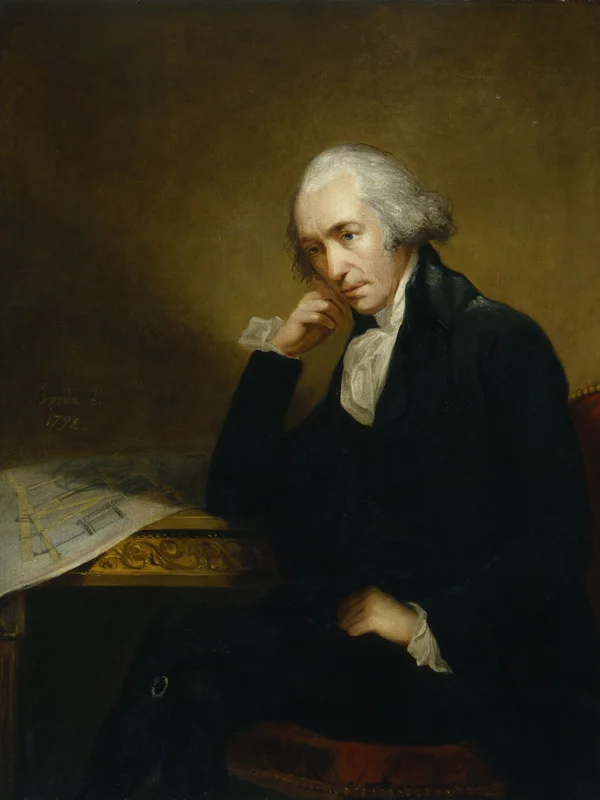

Scottish inventor and mechanical engineer whose separate condenser of 1765 made the steam engine fuel-efficient, turning it into the power source of the Industrial Revolution.
Early Life
James Watt was born on 19 January 1736 in Greenock, Scotland, the eldest surviving child of a shipwright and merchant. He was educated at the grammar school in Greenock and learned practical skills in his father's workshop, where he handled tools and instruments from a young age. He was a delicate child and was taught partly at home. In 1755 he went to London to learn the trade of mathematical instrument making, and in 1756 he returned to Scotland to set up as an instrument maker to the University of Glasgow.
Education
Watt had little formal schooling beyond the grammar school in Greenock. He learned his trade as an apprentice instrument maker in London in 1755, and from 1756 he worked as a mathematical instrument maker to the University of Glasgow, where contact with professors and their scientific instruments gave him much of his education in natural philosophy.
Career
Watt trained as a mathematical instrument maker, working in London in 1755 and then at the University of Glasgow from 1756, where a model Newcomen engine was brought to him for repair in 1763. Studying its wastefulness led him to the separate condenser in 1765. He patented the idea in 1769, but lacked the money to build engines until he found backers, first the ironmaster John Roebuck and then, from 1774, the Birmingham manufacturer Matthew Boulton. Parliament extended his patent in 1775 until 1800, and the Boulton & Watt partnership at Soho, near Birmingham, built and installed engines across Britain and abroad. Watt retired from the firm in 1800, when the patent expired, and spent his later years at Heathfield Hall, near Birmingham, working on inventions including a machine for copying letters and sculptures. He died there in 1819.
Achievements
Watt's central achievement was the separate condenser, conceived in 1765 and patented in 1769. Earlier Newcomen engines wasted most of their fuel because the cylinder was cooled on every stroke; Watt condensed the steam in a separate cold vessel, so the cylinder stayed hot, and his engines burned far less coal. With Matthew Boulton he turned the idea into a business: Boulton & Watt engines pumped mines, drove mills and powered factories. His later patents, the sun-and-planet gear of 1781, the double-acting engine of 1782 and the parallel motion of 1784, turned the up-and-down motion of a pumping engine into the rotary motion factories needed, and the centrifugal governor kept engine speed steady. The unit of power, the watt, was named in his honour.
- Conceived the separate condenser in 1765, the improvement that made the steam engine far more fuel-efficient
- Patented his improved steam engine in 1769, under the title 'A New Invented Method of Lessening the Consumption of Steam and Fuel in Fire Engines'
- Built, with Matthew Boulton, the Boulton & Watt engines that powered mines, mills and factories across Britain
- Patented the sun-and-planet gear in 1781, the double-acting engine in 1782 and the parallel motion in 1784, turning steam power into rotary power for factories
- Fitted his engines with the centrifugal governor, which kept an engine running at a steady speed under changing loads
- Had his 1769 patent extended by Parliament in 1775 until 1800, giving Boulton & Watt time to build the steam-engine business
- The unit of power, the watt, was named in his honour
Legacy
Watt is remembered as the engineer whose improvements made steam power practical and affordable, and so helped drive the Industrial Revolution. He did not invent the steam engine, but his separate condenser and his rotary-motion mechanisms turned an inefficient mine pump into the general power source of factories, mills and transport. His engines, built by Boulton & Watt, were installed across Britain and exported abroad, and the business model of selling engines with installation and maintenance became a pattern for engineering firms. The watt, the unit of power, keeps his name in daily use, and his workshop, preserved by the Science Museum in London, is one of its most visited displays.
Contributions
Watt's contribution was to make steam power economical. The Newcomen engine burned huge amounts of coal because it heated and cooled its cylinder on every stroke; Watt's separate condenser kept the cylinder hot and condensed the steam elsewhere, cutting fuel use sharply. His rotary-motion mechanisms then freed the engine from pumping alone, so that one engine could drive the machinery of a whole factory. Together, cheap steam and rotary power made it possible to build factories away from water power, to mechanise spinning, weaving and ironmaking, and to carry the Industrial Revolution into new towns and industries.
Notable Works
- Watt steam engine with separate condenser (patented 1769)
- Sun-and-planet gear for rotary motion (1781)
- Double-acting steam engine (1782)
- Parallel motion linkage (1784)
- Centrifugal governor for steam engines
- Boulton & Watt, Soho, Birmingham
Milestones
- 1736 — Born on 19 January in Greenock, Scotland Source: Encyclopaedia Britannica
- 1755 — Went to London to train as a mathematical instrument maker Source: Wikipedia
- 1756 — Became mathematical instrument maker to the University of Glasgow Source: Encyclopaedia Britannica
- 1763 — A model Newcomen engine was brought to him for repair Source: Encyclopaedia Britannica
- 1765 — Conceived the separate condenser on Glasgow Green Source: Encyclopaedia Britannica; Science Museum Group
- 1769 — Patented his improved steam engine on 5 January Source: Encyclopaedia Britannica
- 1774 — Moved to Birmingham to work with Matthew Boulton Source: Encyclopaedia Britannica
- 1775 — Parliament extended his patent until 1800; Boulton & Watt partnership began Source: Encyclopaedia Britannica
- 1776 — First commercial Boulton & Watt engines went into service Source: Wikipedia
- 1781 — Patented the sun-and-planet gear for rotary motion Source: Encyclopaedia Britannica
- 1782 — Patented the double-acting engine Source: Encyclopaedia Britannica
- 1784 — Patented the parallel motion linkage Source: Encyclopaedia Britannica
- 1785 — Elected a Fellow of the Royal Society Source: Wikipedia
- 1800 — Retired from Boulton & Watt when his patent expired Source: Encyclopaedia Britannica
- 1819 — Died on 25 August at Heathfield Hall, near Birmingham, aged 83 Source: Encyclopaedia Britannica
Timeline
- 19 January 1736
Born in Greenock, Scotland (19 January Old Style; 30 January New Style)
Approximate date Source: Encyclopaedia Britannica; Wikipedia - 1755
Went to London to train as a mathematical instrument maker
Year only — exact date unknown Source: Encyclopaedia Britannica; Wikipedia - 1756
Became mathematical instrument maker to the University of Glasgow
Year only — exact date unknown Source: Encyclopaedia Britannica - 1763
A model Newcomen engine was brought to his Glasgow workshop for repair, starting his study of steam power
Year only — exact date unknown Source: Encyclopaedia Britannica - 1765
Conceived the separate condenser during a walk on Glasgow Green
Year only — exact date unknown Source: Encyclopaedia Britannica; Science Museum Group - 5 January 1769
Received his patent for lessening the consumption of steam and fuel in fire engines
Source: Encyclopaedia Britannica; Wikipedia - 1774
Moved to Birmingham and began working with Matthew Boulton
Year only — exact date unknown Source: Encyclopaedia Britannica - 1775
Parliament extended his 1769 patent until 1800; the Boulton & Watt partnership began
Year only — exact date unknown Source: Encyclopaedia Britannica - 1776
The first commercial Boulton & Watt engines went into service
Year only — exact date unknown Source: Encyclopaedia Britannica; Wikipedia - 1781
Patented the sun-and-planet gear, giving engines rotary motion
Year only — exact date unknown Source: Encyclopaedia Britannica - 1782
Patented the double-acting engine
Year only — exact date unknown Source: Encyclopaedia Britannica - 1784
Patented the parallel motion linkage
Year only — exact date unknown Source: Encyclopaedia Britannica - 1785
Elected a Fellow of the Royal Society
Year only — exact date unknown Source: Wikipedia - 1800
His patent expired and he retired from Boulton & Watt
Year only — exact date unknown Source: Encyclopaedia Britannica - 25 August 1819
Died at Heathfield Hall, near Birmingham, aged 83
Source: Encyclopaedia Britannica
Related Personalities
Frequently Asked Questions
Who was James Watt?
James Watt (1736–1819) was a Scottish inventor and mechanical engineer whose improvements to the steam engine helped drive the Industrial Revolution. He did not invent the steam engine itself, but his separate condenser of 1765 made it far more fuel-efficient.
His later mechanisms turned the engine into rotary power for factories. The unit of power, the watt, was named in his honour.
Source: Encyclopaedia Britannica ; WikipediaWhat did James Watt invent?
Watt's great invention was the separate condenser, conceived in 1765 during a walk on Glasgow Green. In a Newcomen engine, cold water was sprayed into the cylinder to condense the steam, so the cylinder had to be reheated on every stroke.
Watt condensed the steam in a separate cold vessel instead, keeping the cylinder hot and cutting fuel use sharply. He patented the idea in 1769.
Source: Encyclopaedia Britannica ; Science Museum GroupDid James Watt invent the steam engine?
No, James Watt did not invent the steam engine. Thomas Savery patented an early steam pump in 1698 and Thomas Newcomen built a practical atmospheric steam engine in 1712, used mainly for pumping mines, and Watt's achievement was to improve that engine so much that it became economical and versatile.
His separate condenser, patented in 1769, and his rotary-motion mechanisms of the 1780s turned the engine into the power source of factories.
Source: Encyclopaedia Britannica ; Science Museum GroupWhen was James Watt born, and why do sources give two dates?
Watt was born on 19 January 1736 in Greenock, Scotland, according to Britannica and most modern sources. Some sources give 30 January 1736 instead, because Britain still used the Julian calendar, known as Old Style, in 1736, and 19 January Old Style is 30 January in the modern Gregorian calendar.
The difference is one of calendars, not of the day he was born.
Source: Encyclopaedia Britannica ; WikipediaWho was Matthew Boulton, and why did Watt need him?
Watt worked in partnership with Matthew Boulton, a Birmingham manufacturer, from 1774. Boulton supplied the capital, the Soho works and business organisation, while Watt supplied the designs and technical skill. Parliament extended Watt's 1769 patent until 1800, giving the firm time to build its business.
The firm of Boulton & Watt built and installed steam engines across Britain, selling them with installation and maintenance, a model later engineering firms followed.
Source: Encyclopaedia Britannica ; Science Museum GroupWhy is the unit of power called the watt?
The watt is the unit of power, named in honour of James Watt for his work on steam engines. It measures the rate at which energy is used or produced, and it is the unit used for the power of electrical appliances, light bulbs and engines.
The naming recognises that Watt's improvements made steam power, and therefore mechanical power in general, practical on an industrial scale.
Source: Encyclopaedia Britannica ; WikipediaSources & References
- James Watt — Encyclopaedia Britannica — Encyclopaedia Britannica (accessed 13 November 2026)
- James Watt — Wikipedia — Wikipedia (accessed 13 November 2026)
- Remains of a Cornish pumping engine, 'Old Bess', built by James Watt, 1777 — Science Museum Group Collection — Science Museum Group (accessed 13 November 2026)
- File:Watt James von Breda.jpg — Wikimedia Commons (portrait file page) — Wikimedia Commons (accessed 13 November 2026)
Explore More
- More Scientists & Inventors
- Personalities from United Kingdom
- More inventors
- More engineers
- More chemists
- Famous people born in January
- Browse all personalities
Featured on these lists: