Henry Ford
Inventor · Engineer · Entrepreneur
1863–1947 · Born in Springwells Township, Michigan, United States · 4 min read
- Verified: 13 November 2026
- Sources: 4
- Independently reviewed
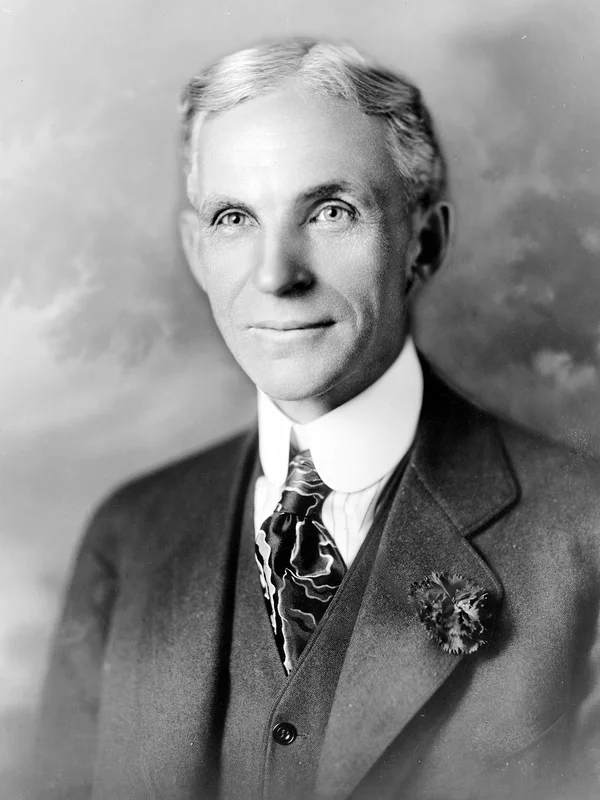

American industrialist who founded the Ford Motor Company in 1903, built the affordable Model T, and perfected the moving assembly line that changed manufacturing worldwide.
Early Life
Henry Ford was born on 30 July 1863 on the family farm in Springwells Township, Michigan, near Dearborn, one of eight children of William and Mary Ford. He disliked farm work and was fascinated by machines from childhood, taking clocks and watches apart to see how they worked. He attended a one-room school and at sixteen left the farm for Detroit, where he apprenticed as a machinist, first at the Michigan Car Company works and then with a maker of steam engines. He returned to the farm for a time, working as a steam-engine repairman, before joining the Edison Illuminating Company in Detroit in 1891.
Education
Ford was educated at a one-room school in Springwells Township and left school at sixteen. His training was as a machinist's apprentice in Detroit, followed by work as a steam-engine repairman and then as an engineer with the Edison Illuminating Company, where he rose to chief engineer in 1893.
Career
Ford grew up on a farm near Dearborn, Michigan, and left at sixteen to apprentice as a machinist in Detroit. He worked as an engineer for the Edison Illuminating Company, becoming chief engineer in 1893, and in his spare time built his first car, the Quadricycle, which he drove in June 1896. He left Edison in 1899 to build cars, but his first two companies failed. In June 1903 he founded the Ford Motor Company, and in 1908 he launched the Model T, the car that made the company. The moving assembly line of 1913–14 let Ford build cars faster and cheaper than any rival, and by the early 1920s about half the cars on American roads were Model Ts. Ford resisted change for too long, keeping the Model T almost unchanged while rivals offered new features, and in 1927 he shut his plants for five months to retool for the Model A. He handed the presidency to his son Edsel in 1919, took it back after Edsel's death in 1943, and retired in 1945 in favour of his grandson Henry Ford II. He died at his home in Dearborn in 1947.
Achievements
Ford's central achievement was to make the car affordable. The Model T, introduced in October 1908, was rugged, simple and cheap enough for farmers and workers to buy, and more than 15 million were sold in the United States before production ended in 1927. That scale was only possible because of the moving assembly line, perfected at the Highland Park plant in 1913–14, which cut chassis assembly from more than twelve hours to about ninety-three minutes. In January 1914 Ford announced a five-dollar daily wage and an eight-hour day, roughly doubling the industry's average pay, so that his own workers could afford the cars they built. He later introduced the Model A in 1927 and the Ford V-8 in 1932, and the Ford Motor Company he founded in 1903 became one of the largest car makers in the world.
- Built the Quadricycle in 1896, his first gasoline-powered car, driven on the streets of Detroit
- Founded the Ford Motor Company in 1903, after two earlier car companies failed
- Introduced the Model T in 1908, the first car built in the millions and affordable to ordinary families; more than 15 million were sold
- Perfected the moving assembly line at Highland Park in 1913–14, cutting chassis assembly from more than twelve hours to about ninety-three minutes
- Announced a five-dollar daily wage and an eight-hour day in January 1914, roughly doubling the industry's average pay
- Introduced the Model A in December 1927 after shutting the plants for five months to retool
- Introduced the Ford V-8 engine in 1932, bringing eight-cylinder power to a low-priced car
Legacy
Ford is remembered as the man who put the world on wheels. He did not invent the automobile, but he made it affordable, and his moving assembly line changed manufacturing far beyond cars: the same methods of standardised parts, conveyor lines and divided labour spread to almost every factory in the world. The five-dollar day and the eight-hour day pushed up wages and shortened working hours across American industry, and the Model T changed American life, letting farmers reach towns, workers commute to factories and families travel for leisure. The Ford Motor Company remains one of the world's largest car makers, and The Henry Ford museum in Dearborn preserves his Quadricycle and the story of his work.
Contributions
Ford's contribution was mass production. Before him, cars were built one at a time by skilled craftsmen and cost more than most people earned in a year; after him, standardised parts moved along a conveyor and workers each did one small task, so a car could be built in about ninety minutes and sold at a price ordinary families could pay. That system, with its high wages and short hours, created both the modern factory and the modern consumer: workers who could afford the products they made. The assembly line he perfected became the pattern for manufacturing everything from appliances to aeroplanes.
Notable Works
- Ford Quadricycle (1896)
- Ford Motor Company, founded 1903
- Model T (1908–1927)
- Moving assembly line (1913–14)
- Model A (1927)
- Ford V-8 engine (1932)
Milestones
- 1863 — Born on 30 July on the family farm near Dearborn, Michigan Source: Encyclopaedia Britannica
- 1879 — Left the farm for Detroit to apprentice as a machinist Source: Wikipedia
- 1891 — Joined the Edison Illuminating Company in Detroit Source: Encyclopaedia Britannica
- 1893 — Became chief engineer of the Edison Illuminating Company Source: Encyclopaedia Britannica
- 1896 — Drove his first car, the Quadricycle, in Detroit on 4 June Source: The Henry Ford
- 1899 — Left Edison to start his first automobile company Source: Encyclopaedia Britannica
- 1903 — Founded the Ford Motor Company on 16 June Source: Encyclopaedia Britannica
- 1908 — Introduced the Model T in October Source: Encyclopaedia Britannica
- 1913 — Perfected the moving assembly line at Highland Park Source: Encyclopaedia Britannica
- 1914 — Announced a five-dollar daily wage and an eight-hour day on 5 January Source: Encyclopaedia Britannica
- 1927 — Introduced the Model A in December; Model T production ended Source: Encyclopaedia Britannica
- 1932 — Introduced the Ford V-8 engine Source: Encyclopaedia Britannica
- 1945 — Retired as president in favour of his grandson Henry Ford II Source: Encyclopaedia Britannica
- 1947 — Died on 7 April at his home in Dearborn, aged 83 Source: Encyclopaedia Britannica
Timeline
- 30 July 1863
Born on the family farm in Springwells Township, Michigan, near Dearborn
Source: Encyclopaedia Britannica - 1879
Left the farm for Detroit to apprentice as a machinist
Year only — exact date unknown Source: Encyclopaedia Britannica; Wikipedia - 1891
Joined the Edison Illuminating Company in Detroit as an engineer
Year only — exact date unknown Source: Encyclopaedia Britannica - 1893
Became chief engineer of the Edison Illuminating Company
Year only — exact date unknown Source: Encyclopaedia Britannica - 4 June 1896
Drove his first car, the Quadricycle, on the streets of Detroit
Source: The Henry Ford; Encyclopaedia Britannica - 1899
Left Edison to start his first automobile company, which failed
Year only — exact date unknown Source: Encyclopaedia Britannica - 16 June 1903
Founded the Ford Motor Company
Source: Encyclopaedia Britannica; Wikipedia - 1908-10
Introduced the Model T
Approximate date Source: Encyclopaedia Britannica - 1913
Perfected the moving assembly line at the Highland Park plant
Year only — exact date unknown Source: Encyclopaedia Britannica - 5 January 1914
Announced a five-dollar daily wage and an eight-hour day
Source: Encyclopaedia Britannica - 1927-12
Introduced the Model A after shutting the plants for five months to retool; Model T production ended
Approximate date Source: Encyclopaedia Britannica - 1932
Introduced the Ford V-8 engine
Year only — exact date unknown Source: Encyclopaedia Britannica - 1945
Retired as president of the Ford Motor Company in favour of his grandson Henry Ford II
Year only — exact date unknown Source: Encyclopaedia Britannica - 7 April 1947
Died at his home in Dearborn, Michigan, aged 83
Source: Encyclopaedia Britannica
Related Personalities
Frequently Asked Questions
Who was Henry Ford?
Henry Ford (1863–1947) was an American industrialist and inventor who founded the Ford Motor Company in 1903 and made the automobile affordable to ordinary people. His Model T, introduced in 1908, was the first car built in the millions, and his moving assembly line of 1913–14 revolutionised factory production. More
than 15 million Model Ts were sold in the United States.
Source: Encyclopaedia Britannica ; The Henry FordDid Henry Ford invent the automobile?
No, Henry Ford did not invent the car. Karl Benz patented the first gasoline-powered automobile in Germany in 1886, a decade before Ford built his first car, the Quadricycle, in 1896. Ford's achievement was different: he made cars affordable by building them on a moving assembly line with standardised parts.
That system let the Model T be sold at a price ordinary families could pay, and it changed manufacturing far beyond the car industry.
Source: Encyclopaedia Britannica ; The Henry FordWhat was the Model T, and why was it important?
The Model T was Ford's ninth car design, introduced in October 1908 and built until 1927. It was rugged, simple to drive and repair, and cheap enough for farmers and workers to buy. More than 15 million were sold in the United States, and by the early 1920s about half
the cars on American roads were Model Ts. Its success was made possible by the moving assembly line, which cut production time sharply.
Source: Encyclopaedia BritannicaWhat was the moving assembly line?
The moving assembly line, perfected at Ford's Highland Park plant in 1913–14, brought the work to the workers on a conveyor instead of having workers move around a stationary car. Each worker did one small task as the chassis moved past, and parts arrived on subsidiary lines with precise timing.
Chassis assembly fell from more than twelve hours to about ninety-three minutes, so Ford could build thousands of cars a day and cut the price.
Source: Encyclopaedia BritannicaWhat was Ford's first car?
Ford built his first car, the Quadricycle, in 1896 in a shed behind his home on Bagley Avenue in Detroit. It was a simple frame on four bicycle wheels with a two-cylinder gasoline engine, and he drove it on Detroit streets on 4 June 1896. He sold it later that
year to fund his second car, and bought it back in 1904. The original Quadricycle is preserved at The Henry Ford museum in Dearborn, Michigan.
Source: The Henry Ford ; Encyclopaedia BritannicaWhat was the five-dollar day?
In January 1914 Ford announced a five-dollar daily wage and an eight-hour day for eligible workers, roughly doubling the industry's average pay and cutting the working day from nine hours to eight. The move reduced labour turnover, let Ford hire the best workers, and meant his own employees could afford
to buy a Model T. It also pushed wages up across American industry and helped spread the eight-hour day.
Source: Encyclopaedia BritannicaSources & References
- Henry Ford — Encyclopaedia Britannica — Encyclopaedia Britannica (accessed 13 November 2026)
- Henry Ford — Wikipedia — Wikipedia (accessed 13 November 2026)
- 1896 Ford Quadricycle — The Henry Ford (artifact record) — The Henry Ford (accessed 13 November 2026)
- File:Henry ford 1919.jpg — Wikimedia Commons (portrait file page) — Wikimedia Commons (accessed 13 November 2026)
Explore More
- More Scientists & Inventors
- Personalities from United States
- More inventors
- More engineers
- More entrepreneurs
- Famous people born in July
- Browse all personalities
Featured on these lists: