Don Bradman
Cricketer · Batsman · Former captain
1908–2001 · Born in Cootamundra, New South Wales, Australia · 4 min read
- Verified: 13 November 2026
- Sources: 6
- Independently reviewed
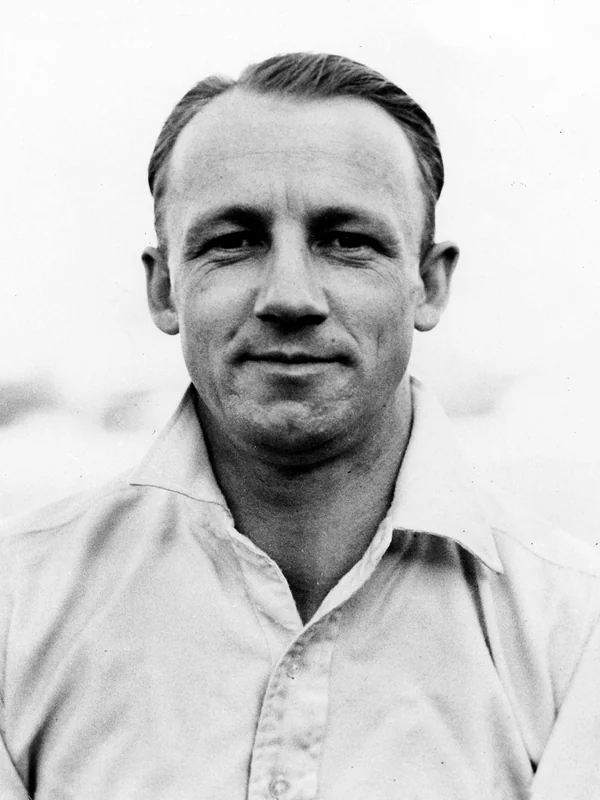

Australian batsman Sir Donald Bradman, 'the Don', averaged 99.94 in 52 Tests — the greatest batting record in cricket — and captained the unbeaten 1948 Invincibles.
Early Life
Donald George Bradman was born on 27 August 1908 in Cootamundra, New South Wales, the youngest of five children of George and Emily Bradman. When he was about two years old the family moved to Bowral, where he grew up. As a boy he practised alone with a cricket stump for a bat and a golf ball, hitting it against the curved brick base of a water tank so it rebounded at speed and at varying angles, a game that sharpened his timing and reactions. He scored his first century at the age of 12 for Bowral Public School, and by his teens he was scoring heavily in district cricket, including 320 not out in a competition final against Moss Vale. He moved to Sydney to play grade cricket for St George and first-class cricket for New South Wales, rising from bush cricket to the Australian Test team in just over two years.
Career
Bradman made his first-class debut for New South Wales in December 1927, scoring 118, and his Test debut against England at Brisbane on 30 November 1928. He was dropped after that first Test but returned to score his first Test century at Melbourne and never looked back. In 1930 he scored 974 runs in the Ashes in England, including 334 at Headingley and 254 at Lord's. England devised Bodyline, bowling short at the body with a packed leg-side field, to curb him in 1932-33; he still averaged 56.57 in the series. He became Australian captain in 1936 and led the side through the late 1930s. After the Second World War interrupted his career, he returned to captain the 1948 tour of England, the Invincibles, who went unbeaten in 34 matches and won the Ashes 4-0. His final Test innings, at The Oval on 14 August 1948, ended in a duck bowled by Eric Hollies when four runs would have given him a career average of exactly 100. After retirement he served cricket as an administrator, selector and writer for three decades.
Achievements
Bradman's records stand apart from every other batsman in cricket history. In 52 Tests he scored 6,996 runs at an average of 99.94, nearly forty runs per innings ahead of the next best career average, and he scored a century in 29 of his 80 Test innings. His 974 runs in the 1930 Ashes series remains the record for a single series, and his 334 at Headingley in that series was then the highest Test score. He scored 12 Test double centuries, the most by any batsman, and two triple centuries at Headingley, 334 in 1930 and 304 in 1934. In first-class cricket he scored 28,067 runs at 95.14 with 117 centuries. He was knighted in 1949, was named one of Wisden's Five Cricketers of the Century in 2000, and was inducted as an inaugural member of the ICC Cricket Hall of Fame in 2009.
- Scored 6,996 runs in 52 Tests at an average of 99.94, the highest career Test batting average by a wide margin
- Scored 974 runs in the 1930 Ashes series in England, still the record for a single Test series
- Scored 334 at Headingley in 1930, then the highest Test score, and 304 at the same ground in 1934
- Scored 29 Test centuries and 12 Test double centuries, the most double centuries by any batsman
- Captained Australia on the 1948 tour of England, when the team went unbeaten in 34 matches and became known as the Invincibles
- Knighted in 1949, the first Australian cricketer to be knighted for services to cricket
- Named one of Wisden's Five Cricketers of the Century in 2000 and inducted as an inaugural member of the ICC Cricket Hall of Fame in 2009
Legacy
Bradman is widely regarded as the greatest batsman of all time, and his Test average of 99.94 is often described as the greatest statistical achievement in any major sport. He became a national icon in Australia during the Great Depression and remained one after the Second World War, with Prime Minister John Howard calling him the greatest living Australian in 1997. His image has appeared on postage stamps and coins, a museum dedicated to his life opened at Bowral while he was still living, and the Bradman Museum and International Cricket Hall of Fame stand there today. The number 99.94 has become a cultural reference point in Australia, and the story of his final-innings duck, four runs short of an average of 100, is one of the most retold tales in sport.
Contributions
Bradman changed what was thought possible with a bat. His combination of fast footwork, calm confidence and rapid scoring produced runs at a rate no batsman before or since has approached, and his dominance forced England to invent Bodyline, a tactic that changed the laws and diplomacy of the game. As captain and later as an administrator he championed attacking, entertaining cricket, and his books Farewell to Cricket and The Art of Cricket carried his ideas to generations of players. His career also showed that a boy from a small country town, practising alone with a stump and a golf ball, could reach the top of world sport.
Notable Works
- Australia national cricket team (1928-1948)
- 1930 Ashes series: 974 runs, including 334 at Headingley
- 1948 Invincibles tour of England, unbeaten in 34 matches
- Farewell to Cricket (1950)
- The Art of Cricket (1958)
Milestones
- 1908 — Born on 27 August in Cootamundra, New South Wales, Australia Source: Encyclopaedia Britannica; Wikipedia (Don Bradman)
- 1927 — Made his first-class debut for New South Wales, scoring 118 Source: Wikipedia (Don Bradman)
- 1928 — Made his Test debut against England at Brisbane Source: Wikipedia (Don Bradman)
- 1930 — Scored 974 runs in the Ashes in England, including 334 at Headingley, a series record that still stands Source: Encyclopaedia Britannica; Wikipedia (Don Bradman)
- 1932 — Faced England's Bodyline tactics in the Ashes in Australia and still averaged 56.57 Source: Wikipedia (Don Bradman)
- 1934 — Scored 304 at Headingley, his second triple century at the ground Source: Wikipedia (Don Bradman)
- 1936 — Appointed captain of Australia Source: Wikipedia (Don Bradman)
- 1948 — Captained the Invincibles on an unbeaten tour of England and played his final Test, finishing with a Test average of 99.94 Source: Encyclopaedia Britannica; Wikipedia (Don Bradman)
- 1949 — Knighted, the first Australian cricketer to receive the honour for cricket Source: Encyclopaedia Britannica
- 2009 — Inducted as an inaugural member of the ICC Cricket Hall of Fame Source: ICC
Timeline
- 27 August 1908
Born in Cootamundra, New South Wales, Australia
Source: Encyclopaedia Britannica; Wikipedia (Don Bradman) - 1927-12
Made his first-class debut for New South Wales, scoring 118 against South Australia at Adelaide
Approximate date Source: Wikipedia (Don Bradman) - 30 November 1928
Made his Test debut against England at Brisbane
Source: Wikipedia (Don Bradman); Encyclopaedia Britannica - 1930-07
Scored 334 against England at Headingley, then the highest Test score, during a series in which he made 974 runs
Approximate date Source: Encyclopaedia Britannica; Wikipedia (Don Bradman) - 1932-12
England began the Bodyline series in Australia, a tactic devised to curb his scoring
Approximate date Source: Wikipedia (Don Bradman) - 1934-07
Scored 304 against England at Headingley, his second triple century at the ground
Approximate date Source: Wikipedia (Don Bradman) - 1936
Appointed captain of Australia
Year only — exact date unknown Source: Wikipedia (Don Bradman) - 14 August 1948
Played his final Test innings at The Oval, bowled for a duck by Eric Hollies when four runs would have given him a Test average of exactly 100
Source: Wikipedia (Fifth Test, 1948 Ashes series) - 1949
Knighted, the first Australian cricketer to be knighted for services to cricket
Year only — exact date unknown Source: Encyclopaedia Britannica - 25 February 2001
Died at Kensington Park, South Australia, aged 92
Source: Wikipedia (Don Bradman); Encyclopaedia Britannica - 19 November 2009
Inducted posthumously as an inaugural member of the ICC Cricket Hall of Fame
Source: ICC
Related Personalities
Frequently Asked Questions
Who was Don Bradman?
Sir Donald George Bradman (1908-2001) was an Australian batsman widely regarded as the greatest Test batsman of all time. In 52 Tests for Australia between 1928 and 1948, he scored 6,996 runs at an average of 99.94, a record that still stands today. He captained the unbeaten 1948 Invincibles tour of England.
Source: Encyclopaedia Britannica ; ICCWhy is Bradman's average of 99.94 so famous?
Bradman's Test average of 99.94 sits far above every other great batsman, most of whom average in the fifties. He needed just four runs in his final innings at The Oval in 1948 to finish at exactly 100, but Eric Hollies bowled him for a duck. The near-miss made 99.94 cricket's most famous number.
Source: Wikipedia (Don Bradman) ; Wikipedia (Fifth Test, 1948 Ashes series)What was Bodyline?
Bodyline was a tactic England used in the 1932-33 Ashes series to curb Bradman's scoring. Fast bowlers aimed short balls at the batsman's body with a packed leg-side field, forcing defensive strokes and catches. The tactic worked partly, but caused a diplomatic row between England and Australia.
Source: Wikipedia (Don Bradman) ; Encyclopaedia BritannicaWhat did Bradman achieve in the 1930 Ashes?
In the 1930 Ashes series in England, Bradman scored 974 runs in five Tests, still the record for a single series. His 334 at Headingley was then the highest Test score, and he followed it with 254 at Lord's. He was 21 years old, and the tour made him a sporting idol in Australia.
Source: Encyclopaedia Britannica ; Wikipedia (Don Bradman)What happened on Bradman's final tour in 1948?
Bradman captained Australia on the 1948 tour of England, where the team went unbeaten in 34 matches and became known as the Invincibles. Australia won the Ashes 4-0. His final Test innings ended in a duck at The Oval, leaving his average at 99.94, and he retired after the tour.
Source: Encyclopaedia Britannica ; Wikipedia (Don Bradman)What honours did Bradman receive?
Bradman was knighted in 1949, the first Australian cricketer to receive the honour for cricket. He was made a Companion of the Order of Australia in 1979. In 2009 he was inducted as an inaugural member of the ICC Cricket Hall of Fame, and the Bradman Museum at Bowral honours his life.
Source: Encyclopaedia Britannica ; ICCSources & References
- Don Bradman — Wikipedia — Wikipedia (accessed 13 November 2026)
- Don Bradman — Britannica — Encyclopaedia Britannica (accessed 13 November 2026)
- Don Bradman inducted into the ICC Cricket Hall of Fame — ICC (accessed 13 November 2026)
- Fifth Test, 1948 Ashes series — Wikipedia — Wikipedia (accessed 13 November 2026)
- Bradman, Don — Encyclopedia.com — Encyclopedia.com (accessed 13 November 2026)
- File:Don Bradman 1930.jpg — Wikimedia Commons (portrait file page) — Wikimedia Commons (accessed 13 November 2026)
Explore More
- More Athletes & Sports
- Personalities from Australia
- Personalities from England
- More cricketers
- More batsmans
- More former captains
- Famous people born in August
- Browse all personalities
Featured on these lists: