Bob Marley
Singer · Songwriter · Guitarist · Musician
1945–1981 · Born in Nine Mile, Saint Ann, Jamaica · 4 min read
- Verified: 13 November 2026
- Sources: 4
- Independently reviewed
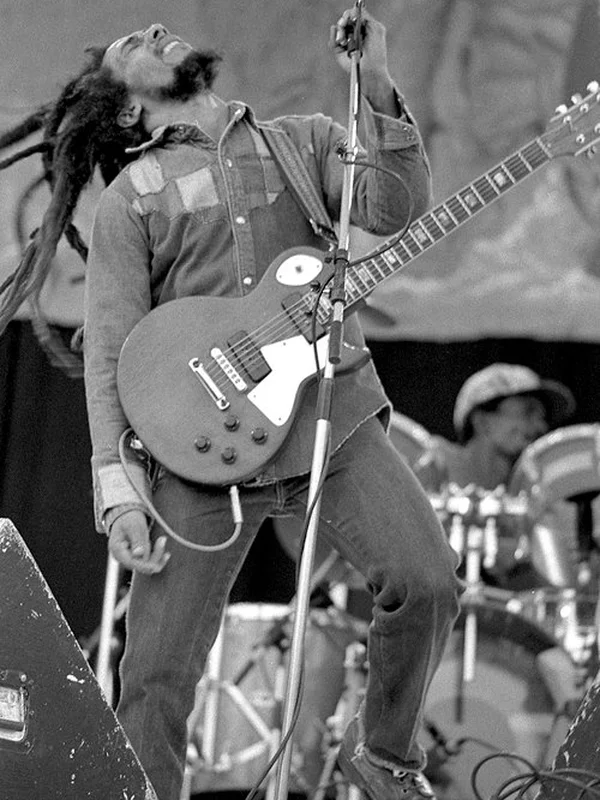

Jamaican singer, songwriter and guitarist who took reggae to a global audience with Bob Marley and the Wailers, through songs such as 'No Woman, No Cry', 'One Love' and 'Redemption Song'; he died of cancer in 1981 aged 36.
Early Life
Robert Nesta Marley was born on 6 February 1945 on the farm of his maternal grandfather in Nine Mile, Saint Ann Parish, Jamaica, to Norval Sinclair Marley, a white Jamaican plantation overseer of English descent, and Cedella Malcolm, a Black Jamaican teenager. His father died when Marley was ten. He moved with his mother to Trench Town, a poor neighbourhood of Kingston, where he met Peter Tosh and Bunny Wailer.
Education
Marley attended school in Nine Mile and in Kingston and left formal education in his teens, working for a time as a welder's apprentice before turning to music full time.
Career
Marley was born in Nine Mile, Saint Ann Parish, Jamaica, and moved with his mother to Trench Town in Kingston as a teenager. In 1963 he formed a vocal group with Peter Tosh and Bunny Wailer that became the Wailers, recording ska and rocksteady songs for the producer Coxsone Dodd. The group signed to Island Records in 1972 and released Catch a Fire in 1973, followed by Burnin' the same year; Eric Clapton's cover of 'I Shot the Sheriff' in 1974 brought Marley's songwriting to a wider audience. After Tosh and Wailer left, Marley led Bob Marley and the Wailers, releasing Natty Dread (1974), Rastaman Vibration (1976), Exodus (1977), Kaya (1978), Survival (1979) and Uprising (1980). Rastaman Vibration gave him his first success in the United States, and Exodus, recorded in London after the assassination attempt, is often called his finest album. His faith as a Rastafari shaped his lyrics, which spoke of freedom, resistance and unity, and his concerts became gatherings for his followers as much as performances. In December 1976 he survived an assassination attempt at his home in Kingston, two days before the Smile Jamaica concert, and performed anyway. In 1978 he headlined the One Love Peace Concert, where he joined the hands of Jamaica's rival political leaders on stage, and in 1980 he performed at Zimbabwe's independence celebrations. He was diagnosed with acral lentiginous melanoma in 1977; the cancer spread, and he died in Miami on 11 May 1981, aged 36.
Achievements
Marley's central achievements were to take reggae from Jamaica to a worldwide audience and to make its message of faith, resistance and unity part of global popular culture. With Bob Marley and the Wailers he released a run of classic albums, from Catch a Fire (1973) to Uprising (1980), including the songs 'No Woman, No Cry', 'One Love', 'Three Little Birds' and 'Redemption Song'. Marley also wrote 'Get Up, Stand Up' and 'Is This Love', songs that remain standards of reggae, and his music has been covered by artists across genres, from Eric Clapton to Lauryn Hill. His album Exodus was named the best album of the twentieth century by Time magazine in 1999, and the BBC named 'One Love' its song of the millennium. He received Jamaica's Order of Merit in 1981 and was inducted into the Rock and Roll Hall of Fame in 1994.
- Formed the Wailers with Peter Tosh and Bunny Wailer in 1963
- Released the breakthrough album Catch a Fire with Island Records in 1973
- Released the album Natty Dread in 1974, featuring 'No Woman, No Cry'
- Released the albums Rastaman Vibration (1976), Exodus (1977), Kaya (1978), Survival (1979) and Uprising (1980)
- Brought reggae to a global audience and became Jamaica's most famous musical export
- Headlined the One Love Peace Concert in Kingston in 1978, joining the hands of rival political leaders on stage
- Performed at Zimbabwe's independence celebrations in 1980
- Received the Order of Merit, Jamaica's third-highest honour, in 1981
- Inducted into the Rock and Roll Hall of Fame in 1994
- His compilation album Legend (1984) became one of the best-selling reggae albums of all time
Legacy
Marley is remembered as the musician who carried reggae and Rastafari culture to the world, and as a symbol of Jamaican identity and of resistance to oppression. His songs remain anthems of peace and unity, and his face is one of the most reproduced images in popular music. His compilation album Legend, released in 1984, has sold steadily for four decades and introduced new generations to his work. He was buried with his guitar and a Bible in a mausoleum at Nine Mile, near his birthplace, and his home there is now a place of pilgrimage for his fans. His children, including Ziggy, Stephen, Damian and Cedella Marley, have carried on his musical legacy.
Contributions
Marley's contribution was to make reggae a world music. He took a Jamaican sound built on ska and rocksteady, gave it the polish of rock and the message of Rastafari faith, and carried it to stadiums in Europe, North America and Africa. His songs gave a voice to the poor and the oppressed, and his image and music became a global symbol of Jamaica itself.
Notable Works
- Catch a Fire (1973)
- Natty Dread (1974)
- Rastaman Vibration (1976)
- Exodus (1977)
- Kaya (1978)
- Uprising (1980)
- Legend (1984)
Milestones
- 1945 — Born Robert Nesta Marley in Nine Mile, Jamaica Source: Encyclopaedia Britannica
- 1963 — Formed the Wailers with Peter Tosh and Bunny Wailer Source: Wikipedia
- 1973 — Released the breakthrough album Catch a Fire Source: Wikipedia
- 1974 — Released Natty Dread, featuring 'No Woman, No Cry' Source: Wikipedia
- 1976 — Survived an assassination attempt; released Rastaman Vibration Source: Wikipedia
- 1977 — Released the album Exodus Source: Wikipedia
- 1978 — Headlined the One Love Peace Concert in Kingston Source: Wikipedia
- 1980 — Released Uprising; performed at Zimbabwe's independence celebrations Source: Wikipedia
- 1981 — Received the Order of Merit of Jamaica; died in Miami aged 36 Source: Encyclopaedia Britannica
- 1984 — Compilation album Legend released Source: Wikipedia
- 1994 — Inducted into the Rock and Roll Hall of Fame Source: Wikipedia
Timeline
- 6 February 1945
Born Robert Nesta Marley in Nine Mile, Saint Ann, Jamaica
Source: Encyclopaedia Britannica - 1963
Formed the Wailers with Peter Tosh and Bunny Wailer
Year only — exact date unknown Source: Wikipedia - 13 April 1973
Released the album Catch a Fire with Island Records
Source: Wikipedia - 25 October 1974
Released the album Natty Dread, featuring 'No Woman, No Cry'
Source: Wikipedia - 3 December 1976
Survived an assassination attempt at his home in Kingston
Source: Wikipedia - 3 June 1977
Released the album Exodus
Source: Wikipedia - 22 April 1978
Headlined the One Love Peace Concert in Kingston
Source: Wikipedia - 10 June 1980
Released the album Uprising, featuring 'Redemption Song'
Source: Wikipedia - 1980
Performed at Zimbabwe's independence celebrations
Year only — exact date unknown Source: Wikipedia - 1981
Received the Order of Merit of Jamaica
Year only — exact date unknown Source: Wikipedia - 11 May 1981
Died in Miami, Florida, aged 36, after the spread of melanoma
Source: Encyclopaedia Britannica
In Their Words
“Emancipate yourselves from mental slavery; none but ourselves can free our minds.” Source: Bob Marley, 'Redemption Song', on the album Uprising (1980) — The closing lines of 'Redemption Song', the final track of Marley's last studio album, Uprising (1980). The words draw on a speech by the Jamaican political leader Marcus Garvey.
Related Personalities
Frequently Asked Questions
Who was Bob Marley?
Bob Marley (born Robert Nesta Marley, 6 February 1945, died 11 May 1981) was a Jamaican singer, songwriter and guitarist who led Bob Marley and the Wailers and took reggae to a global audience with songs such as 'No Woman, No Cry', 'One Love' and 'Redemption Song'.
Source: Encyclopaedia BritannicaWhere was Bob Marley born?
Marley was born on 6 February 1945 in Nine Mile, Saint Ann Parish, Jamaica. He moved to Trench Town in Kingston as a teenager, where he formed the Wailers with Peter Tosh and Bunny Wailer in 1963.
Source: Encyclopaedia Britannica ; WikipediaHow did Bob Marley die?
Marley died of cancer on 11 May 1981 in Miami, Florida, aged 36. He had been diagnosed in 1977 with acral lentiginous melanoma, a form of skin cancer, which spread to his lungs and brain.
Source: Encyclopaedia Britannica ; WikipediaWhat are Bob Marley's most famous songs?
Marley's best-known songs include 'No Woman, No Cry', 'One Love', 'Three Little Birds', 'Get Up, Stand Up', 'Is This Love', 'Jamming' and 'Redemption Song'. His albums include Catch a Fire (1973), Exodus (1977) and Uprising (1980), and the compilation Legend (1984).
Source: Encyclopaedia Britannica ; WikipediaWhat happened in the 1976 assassination attempt on Bob Marley?
In December 1976, two days before the Smile Jamaica concert in Kingston, gunmen attacked Marley's home and wounded him, his wife Rita and his manager. Marley performed at the concert anyway, two days later. No one was ever charged with the attack.
Source: Wikipedia ; Encyclopaedia BritannicaSources & References
- Bob Marley — Encyclopaedia Britannica — Encyclopaedia Britannica (accessed 13 November 2026)
- Bob Marley — Wikipedia (cross-check) — Wikipedia (accessed 13 November 2026)
- Bob Marley — Official website — Bob Marley (official site) (accessed 13 November 2026)
- File:Bob-Marley.jpg — Wikimedia Commons (portrait file page) — Wikimedia Commons (accessed 13 November 2026)