Timothy John Berners-Lee
Inventor · Computer scientist · Engineer
b. 1955 · Born in London, England · 3 min read
- Verified: 13 November 2026
- Sources: 6
- Independently reviewed
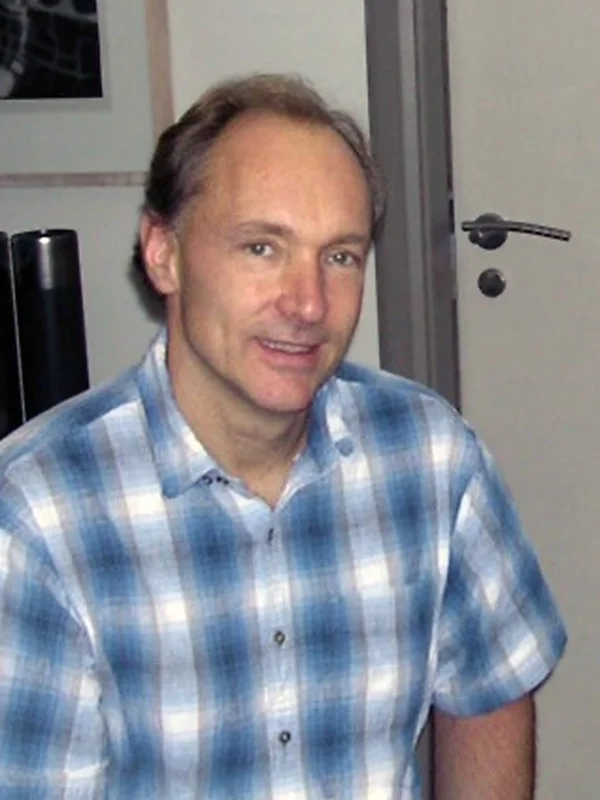

English computer scientist who invented the World Wide Web at CERN in 1989, built HTML, HTTP and URLs, and founded the World Wide Web Consortium in 1994.
Early Life
Timothy John Berners-Lee was born on 8 June 1955 in London, England, the eldest of four children of Mary Lee Woods and Conway Berners-Lee, both mathematicians and computer scientists who had worked on the Ferranti Mark I, one of the first commercial computers. He grew up in a household full of talk about computers and mathematics, and as a boy he built a computer from spare parts and an old television set. He was educated at Emanuel School in London and then at Queen's College, Oxford, where he read physics and graduated with first-class honours in 1976.
Education
Berners-Lee studied physics at Queen's College, University of Oxford, graduating with a first-class Bachelor of Arts degree in 1976. He is a professorial research fellow at the University of Oxford and a professor emeritus at the Massachusetts Institute of Technology.
Career
Berners-Lee studied physics at Queen's College, Oxford, graduating in 1976, and worked as an engineer for Plessey Telecommunications and as a founding director of Image Computer Systems. In 1980 he spent six months as a contractor at CERN, where he built ENQUIRE, a prototype hypertext system for sharing information. He returned to CERN as a fellow in 1984 and in March 1989 submitted his proposal for the World Wide Web. His manager, Mike Sendall, wrote 'Vague, but exciting' on the cover and let him proceed. By the end of 1990 the first browser and server were running on a NeXT computer at CERN, and in August 1991 the first website went public. In October 1994 he moved to MIT and founded the W3C, which he has led ever since as director and now emeritus director. He is a professorial research fellow at the University of Oxford and a professor emeritus at MIT, and he continues to work on decentralising the Web, including the Solid project and the company Inrupt, founded in 2019.
Achievements
Berners-Lee's central achievement was the World Wide Web, invented in 1989 while he worked at CERN, the European particle-physics laboratory. His proposal, 'Information Management: A Proposal', joined two existing ideas, hypertext and the internet, into a system where documents could link to each other across computers. In 1990 he built all the pieces: HTML for writing pages, HTTP for transferring them, URLs for addressing them, the first web browser and the first web server. The first website, info.cern.ch, went public in August 1991, and in April 1993 CERN released the Web into the public domain, free for anyone to use. In 1994 he founded the World Wide Web Consortium (W3C) at MIT to develop open web standards. He received the 2016 Turing Award, the highest honour in computer science, was knighted in 2004, and was admitted to the Order of Merit in 2007.
- Invented the World Wide Web in 1989, while working at CERN, with a proposal for linking documents by hypertext
- Designed and built HTML, the language of web pages, HTTP, the protocol that transfers them, and the URL addressing system
- Built the first web browser and the first web server, WorldWideWeb, in 1990
- Opened the first website, info.cern.ch, in August 1991, making the Web public
- Founded the World Wide Web Consortium (W3C) at MIT in 1994 to keep web standards open and vendor-neutral
- Saw CERN release the Web into the public domain, royalty-free, on 30 April 1993
- Received the 2016 ACM Turing Award for inventing the Web, the first web browser, and the protocols that let it scale
- Was knighted in 2004 for services to the global development of the internet and admitted to the Order of Merit in 2007
Legacy
Berners-Lee is remembered as the inventor of the World Wide Web, the system that turned the internet from a network for specialists into a public space for information, commerce, learning and communication. He gave the Web away rather than patenting it: CERN released it into the public domain in 1993, and the W3C he founded has kept its standards open, so that no company owns the Web itself. That decision shaped the modern world more than any single invention of the late twentieth century. He continues to argue for a Web that protects privacy and gives users control of their own data, through the Solid project and his work at MIT and Oxford.
Contributions
Berners-Lee's contribution was to make the internet usable by everyone. The internet already existed in 1989, but it was hard to use and its information was locked in separate systems; his Web joined hypertext to the internet, so that any document could link to any other, anywhere in the world, with a click. He built the three technologies that made it work, HTML, HTTP and URLs, and then gave the whole system away, free and open. The result was the Web that now carries news, shopping, banking, education and social life, and the open standards he set up through the W3C are the reason any browser can read any website.
Notable Works
- The World Wide Web (proposed 1989)
- HTML, HTTP and URLs (1990)
- First web browser and first web server, WorldWideWeb (1990)
- First website, info.cern.ch (1991)
- World Wide Web Consortium (W3C), founded 1994
- Solid project for decentralising the Web
Milestones
- 1955 — Born on 8 June in London, England Source: Wikipedia
- 1976 — Graduated from Queen's College, Oxford, with a first-class degree in physics Source: W3C
- 1980 — Built ENQUIRE, a prototype hypertext system, while contracting at CERN Source: CERN
- 1984 — Returned to CERN as a fellow Source: EBSCO
- 1989 — Submitted the proposal 'Information Management: A Proposal' on 12 March Source: CERN
- 1990 — Completed the first web browser and the first web server Source: CERN; W3C
- 1991 — The first website, info.cern.ch, went public on 6 August Source: CERN
- 1993 — CERN released the World Wide Web into the public domain on 30 April Source: CERN
- 1994 — Founded the World Wide Web Consortium (W3C) at MIT in October Source: W3C
- 2004 — Knighted by Queen Elizabeth II Source: W3C
- 2007 — Admitted to the Order of Merit Source: Wikipedia
- 2017 — Received the 2016 ACM Turing Award on 4 April Source: ACM
- 2019 — Co-founded Inrupt, built around the Solid project Source: EBSCO
- 2025 — Published the memoir 'This Is For Everyone' Source: EBSCO
Timeline
- 8 June 1955
Born in London, England, to Mary Lee Woods and Conway Berners-Lee
Source: Wikipedia; W3C - 1976
Graduated from Queen's College, Oxford, with a first-class degree in physics
Year only — exact date unknown Source: W3C; EBSCO - 1980
Worked as a contractor at CERN and built ENQUIRE, a prototype hypertext system
Year only — exact date unknown Source: CERN; Wikipedia - 1984
Returned to CERN as a fellow
Year only — exact date unknown Source: EBSCO; Wikipedia - 12 March 1989
Submitted the proposal 'Information Management: A Proposal', the founding document of the World Wide Web
Source: CERN; W3C - 1990-12
Completed the first web browser and the first web server, WorldWideWeb, at CERN
Approximate date Source: CERN; W3C - 6 August 1991
The first website, info.cern.ch, went public
Source: CERN; ACM - 30 April 1993
CERN released the World Wide Web into the public domain, royalty-free
Source: CERN; Wikipedia - 1994-10
Founded the World Wide Web Consortium (W3C) at the Massachusetts Institute of Technology
Approximate date Source: W3C; CERN - 2004
Knighted by Queen Elizabeth II for services to the global development of the internet
Year only — exact date unknown Source: W3C; Wikipedia - 2007
Admitted to the Order of Merit
Year only — exact date unknown Source: Wikipedia - 4 April 2017
Received the 2016 ACM Turing Award for inventing the World Wide Web
Source: ACM; Wikipedia - 2019
Co-founded Inrupt, a company built around the Solid project to decentralise the Web
Year only — exact date unknown Source: EBSCO; Wikipedia - 2025
Published the memoir 'This Is For Everyone: The Unfinished Story of the World Wide Web'
Year only — exact date unknown Source: EBSCO
Related Personalities
Frequently Asked Questions
How old is Tim Berners-Lee?
Tim Berners-Lee was born on 8 June 1955 in London, England, so he is 71 years old as of November 2026. His age changes every year on 8 June. He is the inventor of the World Wide Web, which he proposed in 1989 while working at CERN, and the founder of the World Wide Web Consortium.
Source: Wikipedia ; W3CWho is Tim Berners-Lee?
Tim Berners-Lee is an English computer scientist best known as the inventor of the World Wide Web. Working at CERN in 1989, he proposed a system of linked documents, then built its three core technologies, HTML, HTTP and URLs, with the first web browser and web server. In 1994 he
founded the World Wide Web Consortium (W3C), which develops open web standards.
Source: W3C ; CERN ; WikipediaWhat is the difference between the World Wide Web and the internet?
The World Wide Web is a system of linked documents that runs on the internet, invented by Tim Berners-Lee at CERN in 1989. The internet is the underlying network connecting computers, while the Web is the system of web pages, linked by hyperlinks and addressed by URLs, that you browse.
Berners-Lee built the Web's core technologies in 1990: HTML for writing pages, HTTP for transferring them, and URLs for addressing them.
Source: CERN ; W3CWhen did Tim Berners-Lee invent the World Wide Web?
Berners-Lee wrote his proposal for the Web, 'Information Management: A Proposal', on 12 March 1989, while working at CERN. His manager, Mike Sendall, wrote 'Vague, but exciting' on the cover and let him proceed. By the end of 1990 Berners-Lee had built the first web browser and the first web server.
In August 1991 the first website, info.cern.ch, went public. CERN released the Web into the public domain in April 1993.
Source: CERN ; W3C ; ACMWhat is the World Wide Web Consortium (W3C)?
Berners-Lee founded the World Wide Web Consortium, known as the W3C, at the Massachusetts Institute of Technology in October 1994. The W3C is the international standards body for the Web, where member organisations, staff and the public work together to develop open, vendor-neutral standards, so that any browser can read
any website. Berners-Lee led it as director and is now its emeritus director.
Source: W3C ; CERNWhat honours has Tim Berners-Lee received?
Berners-Lee received the 2016 ACM Turing Award, the highest honour in computer science, for inventing the World Wide Web, the first web browser, and the fundamental protocols and algorithms allowing the Web to scale. He was knighted by Queen Elizabeth II in 2004 for services to the global development of the internet.
In 2007 he was admitted to the Order of Merit. He was elected a Fellow of the Royal Society in 2001.
Source: ACM ; W3C ; WikipediaSources & References
- Tim Berners-Lee — W3C biography — World Wide Web Consortium (W3C) (accessed 13 November 2026)
- A short history of the Web — CERN — CERN (accessed 13 November 2026)
- Tim Berners-Lee — Wikipedia — Wikipedia (accessed 13 November 2026)
- Tim Berners-Lee — Research Starters biography — EBSCO (accessed 13 November 2026)
- Sir Tim Berners-Lee — 2016 ACM A.M. Turing Award — Association for Computing Machinery (ACM) (accessed 13 November 2026)
- File:Tim Berners-Lee.jpg — Wikimedia Commons (portrait file page) — Wikimedia Commons (accessed 13 November 2026)
Explore More
- More Scientists & Inventors
- Personalities from United Kingdom
- Personalities from United States
- Personalities from Switzerland
- More inventors
- More computer scientists
- More engineers
- Famous people born in June
- Browse all personalities
Featured on these lists: