Pope Francis
Pope · Archbishop · Cardinal · Jesuit priest
1936–2025 · Born in Buenos Aires, Argentina · 4 min read
- Verified: 13 November 2026
- Sources: 4
- Independently reviewed
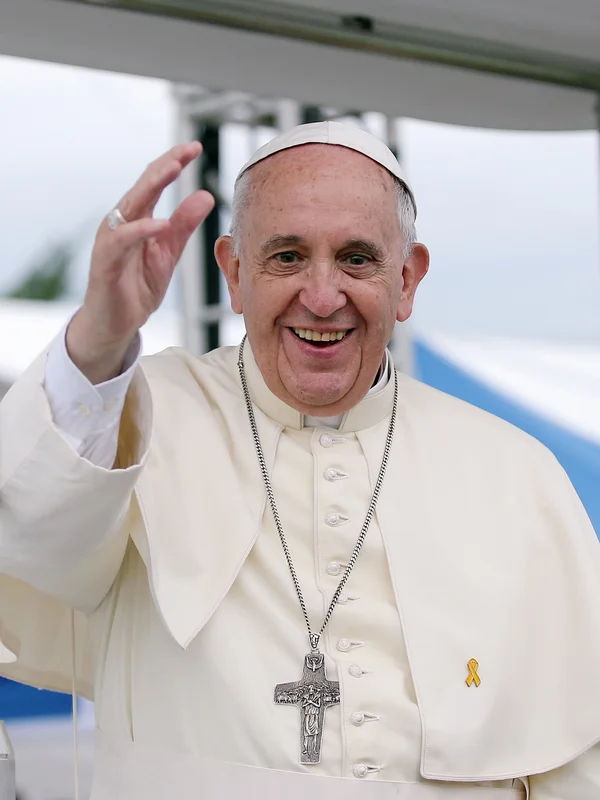

266th pope of the Catholic Church (2013-2025); the first Jesuit pope, the first from Latin America and the first to take the name Francis.
Early Life
Jorge Mario Bergoglio was born on 17 December 1936 in Buenos Aires, Argentina, the son of Italian immigrants from Piedmont. He studied to become a chemical technician and worked in food processing before joining the Society of Jesus in 1958, after recovering from a severe illness in which part of a lung was removed. He studied humanities, philosophy and theology in Argentina and was ordained a priest on 13 December 1969.
Education
Bergoglio earned a diploma as a chemical technician before entering the Jesuits. He studied humanities at the Colegio de la Inmaculada Concepción in Santa Fe, philosophy at the Colegio Máximo de San José in San Miguel, and theology at the same college, and later studied in Germany. He taught literature and psychology at Jesuit schools in Santa Fe and Buenos Aires before taking on leadership roles in the order.
Career
Bergoglio joined the Society of Jesus in 1958, was ordained a priest in 1969, and took his final Jesuit vows in 1973. He served as provincial of the Argentine Jesuits from 1973 to 1979 and as rector of the Colegio de San José, then became auxiliary bishop of Buenos Aires in 1992, archbishop in 1998 and a cardinal in 2001. As archbishop he was known for a simple lifestyle and for his attention to the poor of Buenos Aires. Following the resignation of Pope Benedict XVI, he was elected pope on 13 March 2013, taking the name Francis in honour of Saint Francis of Assisi. As pope he created the Council of Cardinals to advise on reform, reorganised Vatican finances, and issued the encyclicals Lumen fidei (2013), Laudato si' (2015), Fratelli tutti (2020) and Dilexit nos (2024), and the apostolic exhortations Evangelii gaudium (2013) and Amoris laetitia (2016). He made pastoral visits to more than 60 countries, including the first papal visit to Iraq in 2021, and worked for dialogue with other Christian churches and other religions. In February 2025 he was admitted to hospital with bilateral pneumonia and spent 38 days there. He made his last public appearance on Easter Sunday, 20 April 2025, giving the Urbi et Orbi blessing, and died the following day.
Achievements
Francis's central achievements were to open the papacy to the global south, to put care for the poor and for the environment at the centre of Catholic teaching, and to reform the governance of the Vatican. His encyclical Laudato si' (2015) made the Catholic Church a prominent voice on climate change, Fratelli tutti (2020) set out a vision of fraternity and social friendship, and Amoris laetitia (2016) addressed the pastoral care of families. He canonised John Paul II and John XXIII, Mother Teresa, Oscar Romero and John Henry Newman, made the first papal visit to Iraq, and signed the Document on Human Fraternity with the Grand Imam of al-Azhar in 2019. He reformed Vatican finances, issued rules for handling abuse cases against bishops, and convened the Synod on Synodality, a worldwide consultation that ran from 2021 to 2024.
- Elected the 266th pope of the Catholic Church on 13 March 2013, the first Jesuit pope and the first from Latin America
- Became the first pope to take the name Francis, in honour of Saint Francis of Assisi
- Issued the encyclical Laudato si' (2015) on care for the environment
- Issued the apostolic exhortation Amoris laetitia (2016) on the family
- Issued the encyclical Fratelli tutti (2020) on fraternity and social friendship
- Issued the encyclical Dilexit nos (2024) on the love of the heart of Jesus
- Canonised John Paul II and John XXIII (2014), Mother Teresa (2016), Oscar Romero (2018) and John Henry Newman (2019)
- Made the first papal visit to Iraq in 2021 and signed the Document on Human Fraternity in Abu Dhabi in 2019
- Reformed the Vatican's finances and created the Council of Cardinals to advise on Church governance
- Opened the Jubilee of Mercy (2015-2016) and the Jubilee of 2025, the Holy Year
- Issued Vos estis lux mundi (2019), setting procedures for handling cases of sexual abuse by bishops
- Convened the Synod on Synodality, a multi-year consultation of the worldwide Church (2021-2024)
Legacy
Francis is remembered as the first pope from the Americas, the first Jesuit pope, and the first pope from outside Europe in more than 1,200 years. Supporters credit his emphasis on mercy, care for the poor and for creation, and his reform of Vatican governance; critics, including some cardinals, argued that some of his teachings and decisions created ambiguity on questions of doctrine and discipline, and that his reforms of the Curia moved slowly. His pontificate is also assessed in the light of his handling of the clerical sexual abuse crisis, where supporters point to new accountability rules and critics argue the response was uneven. He died on 21 April 2025, Easter Monday, at the age of 88, and was buried at the Basilica of Saint Mary Major in Rome, the first pope in over a century to be buried outside the Vatican.
Contributions
Francis's contribution was to shift the public voice of the papacy towards mercy, care for the poor and care for creation, and to give the Catholic Church its first pope from the global south. Through Laudato si' he brought Catholic teaching into the centre of the climate debate, through Fratelli tutti he set out a vision of human fraternity, and through his reforms he changed how the Vatican is governed and how abuse cases are handled.
Notable Works
- Evangelii gaudium (2013)
- Laudato si' (2015)
- Amoris laetitia (2016)
- Fratelli tutti (2020)
- Dilexit nos (2024)
Milestones
- 1936 — Born on 17 December in Buenos Aires, Argentina Source: Encyclopaedia Britannica
- 1958 — Joined the Society of Jesus Source: Encyclopaedia Britannica
- 1969 — Ordained a priest Source: Vatican
- 1973 — Became provincial of the Argentine Jesuits Source: Vatican
- 1992 — Appointed auxiliary bishop of Buenos Aires Source: Vatican
- 1998 — Became archbishop of Buenos Aires Source: Encyclopaedia Britannica
- 2001 — Created a cardinal Source: Encyclopaedia Britannica
- 2013 — Elected the 266th pope, taking the name Francis Source: Encyclopaedia Britannica
- 2014 — Canonised John Paul II and John XXIII Source: Wikipedia
- 2015 — Issued Laudato si' and opened the Jubilee of Mercy Source: Encyclopaedia Britannica
- 2016 — Issued Amoris laetitia; canonised Mother Teresa Source: Encyclopaedia Britannica
- 2019 — Signed the Document on Human Fraternity in Abu Dhabi Source: Encyclopaedia Britannica
- 2020 — Issued Fratelli tutti Source: Encyclopaedia Britannica
- 2021 — First papal visit to Iraq Source: Encyclopaedia Britannica
- 2024 — Issued Dilexit nos Source: Encyclopaedia Britannica
- 2025 — Died on 21 April in Vatican City, aged 88 Source: Encyclopaedia Britannica
Timeline
- 17 December 1936
Born Jorge Mario Bergoglio in Buenos Aires, Argentina
Source: Encyclopaedia Britannica - 1958
Joined the Society of Jesus
Year only — exact date unknown Source: Encyclopaedia Britannica - 13 December 1969
Ordained a priest
Source: Vatican - 1973
Took final Jesuit vows; became provincial of the Argentine Jesuits
Year only — exact date unknown Source: Vatican - 1992
Appointed auxiliary bishop of Buenos Aires
Year only — exact date unknown Source: Vatican - 1998
Became archbishop of Buenos Aires
Year only — exact date unknown Source: Encyclopaedia Britannica - 2001
Created a cardinal by Pope John Paul II
Year only — exact date unknown Source: Encyclopaedia Britannica - 13 March 2013
Elected the 266th pope, taking the name Francis
Source: Encyclopaedia Britannica - 2014
Canonised John Paul II and John XXIII
Year only — exact date unknown Source: Wikipedia - 2015
Issued the encyclical Laudato si'; opened the Jubilee of Mercy
Year only — exact date unknown Source: Encyclopaedia Britannica - 2016
Issued Amoris laetitia; canonised Mother Teresa
Year only — exact date unknown Source: Encyclopaedia Britannica - 2019
Signed the Document on Human Fraternity in Abu Dhabi; issued Vos estis lux mundi
Year only — exact date unknown Source: Encyclopaedia Britannica - 2020
Issued the encyclical Fratelli tutti
Year only — exact date unknown Source: Encyclopaedia Britannica - 2021
Made the first papal visit to Iraq; opened the Synod on Synodality
Year only — exact date unknown Source: Encyclopaedia Britannica - 2024
Issued the encyclical Dilexit nos
Year only — exact date unknown Source: Encyclopaedia Britannica - 14 February 2025
Admitted to hospital with bilateral pneumonia for a 38-day stay
Source: Vatican - 20 April 2025
Made his last public appearance, giving the Easter Urbi et Orbi blessing
Source: Vatican - 21 April 2025
Died at the Domus Sanctae Marthae in Vatican City, aged 88
Source: Encyclopaedia Britannica - 26 April 2025
Funeral in Saint Peter's Square; buried at the Basilica of Saint Mary Major
Source: Vatican
In Their Words
“Who am I to judge?” Source: Pope Francis, press conference aboard the papal flight, 28 July 2013 — His reply to a question about gay priests, aboard the papal flight returning from World Youth Day in Rio de Janeiro.
Related Personalities
Frequently Asked Questions
Who was Pope Francis?
Pope Francis was born Jorge Mario Bergoglio on 17 December 1936 in Buenos Aires, Argentina, the son of Italian immigrants. He joined the Jesuits in 1958, was ordained a priest in 1969, and became archbishop of Buenos Aires in 1998 before being elected pope in 2013.
Source: Encyclopaedia Britannica ; VaticanWhen did Pope Francis become pope?
Pope Francis was elected on 13 March 2013, following the resignation of Pope Benedict XVI. He was the 266th pope of the Catholic Church and the first Jesuit pope, the first from Latin America, and the first pope from outside Europe in more than 1,200 years.
Source: Encyclopaedia Britannica ; VaticanHow did Pope Francis die?
Pope Francis died on 21 April 2025, Easter Monday, at the Domus Sanctae Marthae in Vatican City, at the age of 88. The Vatican reported that he died of a cerebral stroke followed by irreversible cardiocirculatory collapse, after a 38-day hospital stay for bilateral pneumonia earlier in the year.
Source: Encyclopaedia Britannica ; VaticanWhy did he choose the name Francis?
Francis took the name in honour of Saint Francis of Assisi, whom he described as the man of poverty, the man of peace, and the man who loves and protects creation. He was the first pope to take the name Francis.
Source: VaticanWhat is Laudato si'?
Laudato si' (2015) is Pope Francis's encyclical on care for the environment, addressed to every person on the planet. It calls for action on climate change and for an integral ecology that links care for creation with care for the poor.
Source: Encyclopaedia Britannica ; VaticanWho succeeded Pope Francis?
Pope Francis was succeeded by Pope Leo XIV, born Robert Francis Prevost, who was elected by the conclave on 8 May 2025. Francis was buried at the Basilica of Saint Mary Major in Rome on 26 April 2025.
Source: Encyclopaedia Britannica ; Vatican NewsSources & References
- Biography of the Holy Father Francis — Vatican — Vatican (accessed 13 November 2026)
- Francis — Encyclopaedia Britannica — Encyclopaedia Britannica (accessed 13 November 2026)
- Pope Francis — Wikipedia (cross-check) — Wikipedia (accessed 13 November 2026)
- File:Pope Francis Korea Haemi Castle 19.jpg — Wikimedia Commons (portrait file page) — Wikimedia Commons (accessed 13 November 2026)