Galileo Galilei
Astronomer · Physicist · Mathematician
1564–1642 · Born in Pisa, Duchy of Florence (now Italy) · 4 min read
- Verified: 13 November 2026
- Sources: 4
- Independently reviewed
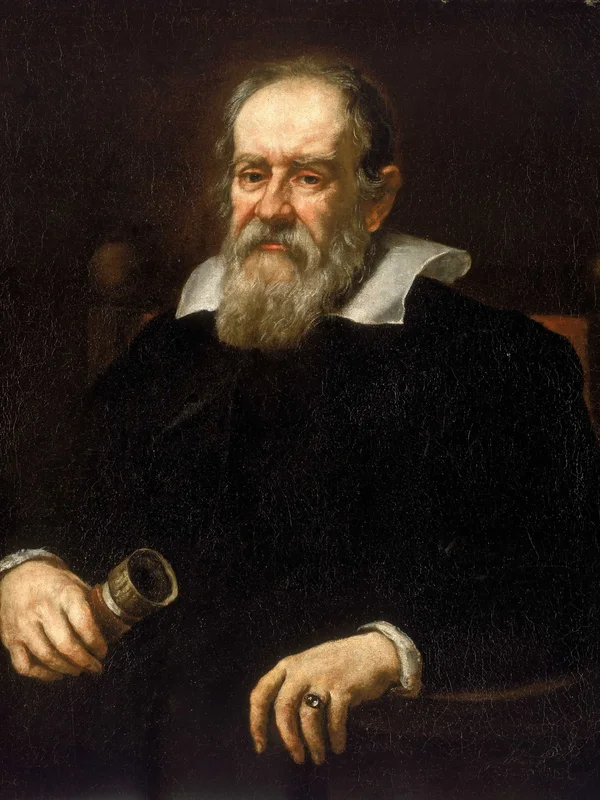

Italian astronomer and physicist whose telescopic discoveries of 1610 and support for heliocentrism reshaped astronomy; condemned by the Inquisition in 1633 and confined to house arrest for his final years.
Early Life
Galileo Galilei was born on 15 February 1564 in Pisa, in the Duchy of Florence, the eldest of seven children of Vincenzo Galilei, a lutenist and music theorist, and Giulia Ammannati. He grew up in Pisa and Florence, where the family moved when he was ten. In 1581 he entered the University of Pisa to study medicine, at his father's wish, but he became more interested in mathematics and physics, attending the lectures of Ostilio Ricci, and left the university in 1585 without taking a degree.
Education
Galileo studied medicine at the University of Pisa from 1581 to 1585 but left without a degree, having turned to mathematics instead. He had no formal degree in mathematics; he taught himself from the works of Euclid and Archimedes and through private study, and his first academic appointment, as professor of mathematics at Pisa in 1589, was based on his reputation as a mathematician rather than on a qualification.
Career
Galileo became professor of mathematics at the University of Pisa in 1589 and at the University of Padua in 1592, where he taught for eighteen years. In 1609 he heard of the telescope invented in the Netherlands, built improved versions of his own, and in January 1610 observed four points of light moving around Jupiter, which he recognised as moons. He published the results in Sidereus Nuncius in March 1610 and was appointed court mathematician and philosopher to Cosimo II de' Medici, Grand Duke of Tuscany. He went on to observe the phases of Venus and sunspots, and his support for the heliocentric system brought him into conflict with the Catholic Church. After the publication of his Dialogue in 1632, he was summoned to Rome and tried by the Inquisition in 1633. He was found guilty of heresy, forced to recant, and spent the rest of his life under house arrest at Arcetri, where he wrote the Discourses of 1638, published in Leiden.
Achievements
Galileo's achievements began in 1609, when he improved the telescope and turned it to the sky, discovering the four largest moons of Jupiter, the mountains of the Moon and the stars of the Milky Way, which he reported in Sidereus Nuncius in 1610. His telescopic observations also showed that the Milky Way is made of countless individual stars, a fact invisible to the naked eye. He discovered the phases of Venus, which could only be explained if Venus orbited the Sun, and observed sunspots and the rotation of the Sun. In physics he formulated the law of falling bodies, showing that objects fall at the same rate regardless of weight, and described the pendulum and the principle of inertia. His Dialogue Concerning the Two Chief World Systems of 1632 defended the heliocentric system of Copernicus, and his final book, the Discourses and Mathematical Demonstrations Relating to Two New Sciences of 1638, written under house arrest, founded the science of mechanics. He is regarded as a central figure of the Scientific Revolution.
- Improved the telescope in 1609 and used it to discover the four largest moons of Jupiter, now called the Galilean moons
- Published Sidereus Nuncius in 1610, reporting the moons of Jupiter, the mountains of the Moon and the stars of the Milky Way
- Discovered the phases of Venus, evidence that Venus orbits the Sun
- Observed sunspots and the rotation of the Sun
- Formulated the law of falling bodies, showing that objects fall at the same rate regardless of weight
- Described the pendulum and the principle of inertia, foundations of later mechanics
- Published the Dialogue Concerning the Two Chief World Systems in 1632, defending the heliocentric system
- Published the Discourses and Mathematical Demonstrations Relating to Two New Sciences in 1638, his most important work on mechanics
- Was appointed court mathematician and philosopher to Cosimo II de' Medici, Grand Duke of Tuscany, in 1610
- Became a central figure of the Scientific Revolution, linking observation, experiment and mathematics
Legacy
Galileo is remembered as the father of modern observational astronomy and of modern physics. His combination of telescopic observation, controlled experiment and mathematical description set the pattern for the scientific method that followed him, and his work influenced Newton, who was born in the year Galileo died. His trial by the Inquisition in 1633 became the most famous conflict between science and religious authority in European history, and the Catholic Church formally acknowledged in 1992 that errors had been made in his case. The phrase 'Eppur si muove', meaning 'and yet it moves', is often attributed to Galileo as something he said after his recantation, but there is no contemporary evidence that he said it, and it is almost certainly apocryphal; the profile does not present it as his words.
Contributions
Galileo's contribution was to change astronomy from a subject of speculation into a subject of observation. His telescope showed that the Moon had mountains, that Jupiter had moons, that Venus had phases and that the Sun had spots, each of which contradicted the accepted picture of a perfect, unchanging heaven. In physics, his law of falling bodies and his work on the pendulum and inertia laid the ground for Newton's mechanics. Above all, he showed that experiment and mathematics together could answer questions about nature that authority alone could not.
Notable Works
- Sidereus Nuncius (1610)
- Dialogue Concerning the Two Chief World Systems (1632)
- Discourses and Mathematical Demonstrations Relating to Two New Sciences (1638)
- The Assayer (1623)
Milestones
- 1564 — Born on 15 February in Pisa, Duchy of Florence Source: Encyclopaedia Britannica
- 1581 — Entered the University of Pisa to study medicine Source: Encyclopaedia Britannica
- 1585 — Left the University of Pisa without a degree, turning to mathematics Source: Encyclopaedia Britannica
- 1589 — Became professor of mathematics at the University of Pisa Source: Encyclopaedia Britannica
- 1592 — Became professor of mathematics at the University of Padua Source: Encyclopaedia Britannica
- 1609 — Built improved telescopes and began observing the sky Source: Encyclopaedia Britannica
- 1610 — Discovered the four largest moons of Jupiter Source: Encyclopaedia Britannica
- 1610 — Published Sidereus Nuncius Source: Encyclopaedia Britannica
- 1610 — Appointed court mathematician to Cosimo II de' Medici Source: Encyclopaedia Britannica
- 1616 — The Church declared heliocentrism contrary to scripture Source: Encyclopaedia Britannica
- 1632 — Published the Dialogue Concerning the Two Chief World Systems Source: Encyclopaedia Britannica
- 1633 — Tried by the Inquisition; found guilty of heresy and placed under house arrest Source: Encyclopaedia Britannica
- 1638 — Published the Discourses and Mathematical Demonstrations Relating to Two New Sciences Source: Encyclopaedia Britannica
- 1642 — Died at Arcetri, near Florence, aged 77 Source: Encyclopaedia Britannica
Timeline
- 15 February 1564
Born in Pisa, Duchy of Florence
Source: Encyclopaedia Britannica - 1581
Entered the University of Pisa to study medicine
Year only — exact date unknown Source: Encyclopaedia Britannica - 1585
Left the University of Pisa without a degree, turning to mathematics
Year only — exact date unknown Source: Encyclopaedia Britannica - 1589
Became professor of mathematics at the University of Pisa
Year only — exact date unknown Source: Encyclopaedia Britannica - 1592
Became professor of mathematics at the University of Padua
Year only — exact date unknown Source: Encyclopaedia Britannica - 1609
Built improved telescopes and began observing the sky
Year only — exact date unknown Source: Encyclopaedia Britannica - 1610-01
Discovered the four largest moons of Jupiter
Year only — exact date unknown Source: Encyclopaedia Britannica - 1610-03
Published Sidereus Nuncius
Year only — exact date unknown Source: Encyclopaedia Britannica - 1610
Appointed court mathematician to Cosimo II de' Medici
Year only — exact date unknown Source: Encyclopaedia Britannica - 1616
The Church declared heliocentrism contrary to scripture; Galileo was warned not to teach it
Year only — exact date unknown Source: Encyclopaedia Britannica - 1632
Published the Dialogue Concerning the Two Chief World Systems
Year only — exact date unknown Source: Encyclopaedia Britannica - 1633
Tried by the Inquisition in Rome; found guilty of heresy and placed under house arrest
Year only — exact date unknown Source: Encyclopaedia Britannica - 1638
Published the Discourses and Mathematical Demonstrations Relating to Two New Sciences
Year only — exact date unknown Source: Encyclopaedia Britannica - 8 January 1642
Died at Arcetri, near Florence, aged 77
Source: Encyclopaedia Britannica
In Their Words
“Philosophy is written in this grand book, the universe, which stands continually open to our gaze. But the book cannot be understood unless one first learns to comprehend the language and read the letters in which it is composed. It is written in the language of mathematics, and its characters are triangles, circles, and other geometric figures.” Source: Galileo Galilei, The Assayer (1623), translated by Stillman Drake — Galileo's statement of his belief that nature is described in mathematical terms, from his 1623 work The Assayer, in the translation by Stillman Drake.
Related Personalities
Frequently Asked Questions
Who was Galileo Galilei?
Galileo Galilei (1564-1642) was an Italian astronomer, physicist and mathematician. He improved the telescope, discovered the four largest moons of Jupiter, and supported the theory that the Earth orbits the Sun, for which he was tried by the Inquisition in 1633.
Source: Encyclopaedia BritannicaWhat did Galileo discover?
Galileo discovered the four largest moons of Jupiter, now called the Galilean moons: Io, Europa, Ganymede and Callisto. He first observed them in January 1610 and reported them in his book Sidereus Nuncius, published in March 1610.
Source: Encyclopaedia Britannica ; Stanford Encyclopedia of PhilosophyWhy was Galileo put on trial?
Galileo was tried by the Roman Inquisition in 1633 because his book Dialogue Concerning the Two Chief World Systems (1632) defended the heliocentric theory that the Earth moves around the Sun, which the Church had declared contrary to scripture in 1616. He was found guilty of heresy, forced to recant, and sentenced to house arrest for the rest of his life.
Source: Encyclopaedia BritannicaDid Galileo really say 'Eppur si muove'?
'Eppur si muove' means 'and yet it moves' in Italian, and is often said to be what Galileo muttered after recanting his belief that the Earth moves. There is no contemporary evidence that he said it, and historians regard the story as almost certainly apocryphal. The profile does not present it as his words.
Source: Stanford Encyclopedia of Philosophy ; Encyclopaedia BritannicaWhat were Galileo's most important books?
Galileo's most important books are Sidereus Nuncius (1610), reporting his telescopic discoveries; the Dialogue Concerning the Two Chief World Systems (1632), defending heliocentrism; and the Discourses and Mathematical Demonstrations Relating to Two New Sciences (1638), his work on mechanics, written under house arrest.
Source: Encyclopaedia Britannica ; Stanford Encyclopedia of PhilosophyHow did Galileo die?
Galileo died on 8 January 1642 at Arcetri, near Florence, after nine years under house arrest. He was 77. The Catholic Church formally acknowledged in 1992 that errors had been made in his case.
Source: Encyclopaedia BritannicaSources & References
- Galileo — Encyclopaedia Britannica — Encyclopaedia Britannica (accessed 13 November 2026)
- Galileo Galilei — Wikipedia (cross-check) — Wikipedia (accessed 13 November 2026)
- Galileo Galilei — Stanford Encyclopedia of Philosophy — Stanford Encyclopedia of Philosophy (accessed 13 November 2026)
- File:Justus Sustermans - Portrait of Galileo Galilei, 1636.jpg — Wikimedia Commons (portrait file page) — Wikimedia Commons (accessed 13 November 2026)