Diego Maradona
Footballer · Forward · Midfielder
1960–2020 · Born in Lanús, Buenos Aires, Argentina · 3 min read
- Verified: 13 November 2026
- Sources: 5
- Independently reviewed
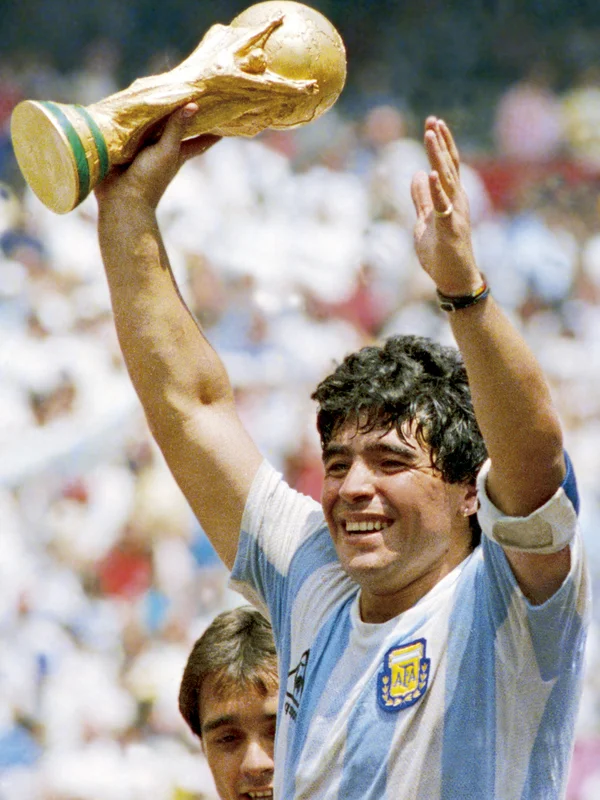

Argentine footballer who captained Argentina to the 1986 World Cup, scoring the 'Hand of God' and 'Goal of the Century' against England, and led Napoli to their first Serie A titles.
Early Life
Diego Armando Maradona was born on 30 October 1960 in Lanús, Buenos Aires province, Argentina, and raised in Villa Fiorito, a poor settlement on the outskirts of Buenos Aires. He joined the youth system of Argentinos Juniors as a boy and was already famous in Argentina as a child prodigy before his professional debut at 15. He came from a large, poor family, and his rise from Villa Fiorito to the top of world football became a central part of his legend in Argentina.
Career
Maradona made his professional debut for Argentinos Juniors in October 1976, ten days before his 16th birthday, and scored 116 goals in 166 league games for the club. He won the Argentine league with Boca Juniors in 1981, then moved to Barcelona in 1982 for a then world-record fee, winning the Copa del Rey in 1983. In 1984 he joined Napoli for another world-record fee and spent seven seasons there, leading the club to its first two Serie A titles. He played in four World Cups for Argentina, captaining the side to victory in 1986 and to the final in 1990, but was expelled from the 1994 World Cup after testing positive for ephedrine. After spells with Sevilla and Newell's Old Boys he returned to Boca Juniors and retired in 1997. He managed the Argentina national team from 2008 to 2010, taking them to the quarter-finals of the 2010 World Cup.
Achievements
Maradona's defining achievement was captaining Argentina to the 1986 World Cup in Mexico, where he scored five goals and made five assists, won the Golden Ball, and scored both goals in the quarter-final against England — the 'Hand of God' goal and the 'Goal of the Century', voted by FIFA voters in 2002 as the greatest goal in World Cup history. At club level he transformed Napoli, leading the southern club to its first two Serie A titles in 1987 and 1990, the Coppa Italia in 1987 and the UEFA Cup in 1989. He won the FIFA World Youth Championship in 1979, earned 91 caps and scored 34 goals for Argentina, and in 2000 was named joint FIFA Player of the Century alongside Pelé after winning FIFA's internet poll.
- Captained Argentina to victory at the 1986 FIFA World Cup, winning the Golden Ball as the tournament's best player
- Scored both goals in Argentina's 2-1 win over England in the 1986 World Cup quarter-final: the 'Hand of God' goal and the 'Goal of the Century'
- Led Napoli to their first two Serie A titles, in 1987 and 1990, plus the Coppa Italia in 1987 and the UEFA Cup in 1989
- Won the FIFA World Youth Championship with Argentina in 1979, winning the Golden Ball as the tournament's best player
- Named joint FIFA Player of the Century in 2000, alongside Pelé, after winning FIFA's internet poll
- Earned 91 caps and scored 34 goals for Argentina across four World Cups (1982, 1986, 1990, 1994)
- Won the Argentine league with Boca Juniors in 1981 and the Copa del Rey with Barcelona in 1983
Legacy
Maradona is widely regarded as one of the greatest footballers of all time, and in Argentina he is a folk hero whose 1986 World Cup campaign is treated as a national epic. His combination of close control, vision and courage made him the outstanding player of the 1980s, and his second goal against England in 1986 is still cited as the greatest solo goal ever scored. His legacy is inseparable from controversy: the 'Hand of God' goal, drug suspensions in 1991 and 1994, and a turbulent life after retirement. In Argentina he remains an icon; in Naples, where he delivered the club's first league titles, he is still revered. In April 2026 a new trial opened in Argentina concerning the medical care he received before his death.
Contributions
Maradona redefined what a number 10 could do: he carried otherwise modest teams — Argentina in 1986 and Napoli in Italy — to the highest honours almost single-handedly, through dribbling, passing and leadership. His 1986 World Cup campaign, with five goals and five assists, remains the most dominant individual tournament performance in the competition's history. He also changed the economics of football, becoming the first player to set the world transfer record twice, and he made Napoli, a club from Italy's poorer south, into champions against the wealthy clubs of the north.
Notable Works
- Argentinos Juniors (1976–1981)
- Boca Juniors (1981–1982, 1995–1997)
- FC Barcelona (1982–1984)
- SSC Napoli (1984–1991)
- Argentina national team (1977–1994), 1986 World Cup winner
- Argentina manager (2008–2010)
Milestones
- 1960 — Born in Lanús, Buenos Aires, Argentina Source: Encyclopaedia Britannica
- 1976 — Made his professional debut for Argentinos Juniors at 15 Source: Wikipedia
- 1979 — Won the FIFA World Youth Championship with Argentina and the Golden Ball Source: FIFA
- 1981 — Won the Argentine league title with Boca Juniors Source: Wikipedia
- 1982 — Moved to Barcelona for a then world-record transfer fee Source: Wikipedia
- 1984 — Joined Napoli for another world-record fee, becoming the first player to set the record twice Source: Wikipedia
- 1986 — Captained Argentina to World Cup victory in Mexico, winning the Golden Ball Source: FIFA; Encyclopaedia Britannica
- 1987 — Led Napoli to their first Serie A title and the Coppa Italia Source: Wikipedia
- 1989 — Won the UEFA Cup with Napoli Source: Wikipedia
- 1990 — Won a second Serie A title with Napoli; reached the World Cup final with Argentina Source: Wikipedia
- 1994 — Expelled from the World Cup after testing positive for ephedrine Source: Encyclopaedia Britannica
- 1997 — Retired from professional football with Boca Juniors Source: Wikipedia
- 2000 — Named joint FIFA Player of the Century alongside Pelé Source: Wikipedia
- 2008 — Appointed manager of Argentina Source: Wikipedia
- 2020 — Died in Tigre, Buenos Aires province, aged 60 Source: Encyclopaedia Britannica
Timeline
- 30 October 1960
Born Diego Armando Maradona in Lanús, Buenos Aires, Argentina
Source: Encyclopaedia Britannica; Wikipedia - 20 October 1976
Made his professional debut for Argentinos Juniors, ten days before his 16th birthday
Source: Wikipedia; Encyclopaedia Britannica - 1979
Won the FIFA World Youth Championship with Argentina in Japan, winning the Golden Ball
Year only — exact date unknown Source: FIFA; Wikipedia - 1981
Won the Argentine league title with Boca Juniors
Year only — exact date unknown Source: Wikipedia; Encyclopaedia Britannica - 1984
Joined Napoli for another world-record transfer fee
Year only — exact date unknown Source: Wikipedia; Encyclopaedia Britannica - 22 June 1986
Scored the 'Hand of God' goal and the 'Goal of the Century' against England in the World Cup quarter-final
Source: FIFA; Encyclopaedia Britannica - 29 June 1986
Captained Argentina to victory over West Germany in the World Cup final and won the Golden Ball
Source: FIFA; Encyclopaedia Britannica - 1987
Led Napoli to their first Serie A title and the Coppa Italia
Year only — exact date unknown Source: Wikipedia; Encyclopaedia Britannica - 1989
Won the UEFA Cup with Napoli
Year only — exact date unknown Source: Wikipedia - 1990
Won a second Serie A title with Napoli and reached the World Cup final with Argentina
Year only — exact date unknown Source: Wikipedia; Encyclopaedia Britannica - 1991
Received a 15-month suspension after testing positive for cocaine; left Napoli
Year only — exact date unknown Source: Encyclopaedia Britannica - 1994-06
Expelled from the World Cup in the United States after testing positive for ephedrine
Approximate date Source: Encyclopaedia Britannica - 1997
Retired from professional football with Boca Juniors
Year only — exact date unknown Source: Wikipedia - 2000
Named joint FIFA Player of the Century alongside Pelé after winning FIFA's internet poll
Year only — exact date unknown Source: Wikipedia; Encyclopaedia Britannica - 25 November 2020
Died in Tigre, Buenos Aires province, aged 60, three weeks after brain surgery
Source: Encyclopaedia Britannica; FIFA
Related Personalities
Frequently Asked Questions
Who is Diego Maradona?
Diego Maradona (1960–2020) was an Argentine footballer widely regarded as one of the greatest players in history. A creative attacking midfielder and captain, he led Argentina to victory at the 1986 World Cup and transformed Napoli into Italian champions. His career combined extraordinary skill with controversy, including drug suspensions and the famous 'Hand of God' goal.
Source: Encyclopaedia BritannicaWhat is the 'Hand of God' goal?
In the 1986 World Cup quarter-final against England, Maradona punched the ball into the net with his hand, and the goal stood because the officials missed the handball. Maradona later described it as scored 'a little with the head of Maradona and a little with the hand of God'. Critics call it cheating; supporters call it cunning.
Source: Encyclopaedia Britannica ; FIFAWhat was the 'Goal of the Century'?
Four minutes after the 'Hand of God' goal, Maradona collected the ball in his own half and dribbled past five England players before scoring. FIFA voters later chose it as the greatest goal in World Cup history. It is remembered as the finest solo goal ever scored, in the match Argentina won 2–1.
Source: FIFA ; Encyclopaedia BritannicaWhat did Maradona win with Napoli?
Maradona led Napoli to their first two Serie A titles, in 1987 and 1990, plus the Coppa Italia in 1987 and the UEFA Cup in 1989. Before his arrival the southern club had never won the Italian league, and he became a near-divine figure in Naples. Napoli did not win another league title until 2023, long after his departure.
Source: Encyclopaedia Britannica ; WikipediaWhy was Maradona sent home from the 1994 World Cup?
Maradona was expelled from the 1994 World Cup in the United States after testing positive for the banned stimulant ephedrine, and he was suspended from football. He said he had taken an energy drink and had not intended to cheat, but the test result stood. Argentina, who had started the tournament strongly, lost in the round of 16 without him.
Source: Encyclopaedia BritannicaWhen and how did Diego Maradona die?
Maradona died on 25 November 2020 in Tigre, Buenos Aires province, aged 60, three weeks after undergoing brain surgery. His death was mourned across Argentina, where three days of national mourning were declared, and around the football world. In April 2026 a new trial opened in Argentina concerning the medical care he received before his death.
Source: Encyclopaedia BritannicaSources & References
- Diego Maradona — Encyclopaedia Britannica — Encyclopaedia Britannica (accessed 13 November 2026)
- Diego Maradona — Wikipedia (cross-check) — Wikipedia (accessed 13 November 2026)
- Watch Maradona's Mexican masterpiece — FIFA (1986 World Cup) — FIFA (accessed 13 November 2026)
- Was Maradona's 'Hand of God' Goal Legal? — Britannica — Encyclopaedia Britannica (accessed 13 November 2026)
- File:Diego Maradona on 29 June 1986.jpg — Wikimedia Commons (portrait file page) — Wikimedia Commons (accessed 13 November 2026)
Explore More
- More Athletes & Sports
- Personalities from Argentina
- Personalities from Spain
- Personalities from Italy
- More footballers
- More forwards
- More midfielders
- Famous people born in October
- Browse all personalities
Featured on these lists: