Alfred Nobel
Inventor · Chemist · Engineer · Entrepreneur
1833–1896 · Born in Stockholm, Sweden · 4 min read
- Verified: 13 November 2026
- Sources: 5
- Independently reviewed
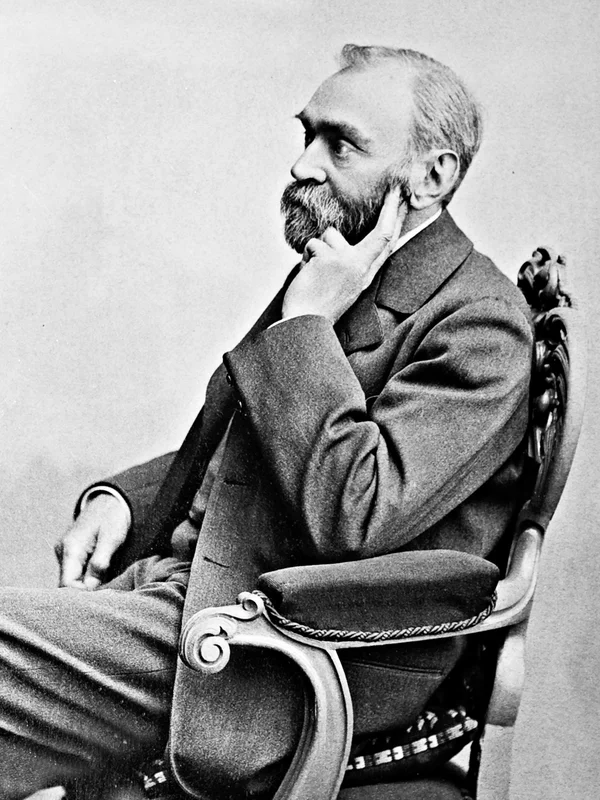

Swedish chemist and inventor who created dynamite in 1866, held 355 patents, and founded the Nobel Prizes by his will of 1895.
Early Life
Alfred Nobel was born on 21 October 1833 in Stockholm, Sweden, the third son of Immanuel Nobel, an engineer and inventor, and Andriette Ahlsell Nobel. The family was poor in his childhood, and his father went bankrupt in the year Alfred was born. In 1842 the family moved to St Petersburg, Russia, where Immanuel Nobel's business prospered building mines and armaments. Alfred was educated by private tutors in St Petersburg and showed an early gift for languages and chemistry. He never attended university, but his father sent him abroad in 1850 to study, first to Paris, where he worked with the chemist Pelouze and met Sobrero, and then to the United States.
Education
Nobel was educated by private tutors in St Petersburg and never took a university degree. He studied chemistry in Paris under Théophile-Jules Pelouze and worked briefly in the United States with the engineer John Ericsson. He spoke several languages, including Swedish, Russian, French, English and German, and wrote poetry and drama in his spare time.
Career
Nobel was born in Stockholm in 1833, the third son of the engineer and inventor Immanuel Nobel. In 1842 the family moved to St Petersburg, where his father built bridges and armaments for the Russian government, and Alfred was educated by private tutors. He studied chemistry in Paris under Théophile-Jules Pelouze, where he met Ascanio Sobrero, the inventor of nitroglycerine, and worked briefly in the United States with the engineer John Ericsson. Returning to Sweden, he began experiments with nitroglycerine in 1862. An explosion at his family's Heleneborg factory in 1864 killed his youngest brother Emil and others, but Nobel persisted, patented the blasting cap that year, and in 1866 invented dynamite. He built factories across Europe, including at Krümmel in Germany and Ardeer in Scotland, and later bought the Bofors ironworks in Sweden, turning it into an armaments maker. He lived mostly in Paris and later in Sanremo, Italy, where he died in 1896. His will, signed in Paris on 27 November 1895, directed that his fortune fund annual prizes in physics, chemistry, physiology or medicine, literature and peace.
Achievements
Nobel's central achievement was dynamite. Nitroglycerine, invented by the Italian chemist Ascanio Sobrero in 1847, was far more powerful than gunpowder but detonated unpredictably and could not be used safely. Nobel first made it usable with the blasting cap, patented in 1864, which detonated it in a controlled way, and then, in 1866, found that absorbing the liquid in kieselguhr, a porous earth, turned it into a paste that could be shaped into rods and handled safely. He patented the mixture as dynamite in 1867. Dynamite transformed mining, quarrying, tunnelling and construction around the world, and Nobel followed it with blasting gelatin in 1875 and ballistite in 1887. By his death in 1896 he held 355 patents. His last will, signed in 1895, left the bulk of his fortune to fund the Nobel Prizes, first awarded in 1901, which became the highest honours in science, literature and peace.
- Invented dynamite in 1866–67, stabilising nitroglycerine by absorbing it in kieselguhr so it could be handled and detonated safely
- Patented the blasting cap (detonator) in 1864, which made controlled detonation of nitroglycerine possible
- Patented dynamite in Sweden and Britain in 1867 and in the United States in 1868
- Invented blasting gelatin in 1875 and ballistite, a smokeless powder, in 1887
- Held 355 patents by the time of his death in 1896
- Built an international explosives business with factories across Europe and beyond
- Signed his last will on 27 November 1895, leaving the bulk of his fortune to fund the Nobel Prizes, first awarded in 1901
Legacy
Nobel is remembered in two ways that pull against each other: as the inventor of dynamite, the explosive that made mining and tunnelling possible and also made war more destructive, and as the founder of the Nobel Prizes, the honours that reward the greatest benefit to humankind. The prizes, first awarded in 1901, five years after his death, became the most prestigious awards in physics, chemistry, medicine, literature and peace, and later in economics. His name also lives on in the element nobelium, named after him, and in the companies descended from his explosives businesses. The story that a premature obituary calling him a merchant of death drove him to found the prizes is widely told but has never been proved from the newspaper itself; his will gives no reason for the bequest, and historians still debate his motives.
Contributions
Nobel's contribution was to make a dangerous substance useful. Nitroglycerine was too unstable to use, so it was a laboratory curiosity; Nobel's blasting cap gave it a controlled trigger, and his dynamite gave it a safe form, a paste that could be carried, drilled into rock and fired on command. That turned explosives into a tool for building: dynamite blasted the tunnels of the Alps, the mines of South Africa and the canals of Panama. The fortune it made him then funded something entirely different, the Nobel Prizes, which have steered a century of science and literature by rewarding work that benefits humankind.
Notable Works
- Dynamite (invented 1866, patented 1867)
- Blasting cap / detonator (1864)
- Blasting gelatin (1875)
- Ballistite smokeless powder (1887)
- Nobel Prizes, founded by his will of 1895
Milestones
- 1833 — Born on 21 October in Stockholm, Sweden Source: NobelPrize.org
- 1842 — Moved with his family to St Petersburg, Russia Source: NobelPrize.org
- 1850 — Sent abroad to study; studied chemistry in Paris Source: ThoughtCo
- 1862 — Began experiments with nitroglycerine Source: NobelPrize.org
- 1863 — Received his first patent on nitroglycerine Source: NobelPrize.org
- 1864 — Patented the blasting cap; Heleneborg explosion killed his brother Emil Source: NobelPrize.org
- 1866 — Invented dynamite by absorbing nitroglycerine in kieselguhr Source: NobelPrize.org
- 1867 — Patented dynamite in Sweden and Britain Source: NobelPrize.org
- 1868 — Received the United States patent for dynamite Source: ThoughtCo
- 1875 — Invented blasting gelatin Source: ThoughtCo
- 1884 — Elected a member of the Royal Swedish Academy of Sciences Source: ThoughtCo
- 1887 — Invented ballistite, a smokeless powder Source: ThoughtCo
- 1895 — Signed his last will in Paris on 27 November, founding the Nobel Prizes Source: NobelPrize.org
- 1896 — Died on 10 December in Sanremo, Italy, aged 63 Source: NobelPrize.org
- 1901 — The first Nobel Prizes were awarded on 10 December Source: NobelPrize.org
Timeline
- 21 October 1833
Born in Stockholm, Sweden, the third son of Immanuel Nobel and Andriette Ahlsell Nobel
Source: NobelPrize.org; Wikipedia - 1842
Moved with his family to St Petersburg, Russia, where his father built armaments
Year only — exact date unknown Source: NobelPrize.org - 1850
Sent abroad to study; studied chemistry in Paris under Théophile-Jules Pelouze and met Ascanio Sobrero
Year only — exact date unknown Source: NobelPrize.org; ThoughtCo - 1862
Began experiments with nitroglycerine
Year only — exact date unknown Source: NobelPrize.org - 1863
Received his first patent on nitroglycerine as an industrial explosive
Year only — exact date unknown Source: NobelPrize.org - 1864
Patented the blasting cap; an explosion at the Heleneborg factory killed his brother Emil
Year only — exact date unknown Source: NobelPrize.org; ThoughtCo - 1866
Invented dynamite by absorbing nitroglycerine in kieselguhr
Year only — exact date unknown Source: NobelPrize.org - 1867
Patented dynamite in Sweden and Britain; demonstrated it at a quarry in Redhill, England
Year only — exact date unknown Source: NobelPrize.org; ThoughtCo - 1868
Received the United States patent for dynamite
Year only — exact date unknown Source: ThoughtCo - 1875
Invented blasting gelatin
Year only — exact date unknown Source: NobelPrize.org; ThoughtCo - 1884
Elected a member of the Royal Swedish Academy of Sciences
Year only — exact date unknown Source: Wikipedia; ThoughtCo - 1887
Invented ballistite, a smokeless powder
Year only — exact date unknown Source: NobelPrize.org; ThoughtCo - 27 November 1895
Signed his last will in Paris, leaving the bulk of his fortune to fund the Nobel Prizes
Source: NobelPrize.org - 10 December 1896
Died in Sanremo, Italy, aged 63
Source: NobelPrize.org - 10 December 1901
The first Nobel Prizes were awarded, five years after his death
Source: NobelPrize.org
Related Personalities
Frequently Asked Questions
Who was Alfred Nobel?
Alfred Nobel (1833–1896) was a Swedish chemist, engineer and inventor best known for inventing dynamite and for founding the Nobel Prizes. He stabilised the explosive nitroglycerine by absorbing it in kieselguhr, patented the mixture as dynamite in 1867, and built an international explosives business.
In his last will, signed in 1895, he left the bulk of his fortune to fund annual prizes in physics, chemistry, medicine, literature and peace.
Source: NobelPrize.org ; WikipediaWhat is dynamite, and how did Nobel invent it?
Dynamite is a stable explosive invented by Alfred Nobel in 1866 and patented in 1867. He made it by absorbing nitroglycerine, a powerful but dangerously unstable liquid invented by Ascanio Sobrero in 1847, in kieselguhr, a porous earth also called diatomaceous earth.
The mixture formed a paste that could be shaped into rods, carried safely and detonated on command with Nobel's blasting cap. It transformed mining, quarrying, tunnelling and construction around the world.
Source: NobelPrize.org ; ThoughtCoWhat was the blasting cap, and why did it matter?
Nobel's blasting cap, or detonator, patented in 1864, was a small charge that could be set off by a fuse to detonate nitroglycerine in a controlled way. Before it, nitroglycerine could explode without warning from heat or shock, which made it unusable.
The blasting cap was therefore the key that unlocked the explosive: with it, Nobel could fire a charge exactly when and where he wanted, and dynamite became a practical tool rather than a hazard.
Source: NobelPrize.orgHow did the Nobel Prizes come about?
On 27 November 1895, in Paris, Nobel signed his last will, directing that the bulk of his fortune be used to fund annual prizes for those who had conferred the greatest benefit on humankind, in physics, chemistry, physiology or medicine, literature and peace.
He died a year later, on 10 December 1896, and after legal disputes over the will, the first Nobel Prizes were awarded in 1901, on the anniversary of his death. A prize in economics was added later, in 1969.
Source: NobelPrize.org ; WikipediaDid a premature obituary inspire the Nobel Prizes?
The famous story says that in 1888 a French newspaper mistakenly published Alfred Nobel's obituary when his brother Ludvig died, calling him the merchant of death, and that the shock made him found the prizes to buy a better reputation.
A mistaken report did appear, but the dramatic headline has never been found in the newspaper itself, and Nobel's will gives no reason for the bequest. Historians therefore treat the story as unproved, and this profile records it as a popular tale rather than as fact.
Source: NobelPrize.org ; WikipediaHow many patents did Alfred Nobel hold, and what else did he invent?
By the time of his death in 1896, Nobel held 355 patents, most of them for explosives and related chemistry. Besides dynamite, his best-known inventions were the blasting cap of 1864, blasting gelatin of 1875, a more powerful explosive made by combining nitroglycerine with gun-cotton, and ballistite of 1887.
He also worked on synthetic rubber, artificial silk and other chemical products, and he owned the Bofors ironworks in Sweden, which he turned into an armaments maker.
Source: NobelPrize.org ; ThoughtCoSources & References
- Alfred Nobel — his life and work — NobelPrize.org — NobelPrize.org (accessed 13 November 2026)
- Alfred Nobel — the man behind the prize — NobelPrize.org — NobelPrize.org (accessed 13 November 2026)
- Alfred Nobel — Wikipedia — Wikipedia (accessed 13 November 2026)
- Biography of Alfred Nobel, Inventor of Dynamite — ThoughtCo (accessed 13 November 2026)
- File:AlfredNobel adjusted.jpg — Wikimedia Commons (portrait file page) — Wikimedia Commons (accessed 13 November 2026)
Explore More
- More Scientists & Inventors
- Personalities from Sweden
- Personalities from France
- Personalities from Italy
- More inventors
- More chemists
- More engineers
- More entrepreneurs
- Famous people born in October
- Browse all personalities
Featured on these lists: